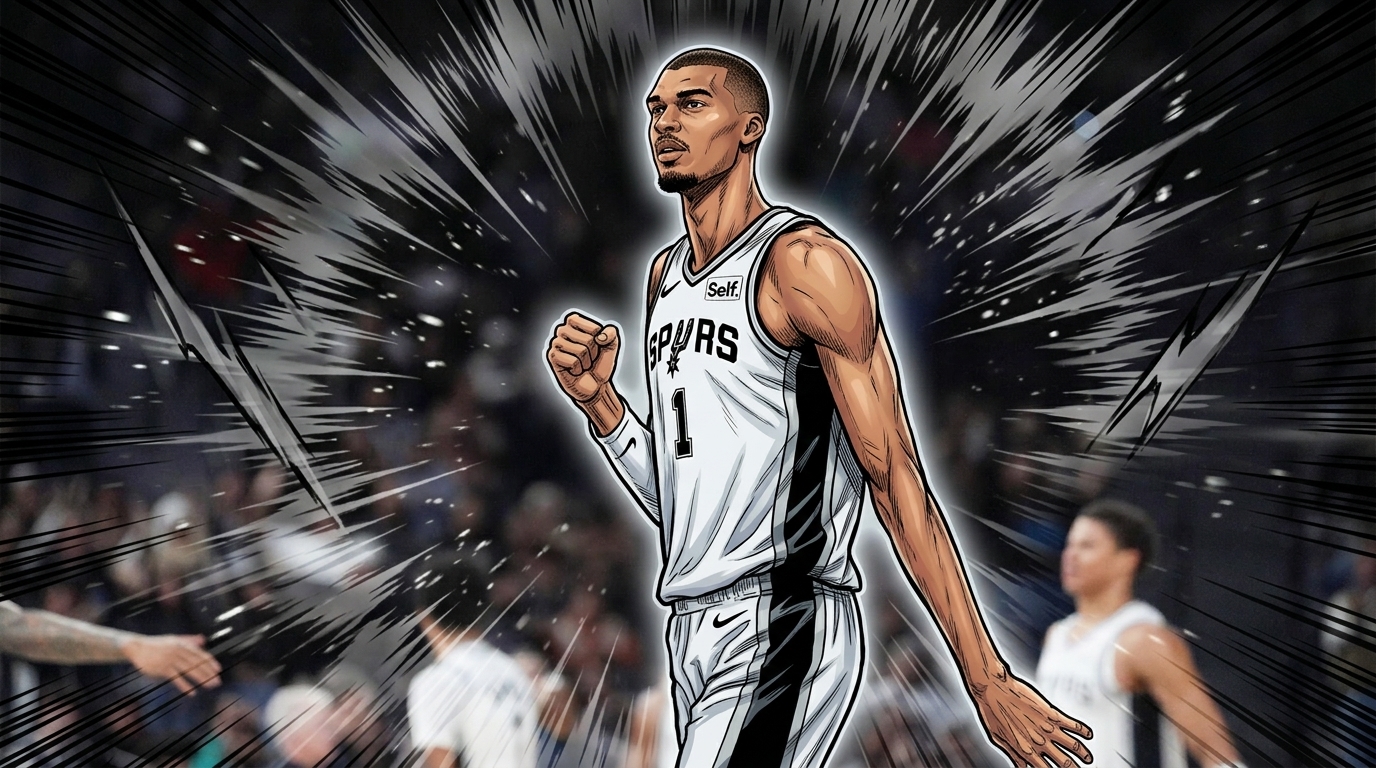
Victor Wembanyama went 6-for-21 in his first NBA Finals game, and at one point, on a single fourth-quarter possession, he hit the side of the backboard with a runner, retrieved his own offensive rebound, moved to the corner, and then hit the side of the backboard again. I have watched it eleven times and I still don’t fully understand what I’m looking at.
The final score was Knicks 105, Spurs 95. The Knicks erased a 14-point third-quarter deficit. Jalen Brunson scored 13 of his 30 points in the fourth quarter, which is the kind of thing that happens when the opposing team’s best player is having an argument with the geometry of the court.
Here is what I mean by that. Wembanyama is 7’4” with an 8-foot wingspan — a wingspan that breaks every implicit assumption about what a human body is supposed to occupy in basketball space. When he moves through the paint, he is not moving through the same court that everyone else is moving through; he is moving through a court that was designed for people significantly smaller than him, and every angle he has to calculate — every release point, every trajectory — is a translation problem. His body is converting spatial intentions into physical geometry in real time, and it usually works. On Tuesday night at Frost Bank Center, it didn’t — worst possible moment, worst possible way, twice on the same possession.
Think of it as an instrument that is tuned for one room being moved into a different room. In the Western Conference Finals against Oklahoma City, Wembanyama averaged 27.3 points on 48.1% shooting across seven games; the instrument was calibrated, the acoustics matched, he was named WCF MVP. The NBA Finals is a different room. The pressure differential is different, the angles feel different, and the same arm that released the ball cleanly in those seven games released it on Tuesday night and sent it into the side of the backboard (not the front — the side), which is a direction that requires a specific and unusual miscalculation to achieve. He achieved it twice. The instrument was not calibrated for this room. It will be.
He said so himself, with the directness that has become his other signature. “I’m gonna figure it out,” Wembanyama told reporters after the game. “I was bad tonight. It’s not more complicated than that.”
The same game produced this, less than two quarters earlier:
https://twitter.com/NBA/status/2062336975542030565
It is a little more complicated than that, in the sense that the player who wept after Game 7 against Oklahoma City — the player who carried a franchise into the Finals at 22 years old — is now being asked to do something nobody has ever asked him to do before: perform at maximum efficiency in the highest-pressure context of his career while his body is still negotiating the terms of how it exists in basketball space. LeBron James went 4-for-16 in his first Finals game in 2007. The sample size for debut catastrophes is not small. What’s unusual is the specific texture of the catastrophe: one of the most physically gifted players in the history of the sport missed a basketball backboard — six feet wide — from close range, twice, in the same minute.
Wemby’s 12 rebounds and 12-for-13 free throw shooting and the general outlines of what he is as a player are visible even in a 6-for-21 line; the ability is not in question. The instrument is not broken. It is simply out of calibration for a room it has never been in before, and the process of calibration, when you are 22 and 7’4” and your wingspan breaks the assumptions built into every angle of a 94-by-50-foot court, occasionally produces something you will watch eleven times without fully resolving. The Spurs are down a game. Game 2 is next.