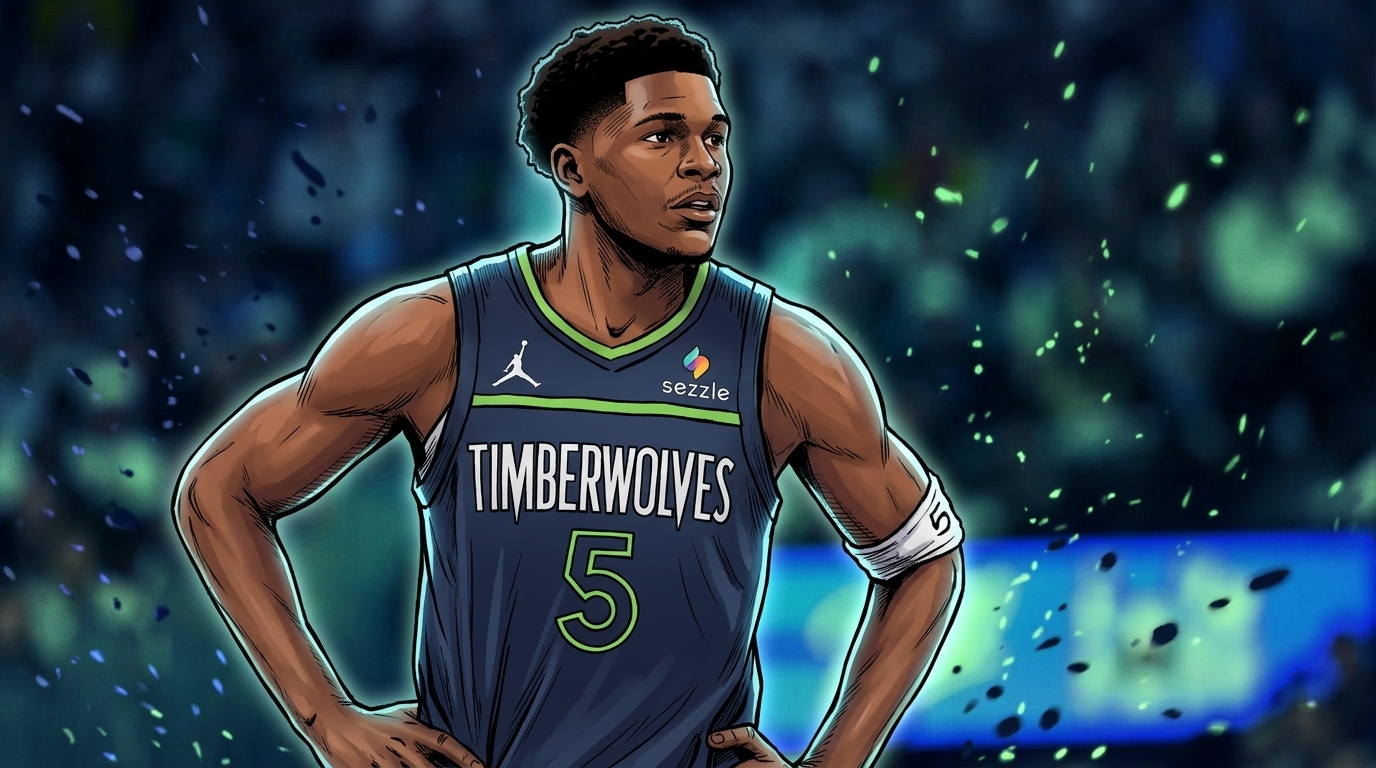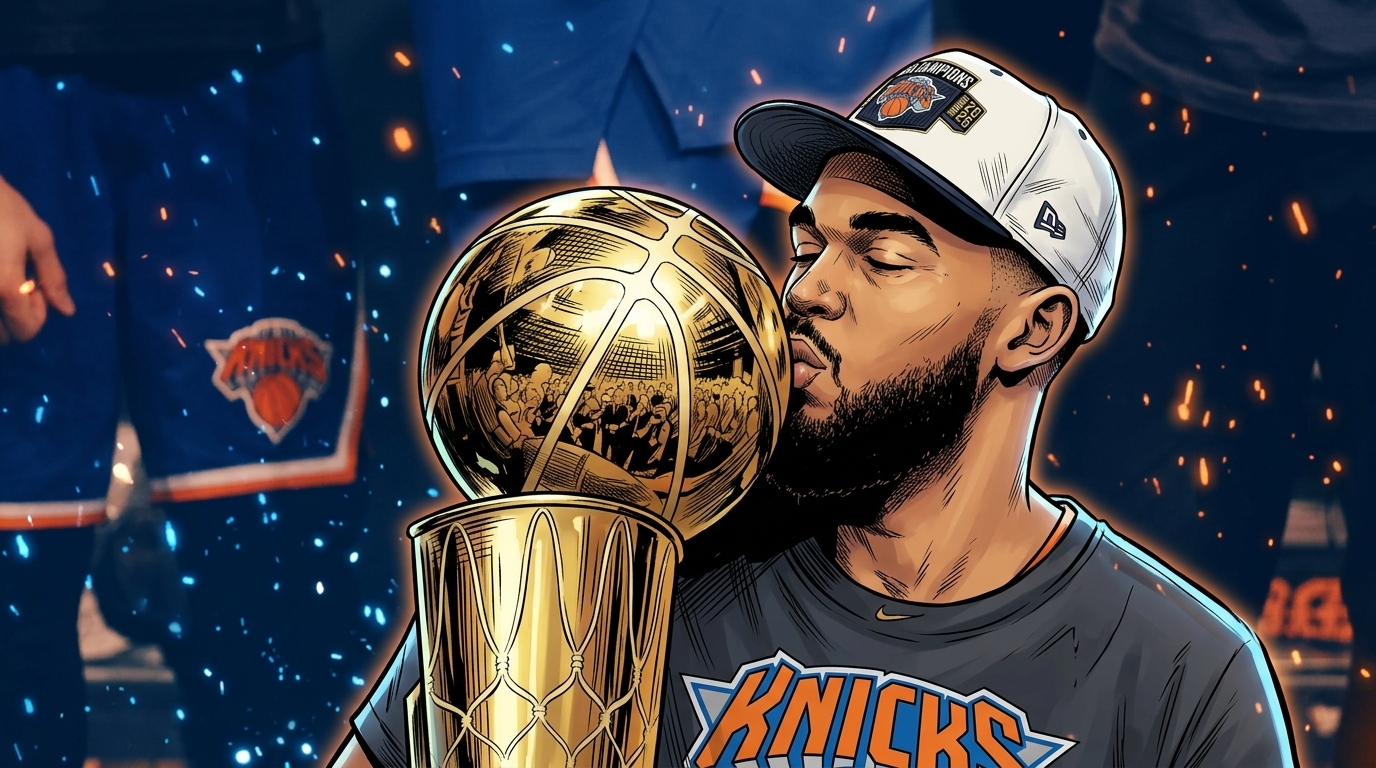
What we watched Sunday night in the final seconds of Game 5 was not really a basketball moment. We’ve been tracking KAT’s grief arc for six years now — the COVID spring that took his mother, Jacqueline “Jackie” Cruz-Towns, then six more family members in the same terrible window. The trophy presentation was the closing parenthesis on all of it. Karl-Anthony Towns kissed the Larry O’Brien Trophy, turned to Ernie Johnson Jr., and said: “Y’all heard my story, you know my story, I just wanna say…thank you, mama, I appreciate you getting me one.”
https://x.com/TheHoopCentral/status/2066006577983934781
That’s the answer to the question the 2026 Knicks season was quietly organized around. Jackie Cruz-Towns died in April 2020, before her son ever wore blue and orange, before the trade that brought him to New York in 2024, before any of this became possible. Her son just delivered her a championship she didn’t get to see coming.
The synthesis here runs through three separate threads, and they don’t mean the same thing in isolation. Brunson’s Finals MVP performance, 45 points in Game 5 on a unanimous verdict, is a basketball story. The Knicks ending a 53-year drought is a franchise story. But KAT’s trophy moment is something else: the completion of a grief arc that began with a pandemic and ran, improbably, through the front door of a Brooklyn funeral home.
Erica Hill founded Sparrow funeral home in Brooklyn, and per ESPN’s Malika Andrews, she organized a Game 4 NBA Finals watch party directly because of KAT. Not because she’s a Knicks fan (though that certainly helps), but because of what Towns had said throughout the series about feeling his mother’s presence: the calm he described, the signs he said he was always searching for. Hill’s quote to ESPN was direct: “Because all we do here is deal with people who are and support people who are grieving…he was the impetus.” She expected maybe 15 RSVPs. She capped attendance at 120. Strangers and families her funeral home had previously served showed up to watch basketball together, with a board where they could write the names of Knicks fans they’d lost. That’s not a detail — that’s the whole story.
Towns had been narrating his own grief publicly throughout the Finals in a way that made it available to people who needed it. Before Game 2, he told reporters he prayed to his mother; when the Knicks won, he took it as confirmation. As he explained to ESPN’s Malika Andrews: “I just felt a calm and a peace that had to come from the woman above. I felt like a kid. It was just fun out here…In a way I felt like I was seeing her in the video.”
https://x.com/ohnohedidnt24/status/2062377808186183977
The “seeing her in the video” line landed differently once you knew what the series looked like from his end. Towns averaged 14 points and 11 rebounds for the Finals, solid numbers but not the dominant series anyone expected when the Knicks acquired him in 2024. Game 5, he was sidelined by foul trouble entirely (Brunson, who carried the day, didn’t seem to notice). But Game 4 was his: two clutch second-half buckets and a game-sealing deflection on a Spurs inbound at the buzzer, the kind of play that turned the 29-point comeback in Game 4 into the hinge of the series. He wasn’t the best player in the Finals. He was something more useful to the story: the one whose grief gave it shape.
The acquisition arc matters here because it defines the timeline. KAT spent nine seasons in Minnesota, nine seasons where he was alternately great and brittle, where the Timberwolves made exactly one conference finals, where he was often unfairly blamed for whatever the franchise’s dysfunction was that particular year. He never reached the Finals. His mother never saw him reach the Finals. The trade to New York happened four years after she died (which is its own specific cruelty, the kind of timing that makes you want to argue with someone about it). Jackie Cruz-Towns never saw her son in blue and orange. She got none of it, and somehow she got all of it.
Towns didn’t perform gratitude at the trophy ceremony — he organized the whole championship into a single address to someone not there to receive it. The Ernie Johnson interview was the right venue for this, and whoever booked that segment understood the assignment. The full quote deserves the space: “You work your whole life for this moment. Throughout my career, I’ve seen myself fall down, people telling me to stay down, and I got back up even when I was in the mud…I kept trusting god, I kept trusting my faith, I kept trusting the work.” He’d said in earlier media availability that the team’s mantra all season was “it is written,” that the Knicks were fated for this. Whatever you think about fate as a framework (and your mileage will vary, as it always does), the line worked because Towns had lived inside a loss large enough to make any other interpretation feel insufficient. You don’t survive losing your mother and six other family members in a single spring and come out believing things happen arbitrarily.
Per Yahoo Sports, the trophy ceremony was chaotic in the way those things always are: champagne, noise, players in various states of disbelief. Towns found stillness inside it. He’d spent the series saying he always felt her presence. At the end, he said thank you. The Brooklyn funeral home crowd, the 120 people who had gathered specifically because grief is communal and KAT had made his communal, felt that too. Erica Hill planned to give them a place to honor their own dead Knicks fans. Towns inadvertently gave everyone a place for it.
The grief timeline doesn’t close. That’s not how any of this works. Jackie Cruz-Towns died in April 2020, and she stays dead in June 2026 regardless of the scoreboard. What changes is that her son held a trophy on live television and talked to her, and 120 strangers in a Brooklyn funeral home watched it happen, and whatever that is, it’s the most complete portrait of what the 2026 Knicks championship actually meant. Brunson was magnificent. The drought was real. The son who finally got one for his mom, who couldn’t stop looking for her in the crowd: that’s the story that lasts.