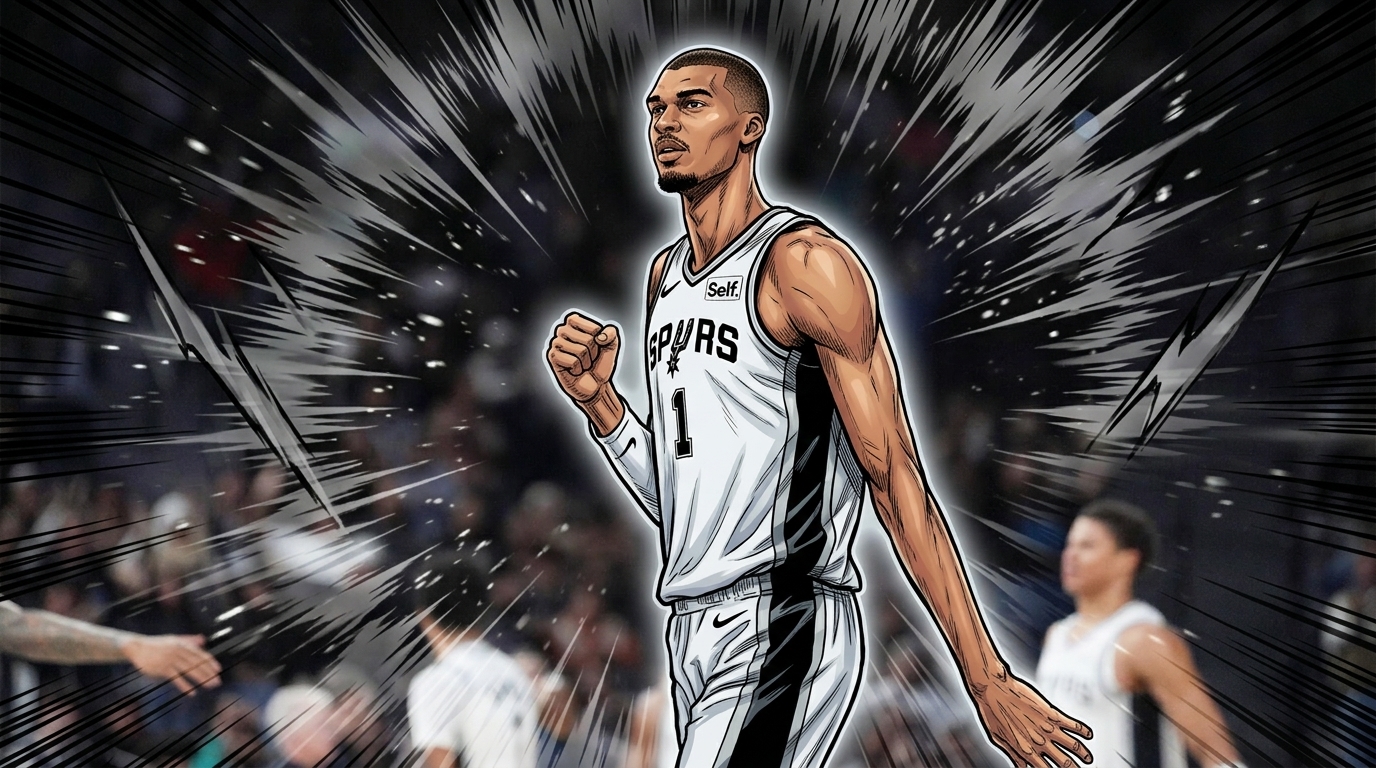
Victor Wembanyama hunched over at the final buzzer on Friday night, collapsed into Stephon Castle’s arms, and cried on national television — and the Knicks, who are next, should understand what those tears actually mean.
This is not a story about vulnerability. ESPN reported Wembanyama’s postgame quote in full, and it is worth reading slowly: “Winning the Larry O’Brien, it’s a childhood dream, and having a real shot at it, having a chance, a tangible chance at winning it, realizing a dream. It’s a lifetime chance. You never know when it’s gonna happen again. The day we win it, speaking for myself, it’s going to be an amazing day of the realization of a dream. It’s hard to put into words. It’s almost like the meaning of my life.” A 22-year-old said that. Not in a quiet hallway. On the court, into a microphone, in front of millions of people, with tears still on his face.
The emotional reframe that most of the coverage is missing: that quote is a threat.
When someone tells you that winning the championship is “almost like the meaning of my life,” they are not being poetic. They are not performing for the camera. They are telling you the precise coordinates of their obsession, and anyone who ends up between them and that target should take the information seriously. The Knicks have an 11-game win streak and a lot of momentum. Wembanyama has a childhood dream and a clock that he can apparently feel ticking in real time.
The first call he wanted to make after the final buzzer was to Gregg Popovich. Popovich is 77 years old, had a stroke, and retired from coaching. He is now the team president. Per Yardbarker, Wembanyama said: “He goes through some things we can’t even imagine. So I need to call him. I need to see him. I need to talk to him. Because there’s no way I can understand right now how he feels.” The man just won the Western Conference Finals MVP unanimously, all nine ballots, the first European-born player to do it, and his first instinct was to find the person who built the institution he is now carrying. That is not the psychology of someone who gets satisfied.
He also said this: “I want to win so bad. It’s like my life depends on it.” And then, separately, because apparently one haunting quote was not enough: “The crazy thing is, maybe I’m crazy, but I want to feel that 15-20 more times in my career. Let’s hope it doesn’t become an addiction. Maybe it already is.”
That last line is the one worth sitting with.
The reaction on social media was immediate:
https://twitter.com/NBA/status/2060928845448958339
He averaged 27.3 points, 10.9 rebounds, 3.1 assists, 1.4 steals, and 2.7 blocks per game in this series. In Game 1, he went for 41 points and 24 rebounds — a comparison to LeBron’s “48 special” in the 2007 Eastern Conference Finals was floating around, and it was not wrong. In Game 7 itself, he was 7-for-15 from the field, 5-for-7 from the line, steady when the game was actual pressure, not just high-volume offense. The Spurs beat Oklahoma City 111-103 in a game where De’Aaron Fox had three steals and Julian Champagnie hit 18 of his 20 points from three. For one night, Wembanyama did not need to score 35 for San Antonio to win. His defensive scheme that shut down SGA in Game 7 was as responsible for this outcome as anything on the stat sheet.
The last time the Spurs were in the Finals was 2014. Wembanyama was 10 years old. He grew up watching this franchise as a French kid who wanted to play in the NBA, who specifically wanted this, who has been pointed at this specific target long enough that reaching the edge of it made him cry. That context does not make the moment sentimental. It makes it structural. The hunger is not something that arrived this postseason. It has been accumulating for twelve years.
His teammates got a piece of it too. “They don’t even know how much I love them,” he said. Then: “We want four more.”
The Knicks start Wednesday.