We’ve been telling Rick Brunson’s story as a footnote. A career footnote, a trivia-night footnote: eight franchises, 337 games, undrafted out of Temple, cut eight times before finding an NBA roster that would have him for more than a season at a stretch. The standard framing is sympathetic. Journeyman survives, raises a superstar son, watches from the bench as the kid does everything dad couldn’t. That framing is accurate enough. It’s just incomplete. Rick Brunson didn’t give Jalen talent. He gave him testimony.
Rick Brunson spent nine NBA seasons averaging 3.2 points and 2.6 assists per game across Portland, New York, Boston, Chicago, Toronto, Los Angeles, Seattle, and Houston. He never held a guaranteed contract. He played in Australia. He played in the CBA. He played in the Philippines. He got to the NBA and held on through sheer professionalism, the kind where you learn to read every room, adjust to every coaching staff, and perform at a useful level for whoever needed a backup point guard that particular November. His best season came with the 2004-05 Los Angeles Clippers: 80 games, 39 starts, 5.5 points and 5.1 assists per game, career-high 14 assists on January 6 against Portland. He was productive. He was never safe.
That condition, never safe and always working, is what Jalen Brunson absorbed growing up. As Jalen told Stephen Colbert on the Late Show: “My dad played for eight teams in nine years. He was on unguaranteed contracts every single year.” He described watching his father in the summer heat, drilling in an empty gym when no contract was on the table: “That image kind of creeps back into my mind about how my dad worked out as hard as he can, every single day in the summertime.” Rick wasn’t modeling how to be a star. He was modeling what it looks like to work when nothing is guaranteed.
What Did Rick Brunson Pass Down to Jalen?
Rick Brunson passed down demonstrational work ethic. Not talent. Testimony. He showed Jalen what relentless preparation looks like on unguaranteed contracts, in eight different cities, under no guarantees of playing time. The family mantra, per ESPN, was “the magic is in the work,” written on mirrors and slipped into lunch bags. Jalen absorbed it as fact.
The clearest expression of that transmission came in a story Jalen told Yahoo Sports’ Arjun Julka in April 2026: “The toughest times where my father was really tough on me was when it was after a high school game, and we won, and then he told me to keep my jersey on, go right to the gym.” Rick Brunson didn’t celebrate wins. He metabolized them. He passed that metabolism to his son.
The Man Who Was in This Building Before His Son Was Born
Here is the part of this story that should stop you. In 1999, Rick Brunson was a member of the New York Knicks. That Knicks team (Patrick Ewing’s team, Latrell Sprewell’s team, Allan Houston’s team) made the NBA Finals as an eight seed and pushed the San Antonio Spurs to five games. Rick appeared in 16 playoff games that postseason. He got 9.8 seconds of court time in Game 3 of the Finals against San Antonio. Nine point eight seconds. The Knicks lost that series. No ring for Rick. (The New York Knicks have now won two championships in the last 53 years. The ticker tape, as of this writing, is still falling.)
Jalen Brunson was two and a half years old during the 1999 Finals. He was physically present in the locker room. Patrick Ewing told NBC News he was “always in the locker room, always bouncing the ball, following me all over.” Jalen has no conscious memory of that series. What he has instead is the shape of a man who was there, who competed, who didn’t win, and who kept going anyway for six more seasons across six more cities until the career was done.
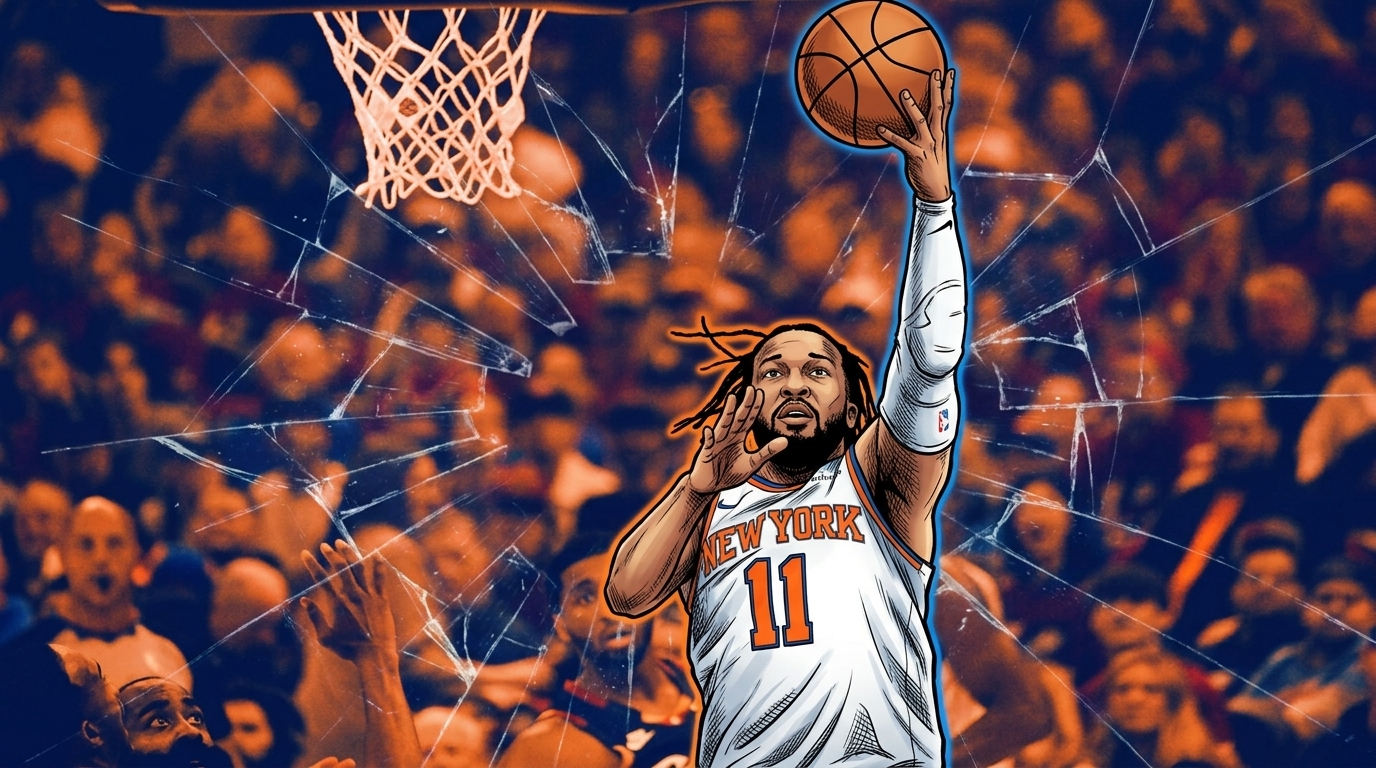
Twenty-seven years later, Jalen Brunson and the New York Knicks defeated the San Antonio Spurs 4-1 in the 2026 NBA Finals. Game 5 in San Antonio: Jalen scored 45 points on 14-of-27 shooting, including 15 of those points in the final 7:43 of a 94-90 clinching win. He averaged 32.6 points per game for the series. He won the Bill Russell Trophy, earning the unanimous Finals MVP verdict — every voter, unanimous — and putting up the highest Finals scoring total in Knicks franchise history. He went straight to midcourt after the buzzer, shook Spurs coach Mitch Johnson’s hand, turned around, and found his father.
Both cried. Rick held his son and kissed him on the head. The clip went immediately viral.
When the Coach and the Father Became the Same Person
Rick Brunson was hired as a Knicks assistant coach on June 2, 2022. Jalen Brunson signed with the Knicks roughly one month later. What that overlap looks like in practice has been one of the more genuinely interesting subplots of the Knicks’ championship night. Not because father-son dynamics in professional sports are novel. Because this particular dynamic was already decades in the making before either of them put on a Knicks uniform in this era.
The Tom Thibodeau thread runs through all of it. Rick met Thibodeau in a Massachusetts men’s league in the 1980s, when Rick was a teenager and Thibodeau was a D-III assistant at Salem State. A forty-year friendship preceded their working relationship in Chicago, then Minnesota, then New York. When Jalen arrived in the building, he arrived with institutional context most players spend years acquiring. As he told ESPN’s Nick Friedell: “Being around him for a long time, knowing the trust that my dad has in him, I’ve been around it. I’ve been around his philosophies for a long time, so I guess I’m used to it.”
The coach-and-father complication is real, and Jalen has been candid about having to learn to navigate it. Per Friedell: “He’s always been tough on me, but I’ve had to figure out when he’s being a coach and when he’s being a dad. Once I figured that out, it was much easier… Just knowing he was looking for what’s best for me, not just yelling at me as a parent.” The kid who had to keep his jersey on after wins grew into the player who can receive correction from the same man and process it as information rather than criticism. That is, to put it plainly, a skill most adult professionals never fully develop.
Rick contributed to the Knicks’ championship run in a way that went unreported until Mike Brown confirmed it afterward. During Game 1 of the 2026 Finals, the Knicks bench was getting on the officials. Rick told them to stop. Brown told Sports Illustrated: “We were all bitching too much at the officials. Rick Brunson was great. He told me to shut the hell up… and he told the rest of the team to be quiet and leave the officials alone.” A journeyman’s composure, forged across eight teams, applied at the highest leverage moment of a championship run. (The Knicks went on to win that game. Rick has not, as far as anyone knows, accepted credit for this.)
After the final buzzer in San Antonio, Jalen went to shake hands with Spurs players. Rick was asked on Inside the NBA why Jalen moved so quickly to find the opposing coaches and players. His answer: “Because he was raised right. But that’s his mom. That ain’t me.”
What Comes Next for the First Father-Son Finals Duo in One Franchise’s History
NBA Communications has confirmed it: Jalen and Rick Brunson are the first father-son Finals duo for the same franchise in NBA history. Rick in 1999, Jalen in 2026, both representing the New York Knicks. That is a distinction that will hold for as long as the record books hold.
https://twitter.com/NBAPR/status/2061154573075480590
The question the record raises is worth sitting with for a moment. Rick Brunson is 54 years old. He has been, by his own accounting, working in basketball since before Jalen was born. Coaching stops at Denver, Chicago, Charlotte, Minnesota. Forty-year friendship with Thibodeau that predates cell phones. Nine seasons of accumulating the institutional knowledge (when to push, when to shut up, when to let the officials figure it out) that he eventually brought into a Knicks assistant’s role. His son won the championship. Rick held the trophy.
Per ESPN, the family mantra (“the magic is in the work”) was written on mirrors, packed in lunch bags, repeated until it became ambient. Jalen Brunson this postseason averaged 32.6 points per game, shot 52.2% from the field in the Finals, and recorded a Q4 scoring average of 11.2 points per game, a Finals record. He was asked by People’s Bailey Richards who was the better player. Rick said Jalen. Jalen agreed, then added: “I wouldn’t be [the better player]. He taught me how to work hard and he taught me how to push myself.”
Rick said afterward, on Good Morning America, quietly, in the kind of register that doesn’t translate well to television: “In ‘99, it was a great run for us, but I would say now it’s more exciting for me as a father to see your son on the stage and performing.”
He never envisioned Jalen getting this far, he added. Not at this level. He just envisioned success, the modest, hard-won kind a man allows himself to imagine when the contracts are unguaranteed and the summers are long and the child is watching every workout. The idea that watching would become the lesson. That the testimony would compound interest.
The Rick Brunson and Jalen Brunson championship story doesn’t end with the trophy. Jalen is 29. He is now the best player on a franchise that will build around him for the foreseeable future. Rick is still on the bench, still a Thibodeau lieutenant, still the guy who will tell the head coach to shut up when the moment calls for it. The inheritance has been delivered. What happens next is the son’s to write, carrying forty years of groundwork his father laid without a guarantee that any of it would matter.
It mattered.