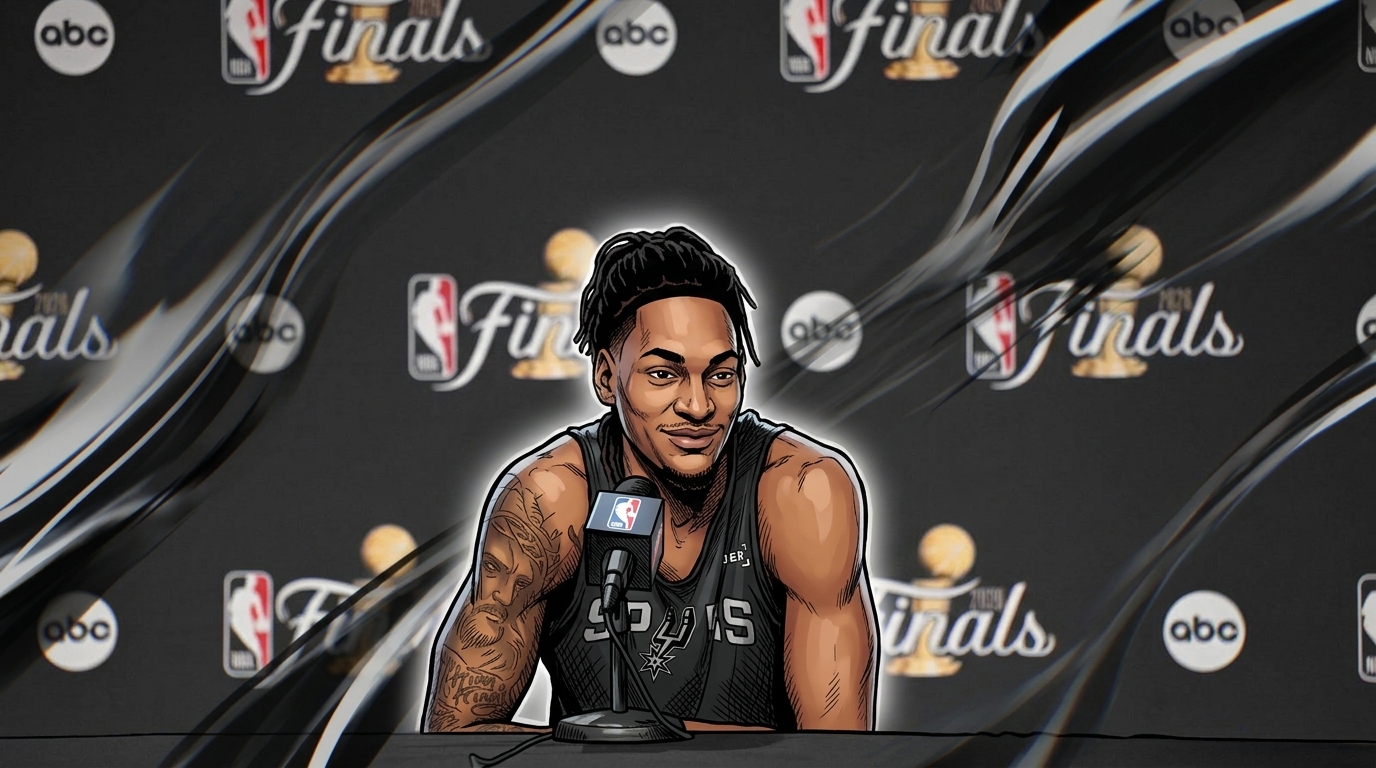

Here is a number worth sitting with: 28.
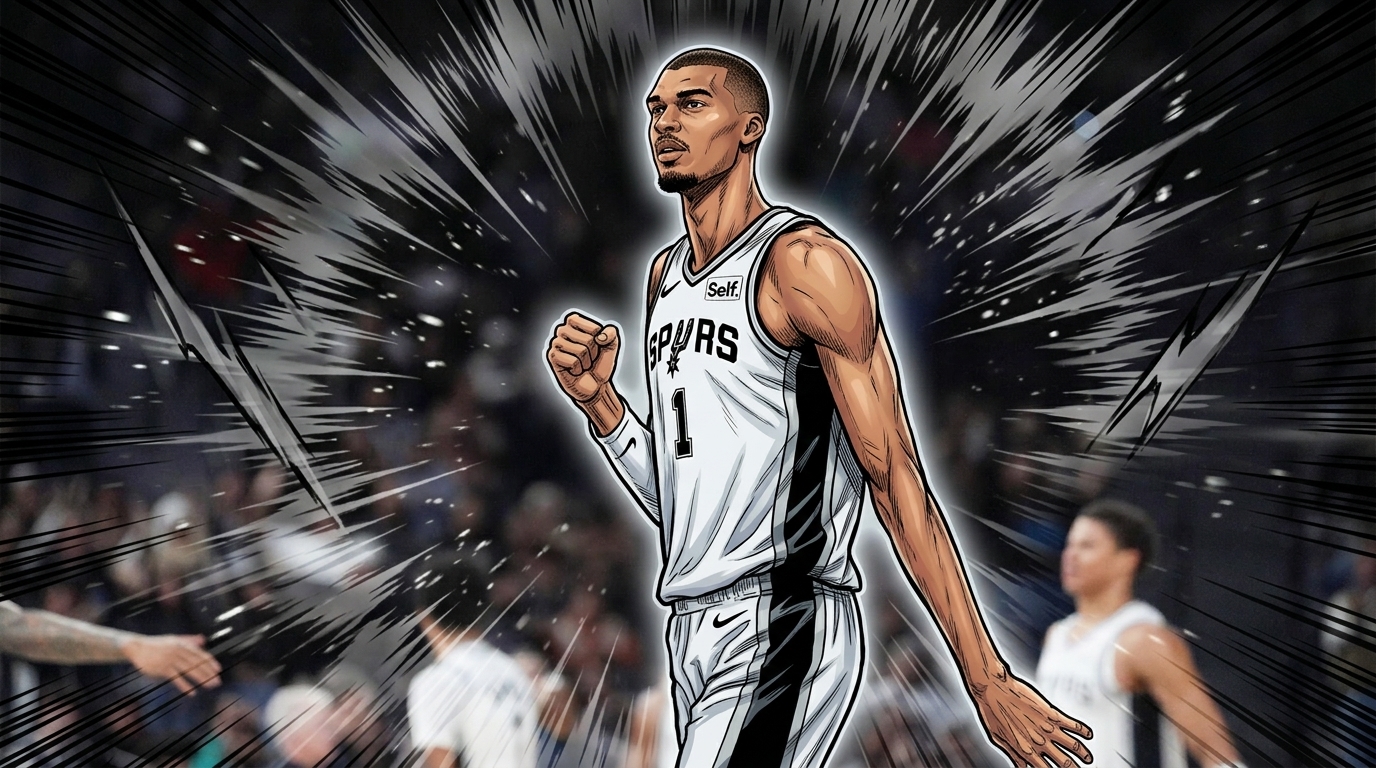
That is the net point swing between Victor Wembanyama on the court and Victor Wembanyama on the bench during the 2026 NBA Finals, per The Ringer’s tracking. When Wembanyama played, the Spurs outscored the Knicks by 8 points across the series. When he rested, New York outscored San Antonio by 20. The Knicks didn’t beat the Spurs in these Finals. They beat the Spurs’ second unit, then survived long enough for Jalen Brunson to close out Games 4 and 5. Brunson’s 45 points in Game 5 were real. Finals MVPs are earned, not gifted. But the on/off data forces a clarifying question: what exactly did New York actually defeat?
That question is the entry point for what I want to call The 100-Game Clock: a framework for understanding what Victor Wembanyama’s press conference statement means, what the historical comps actually predict, and why the franchise that just won a championship should probably be the one losing sleep this summer.
The Year-3 Test
The Year-3 Test is simple in premise and brutal in application: how do you evaluate an all-time prospect after his third NBA season, knowing that Year 3 is almost never the finished product?
Wembanyama’s 2025-26 regular season line (25 points, 11.5 rebounds, 3.1 assists, 3.1 blocks, 51.2% from the field, per Basketball Reference) is already an anomaly. The blocks number alone (unanimous Defensive Player of the Year, the first unanimous winner ever) would make him historically significant if he retired tomorrow. He finished third in MVP voting behind Shai Gilgeous-Alexander and Nikola Jokic, which is either a reasonable outcome given SGA’s transcendent scoring season, or a mild scandal depending on how much weight you put on two-way impact. The WCF MVP was uncontroversial. The 62-20 record his team posted was the second-best in the Western Conference.
Then the Finals happened. And the tactical preview we ran before the series proved prescient on one specific point: this Spurs roster, built around Wembanyama’s singularity, had a support-cast ceiling that New York’s depth could exploit. Wembanyama averaging 26 points, 11.2 rebounds and 3.6 blocks in the Finals (per Basketball Reference) against a team that still won 4-1 is the Year-3 Test’s central paradox. The player was dominant. The team was not dominant enough.
The historical lens here is where it gets interesting.
What the On/Off Numbers Actually Prove
The 28-point swing is not a curiosity. It is a diagnostic.
It means the Spurs, as currently built, are approximately a league-average team without Wembanyama’s minutes, and a Finals-caliber team with them. That gap is simultaneously a tribute to his individual impact and an indictment of roster depth. No other player in this series generated anything close to that kind of leverage. Brunson’s on/off in the Finals was positive but modest; the Knicks were built to survive his rest minutes in a way San Antonio simply could not match.
Woof.
The Spurs were outscored by 20 points in Wembanyama’s rest minutes across a five-game series. That’s not a rotation problem. That’s a depth emergency.
Which brings us to the quotes. After Game 5 (a 94-90 Knicks win that felt both closer and further away than the score suggests), Wembanyama told reporters: “This is the biggest lesson of my life, the biggest learning moment.” That lands differently when you understand what he was specifically learning. He averaged 26/11.2/3.6 for the series and lost. The lesson isn’t about his game. It’s about what his game cannot compensate for alone.
Then came the specific statement that reframes everything:
https://x.com/espn/status/2066016314095763714
“What I’m pissed about is there are probably 100 games before we can be back in the Finals. I’m going to have to hold that inside of me and slow down and wait.”
The arithmetic is exact. The Spurs played 82 regular season games plus 18 playoff games this year: 100 games total. Wembanyama is telling the league he will carry this loss for the full duration of one NBA season. He is not venting. He is setting a calendar.
Is This the Most Dangerous Trajectory in NBA History?
The data here is unambiguous on the historical precedents, and they point in one direction.
LeBron James, age 22, lost the 2007 NBA Finals 4-0 to the San Antonio Spurs. He then won four championships, reached ten Finals total, and produced the most decorated multi-decade run in modern NBA history. The comparison is almost too clean to be useful. Except it isn’t, because the specific circumstances mirror almost perfectly. A 22-year-old generational talent, a Finals loss that exposed roster construction limits, a press conference performance defined by controlled fury rather than tears. James in 2007 didn’t cry either.
The Tim Duncan parallel is even stranger. Duncan was 22-23 when he won his first championship in 1999 — over the New York Knicks, in five games. The 1999 championship this series kept invoking came full circle here: Wemby’s Spurs faced the same opponent Duncan’s Spurs defeated, and lost. Same franchise. Same matchup. Opposite result. The echo is eerie enough that you almost want to dismiss it as noise; the pattern it suggests is that Spurs-Knicks Finals tend to produce dynasty-defining moments for whoever wins. In 1999, that was Duncan. In 2026, that is the Knicks. For now.
Darko Milicic was 18 when the 2004 Pistons won a ring he barely contributed to. Tyler Herro was 20 on the 2020 Heat team that lost in six. Wembanyama reached the Finals as a legitimate centerpiece starter at 22 in Year 3, averaging Finals numbers that most All-Stars never reach in their careers. The trajectory is not analogous to a promising role player getting a ring early. It is analogous to the players who anchor 10-year dynasties.
The question isn’t whether Wembanyama is on an all-time track. The question is how wide that gap closes between what he can do and what his roster can support, and how quickly.
The 100-Game Clock
Here’s what the Clock actually means as a predictive framework.
Wembanyama will be 23 next season. His blocks rate, assist rate and three-point percentage (34.9% in 2025-26 on increasing volume) all have meaningful room to grow. His 82.7% free throw rate on a 64-game season suggests durability and refinement are tracking together. The area of greatest concern (the rest-minutes vulnerability, the defensive dominance that defined what he did to the Thunder in the Conference Finals that then got stretched thin late in series) is a roster problem, not a Wembanyama problem. Roster problems get solved in offseasons, especially when teams with 62-win ceilings and a franchise player coming off a Finals appearance have a clear pitch to free agents and a front office with something to prove.
Wembanyama said one more thing after Game 5 that deserves more attention than it got. He noted that “our domination stints — we absolutely dominated for most of this series. But our errors, our mistakes are punished so hard.” That’s not a player making excuses. That’s a player identifying a precision deficit. Elite teams eliminate unforced errors under Finals pressure. Young teams don’t. Year-4 Wembanyama running a more experienced roster, with a full summer spent carrying this loss as motivation, is the specific version of this player the league needs to prepare for.
He walked off the court after the final buzzer without shaking any Knicks’ hands. That will be talked about. The other thing he said at the end of his press conference — “Appreciate y’all. See you… never.” That will be talked about more.
The 100-Game Clock started Sunday night. When it expires, the Spurs will return to the playoffs with a 22-year-old who averaged 26/11/3.6 in his first Finals appearance and lost, who spent an entire season holding that, who has now watched what a championship roster’s depth looks like up close and had an offseason to do something about it.
The data builds one case, and I’ll commit to it: give me Year-4 Wembanyama. Not because the narrative is compelling (it obviously is) but because the trajectory comps, the on/off leverage numbers, the age curve, and the organizational infrastructure all converge on the same outcome. The Knicks won. The 100-Game Clock is running. Those two facts are not in conflict.