
The question the data needs to answer tonight is this: what do you do with lottery picks when you already have the best player in the world?
Most organizations never have to ask it. The draft lottery exists, by design, to help bad teams. You lose enough games, you earn a ticket, you take a player in the top 14 and you try to build something. The pipeline runs one direction. Oklahoma City is running it in two directions simultaneously — and there is no map for that.
The Presti Paradox
Call it what it is: the Presti Paradox. Sam Presti has engineered a roster construction situation that has no true historical parallel — a team operating in full dynasty mode on the court while maintaining an asset profile that looks like a franchise in year two of a teardown.
Tonight, OKC holds picks 12, 17, and 37 in the 2026 NBA Draft. Pick 12 came from the Clippers. Pick 17 came from the 76ers. Pick 37 came from Dallas. These are assets accumulated through years of patience, calculated losing, and trades that looked strange at the time and look prescient now. Presti also has approximately 10 first-round picks spread across the next five drafts. Ten.
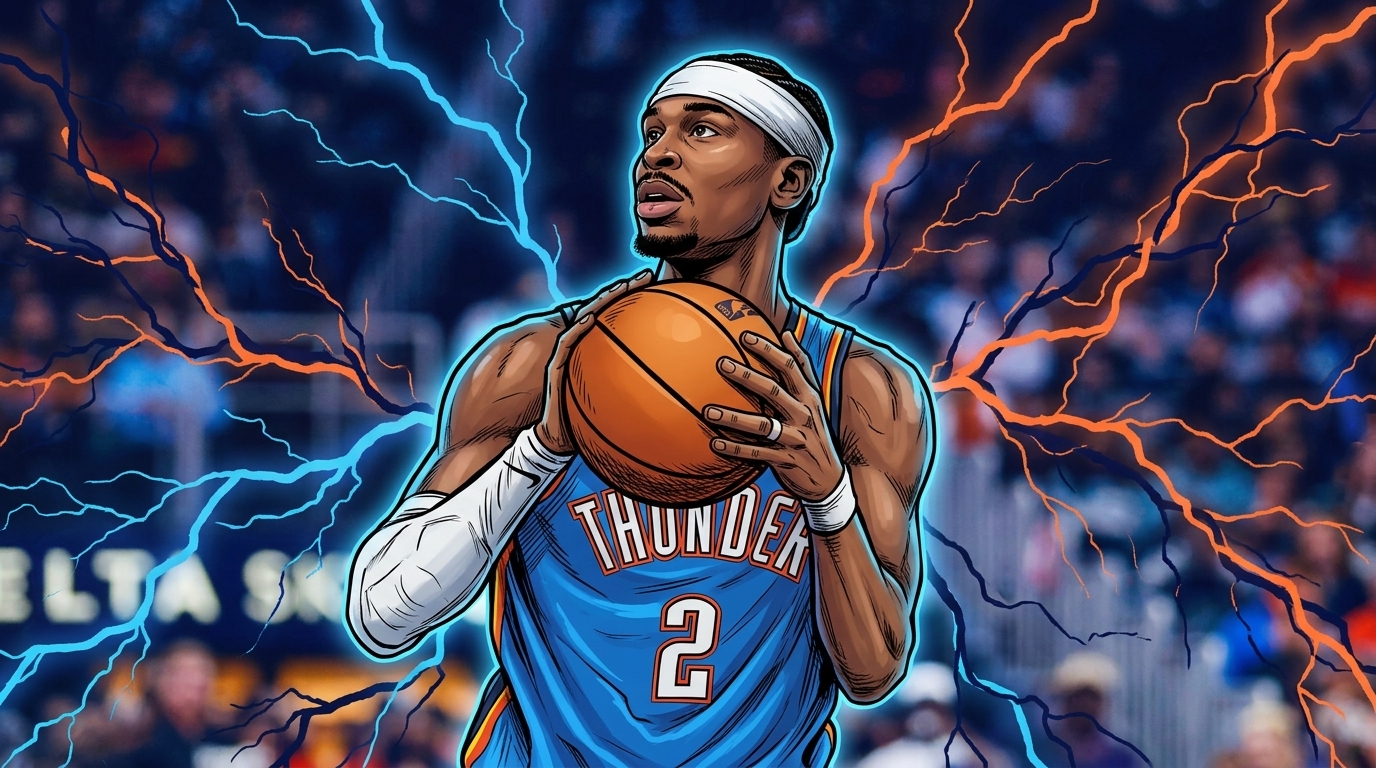
The player those picks surround? Shai Gilgeous-Alexander. Back-to-back regular-season MVP. 2025 Finals MVP. The fourth player in NBA history — joining Kareem, Jordan, and Shaq — to win the regular-season MVP award, the Finals MVP, and the scoring title in the same season. He averaged 31.1 points, 6.6 assists, 4.3 rebounds, and 1.4 steals across 68 games this year. In the 2025 Finals against Indiana, he went 31.4 points, 8.2 assists, 5.2 rebounds, and 1.8 steals per game as OKC closed out the Pacers in seven.
https://twitter.com/okcthunder/status/1936984211782557972
The Thunder lost to San Antonio in the 2026 Western Conference Finals in Game 7, 111-103, with SGA putting up 35 points and 9 assists in the loss. That stings. But it is also context: this is not a team in crisis. This is a team that won a championship last year and made a conference finals this year with a roster that projects to get better.
The Presti Paradox is the condition of being simultaneously the most asset-rich rebuilding team and the most underrated dynasty in the league. No team has ever occupied both positions at once.
Why Does OKC Have Lottery Picks at All?
The short answer: trades, not losses. No defending champion has ever picked in the lottery via their own selection — because lottery teams don’t win titles. OKC’s lottery picks are entirely acquired assets, which means Presti accumulated them during the lean years and is now cashing them in during the flush years. Pick 12 is the Clippers’ pick, collateral from the Paul George era. Pick 17 is Philadelphia’s, residue from a different franchise’s dysfunction. OKC didn’t tank for these. They were paid for with patience.
That distinction matters enormously. These aren’t compensation for failure. They’re dividends on a long-term investment thesis that most front offices couldn’t have sustained under the pressure that comes with losing seasons in a major market.
What the Historical Comps Actually Show
Three teams get floated when people try to contextualize what OKC is doing. None of them actually fit.
The Golden State Warriors won the 2015 title and came back the following year with the 73-win season. But they did not have meaningful lottery assets going into that offseason. Their dynasty upgrade was Kevin Durant — a free-agent acquisition, not a drafted one. They converted present success directly into more present success, with zero draft capital as leverage.
The San Antonio Spurs built their dynasty through lottery picks, but they did it in separate eras: David Robinson at one and Tim Duncan at five. Two foundational picks, two distinct rebuilds, separated by years of intentional losing. The Spurs never drafted in the lottery while simultaneously holding a Finals MVP. They earned those picks by being bad, the old-fashioned way.
The Miami Heat’s LeBron era is the inverse of OKC: maximum present, zero future. LeBron, Wade, Bosh, championship. No picks. No assets. A complete mortgage on tomorrow to fund today.
Woof. OKC has more first-round picks in the next five years than the Heat had in the entire LeBron window — while employing a better player.
There is genuinely no team in NBA history that has entered a draft night holding two lottery picks, a reigning Finals MVP, multiple future first-rounders, and an open question about whether they should use any of those assets to get even better tonight.
What Presti Does With Picks 12 and 17
The constraint is real: OKC has only one open roster spot. They cannot carry two lottery picks as active players. So Presti’s pre-draft strategy has to resolve this tension — either consolidate, move back, or take one pick and trade the other.
He told Yahoo Sports at his end-of-season press conference: “Everybody knows we try to move up every year. We try to get a price for what it would take for us to move out entirely, and then we also have contingencies to move back in the draft.” That’s Presti speaking in public, which means every team in the league has already processed this and submitted their offers.
The names clustering around pick 12 — Yaxel Lendeborg, Darius Acuff Jr., Mikel Brown Jr., Brayden Burries — are all players with real upside but roster-spot questions on a contending team. Lendeborg, the Michigan power forward, projects as the kind of developmental big who can grow into a starting role over three years. On a bad team, you take him and hand him the keys. On OKC, you’re asking him to contribute immediately in a Finals environment. That’s a different ask.
Which is why the consolidation scenario has real appeal. Packaging 12 and 17 to move into the top five or top eight — into the deepest draft class since 2003 — gets you a player who might be able to contribute on a championship timeline. Moving back from both picks and collecting additional future assets extends the runway further.
The Aaron Wiggins trade to Atlanta for two second-rounders signals the direction: Presti is already making moves to clear roster space and collect more picks, even at the margins. This isn’t a franchise that is done acquiring.
The thing that gets lost in all the draft night trade chaos is that OKC doesn’t have to do anything dramatic tonight. They can take the best player at 12, trade 17 for future consideration, and go into next season with SGA, their existing core, and another first-round pick coming in. That outcome — the boring one — would still leave them better positioned than 28 other franchises.
The Presti Paradox isn’t a problem to be solved. It’s a permanent condition. Presti has engineered a state where OKC wins on every timeline: the title window is open now, the asset base replenishes itself regardless of results, and the franchise has never been more attractive to free agents, trade partners, or incoming rookies. Most teams spend a decade trying to achieve one of those three things. OKC has all three at once, in June 2026, on a draft night where they’re picking in the lottery like they lost forty games.
Give me the Thunder to use pick 12 to move up, consolidate into a top-eight player, and carry this paradox deeper into a second championship run. Sam Presti doesn’t do boring.