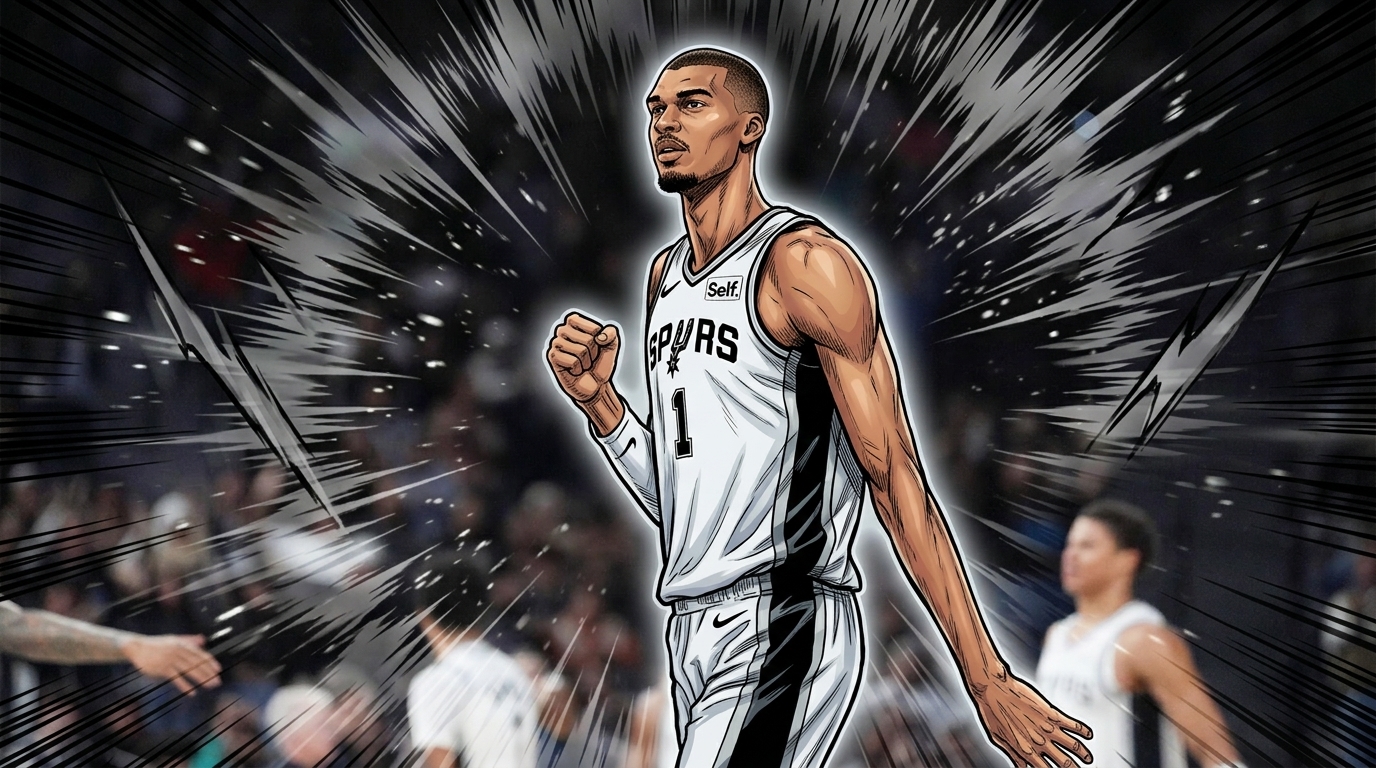

There is a diagnostic tool I call the Wembanyama Stress Test: take any roster in the Western Conference and ask a single question — what happens when Victor Wembanyama is guarding your rim for 35 minutes a game in a playoff series? For the Oklahoma City Thunder, who won 64 games and produced the consensus best player in basketball in Shai Gilgeous-Alexander, the answer to that question was Game 7, Western Conference Finals, season over. The diagnostic does not lie.
And Sam Presti, to his great credit, is not pretending otherwise.
Five days before the 2026 NBA Draft, the Thunder hold pick No. 12 (from the Clippers), pick No. 17 (from the 76ers), a second-round pick at No. 37, and what ESPN’s Brian Windhorst describes as a war chest of approximately ten future first-rounders accumulated across years of deliberate asset collection. Presti told reporters at his end-of-season press conference that the organization tries to price out full-slot sales every year and maintains contingencies to move back in. That is the language of a general manager who already knows where he wants to go and is negotiating the price to get there.
The Wembanyama Problem
The San Antonio Spurs eliminated OKC in seven games, and the mechanics of that series deserve honest accounting. Jalen Williams, the Thunder’s second-best player, was lost to injury; the Jalen Williams injury situation reshaped the series fundamentally, removing OKC’s primary secondary creator and the player best equipped to take pressure off SGA in isolation-heavy moments. But the deeper problem was structural in the truest basketball sense: the Thunder had nobody who could credibly deter Wembanyama at the rim.
Woof.
Wembanyama’s rim protection metrics, his ability to collapse Thunder drives and recover to contest pull-ups, his effect on OKC’s pick-and-roll coverage: all of it represents exactly the kind of elite interior anchor that Oklahoma City’s roster was built without. As we detailed in our WCF series breakdown, SGA was brilliant. He produced a 31.1-point regular season against the toughest possible competition, won back-to-back MVP awards with 83 first-place votes, and played the way the best player in the world should play. The ceiling of what he could do was not the limiting factor. The floor of what OKC’s interior could offer was.
That is a solvable problem. And Presti has the assets to solve it before the rest of the league catches up to how serious OKC’s window actually is.
The War Chest: Where Did All These Picks Come From?
The short version: years of deliberate draft-capital accumulation through trades that prioritized future flexibility over immediate win-now help. The longer version involves tracking pick flows from the Clippers deal, the 76ers trade, the Mavericks second-rounder, and a string of other transactions that left Presti holding leverage most GMs spend entire careers trying to manufacture.
The Thunder’s philosophy is simple: collect picks when they’re cheap, redeploy them when a target emerges. It has produced moments like this one, where five days before the draft they are reportedly in exploratory discussions with teams in the top 10 about what a move-up package might cost. ESPN’s Anthony Slater and Tim MacMahon reported those conversations are happening. They are not exploratory in the sense of idle curiosity. Presti does not do idle curiosity.
The injury fallout from the Spurs series is still being counted. Ajay Mitchell, the Thunder’s young Belgian guard, sustained a calf strain during the WCF and will miss Belgium’s upcoming World Cup qualifiers as a result — the Belgian national team confirming this week what OKC fans already knew:
https://twitter.com/belgianlions/status/2067219302307004485
The Thunder went into that Game 7 short-handed and now enter the draft with the memory of it still fresh. Presti is building the answer.
Who Does OKC Jump Into the Top 10 to Take?
The answer the data points to is Aday Mara, the 7’3” center out of Michigan. Mara projects as a top-12 target on most major draft boards. He averaged 12.1 points, 6.8 rebounds, and 2.6 blocks per game, shot 67% from the field, and won Big Ten Defensive Player of the Year, and set a Michigan single-season record with 103 blocks in 2025-26. His 7’6” wingspan and 9’9” standing reach are not normal human measurements.
Mara is the player whose profile most directly addresses what Wembanyama did to OKC in May. He is a legitimate rim anchor who alters games with presence before contact: an elite timing shot-blocker with rare passing instincts for a player his size, the kind of big who can read the floor and distribute from the elbow rather than just catch lobs. His fit alongside SGA’s downhill attack as a screener, roller, and interior deterrent is as clean a puzzle piece as you will find in this draft class. The concerns are real: career free throw shooting around 58.5%, conditioning questions, turnovers at Michigan. But those are the concerns of a player with a legitimate ceiling, not a player with a fundamental limitation.
Eurohoops reported both OKC and the Chicago Bulls are pursuing Mara. The Bulls hold pick No. 11. If the Thunder want Mara, they likely need to jump ahead of Chicago, which means getting into the top 10.
The Trade Math: What Does It Cost, Who’s Selling?
Bobby Marks at ESPN has modeled the most obvious scenario: picks 12 and 17 to the Milwaukee Bucks in exchange for a top-10 slot. Milwaukee, in a transitional moment of their own following the Giannis era, has motivation to accumulate future assets. Two high-lottery picks with immediate value maps cleanly against a top-10 slot the Bucks may not have a consensus target for.
A second scenario has OKC packaging picks 12, 17, and 37 to the Atlanta Hawks for the No. 8 overall pick. Atlanta has been a willing trade partner in the past and holds a selection high enough that acquiring multiple assets in return makes sense for a rebuild. The Thunder could also attach a player to sweeten either deal. Roster consolidation like the Jones move suggests Presti is already thinking about which contracts serve that purpose.
The math is not complicated. The Thunder have more ammunition than almost any team in basketball. The question is not whether they can afford to move up. The question is whether the right player is sitting where they can realistically get him without overpaying into absurdity. At No. 10, Mara represents a price that is aggressive without being irrational.
Presti said it himself: he has contingencies. This is what contingencies look like when they execute.
Presti’s Blueprint Has a Historical Analogue
The San Antonio Spurs drafted Tim Duncan in 1997 and did not stop building. Tony Parker in 2001, Manu Ginobili selected in 1999 and developed until 2002, a continuous process of layering talent around the anchor while never allowing a single playoff loss to produce panic moves. The Spurs won five championships across 15 years by treating team construction as a perpetual motion machine, not a destination.
Sam Presti is running the same blueprint with better pick volume. The Thunder won 64 games in 2025-26, finished as the No. 1 seed in the West, won back-to-back regular season MVPs through SGA, and lost in Game 7 of the Western Conference Finals to the eventual runner-up Spurs — a series in which their second-best player was injured. That is not a broken team. That is a team one piece away, operating in a draft where that piece is available in the top 10.
The long-term SGA-Wembanyama rivalry is going to define the next decade of Western Conference basketball. Presti knows this. Adding a 7’3” rim anchor to the equation before the next chapter of that rivalry begins is not just good drafting. It is the correct answer to a diagnostic that already told him exactly what he needs.
The Thunder will trade up on June 26. The target is Mara. The price is two lottery picks and however many futures it takes to close the gap.
The Wembanyama Stress Test will run again next spring. Presti intends to have a better answer.