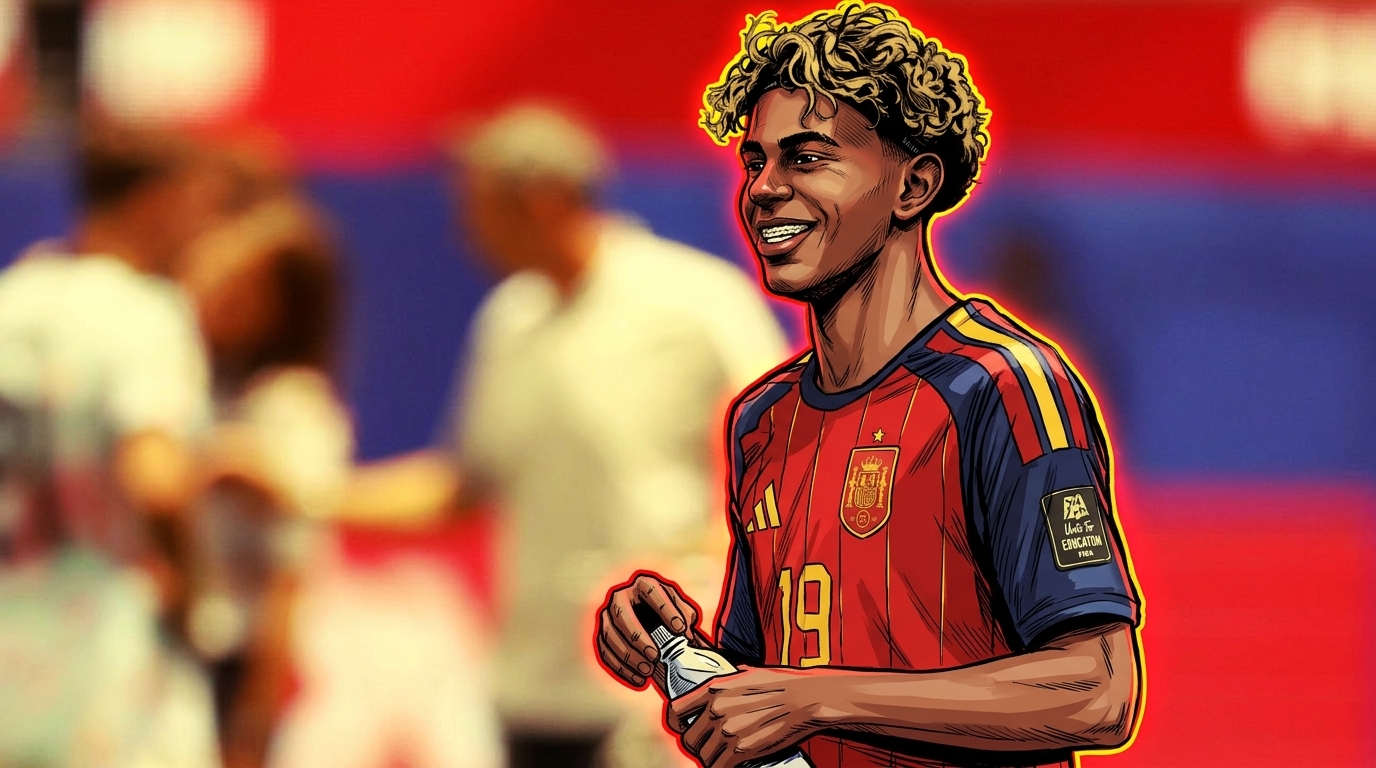

Half a trillion dollars was wagered on this World Cup and I cannot get a single governing body to admit that this is a crisis.
Gaming Compliance International estimates $593 billion in total World Cup 2026 illegal betting and legal wagering combined. Their president, Ismail Vali, said it on Day 1 of the tournament: “this is an over half a trillion dollar betting event.” Forbes published it. The number sat there. The tournament kept going. Lamine Yamal ran at defenders, Spain beat France 2-0 in the semis, the Final at MetLife is four days away, and the number just kept sitting there, unloved and unexploded.
Here is the part that should make your stomach drop: 69 percent of that $593 billion — roughly $409 billion — flowed through illegal, unregulated sportsbooks. Books that operate out of Anjouan and Curaçao under offshore licenses with anti-money laundering controls that amount to a suggestion. Books that exist outside every regulation the United States, Europe, and FIFA have collectively assembled. Nearly seven out of every ten dollars bet on this tournament touched a market that no government can audit, trace, or touch.
Vali told Forbes this isn’t specific to the World Cup. Globally, illegal sports betting runs at $5.9 trillion annually, roughly 80 percent unregulated. “Every online marketplace,” he said, “is basically running at around an 80-20 split.” The World Cup is actually cleaner than average, relatively speaking, which tells you everything about the baseline we’re operating from.
The standard move here would be to call FIFA corrupt and be done with it. That’s the easy version of this story. But World Cup 2026 illegal betting didn’t reach half a trillion dollars because FIFA is looking away. It reached half a trillion dollars because the legal market structurally cannot serve the demand. Legal sportsbooks are geographically restricted. They’re regulated out of the key Asian markets where most of this volume originates. They price casual bettors out with margins that make offshore books look like a public service. The illegal market didn’t grow because enforcement is weak. It grew because it is the only available product for hundreds of millions of bettors. That’s a market structure problem, and no number of FIFA press releases changes it.
South Korea blocked 1,280 illegal betting sites ahead of the tournament. Blocked them. As if the people running those books don’t just spin up new domains before the browser tab closes. They do. Obviously they do. The whole exercise is a formal gesture toward a problem that has no formal solution, which is a pretty good description of every anti-gambling-enforcement effort in the past decade, and it’s maddening that we keep pretending otherwise. Illegal streaming got the same treatment.
https://x.com/TheAthleticFC/status/2071912153292951658
Then there’s the match integrity layer, which is where this gets genuinely ugly. The Athletic reported that two unnamed World Cup 2026 players were flagged to their national federations by independent integrity experts — spot-fixing allegations, specifically deliberately collecting yellow cards in league matches to serve betting markets. FIFA responded with a “zero tolerance” statement. They are not actually investigating these specific allegations. There was also the Austria-Algeria group stage situation, where both sides allegedly agreed to the 3-3 draw in the 96th minute to ensure mutual advancement. FIFA decided not to investigate that either.
When asked why none of this produces actual enforcement action, the answer is structural: FIFA has no enforcement arm for illegal bookmaking. None. Zero. The biggest sporting event on the planet is surrounded by a $409 billion shadow economy and the governing body’s response is a press release, because that is literally all they have the power to produce. That’s not corruption. That’s something almost worse — it’s a complete institutional void dressed up in official language, and every “zero tolerance” statement FIFA issues into that void is bullshit. The UNODC published a dedicated report warning that without stronger cross-border coordination, illegal betting and corruption could flourish at World Cup 2026 and the LA 2028 Olympics. A report. A warning. The preferred output of institutions that cannot act.
The $7.3 billion that Daily Beirut documented as tracked/identified betting volume? That’s what’s actually visible to regulators. The rest — the $585 billion difference — is shadow. When you see US legal sportsbooks set betting records this tournament, understand: the legal, visible, regulated market is the rounding error. The legal handles that DraftKings and FanDuel fought hard to protect — so hard that their industry spent $43 million lobbying against gambling regulation — represent a fraction of what actually moves on any given match.
The Final is Sunday at MetLife. Billions more will be wagered, the vast majority of it through channels no regulator has jurisdiction over, on a sport FIFA governs without any mechanism to police the money surrounding it. The UNODC will publish another report. FIFA will reissue its zero-tolerance statement. Ismail Vali will give another interview.
Nothing will happen, and next time the number will be bigger.