What does a series look like when the premise it was built on stops being true?
That’s the question sitting over tonight’s Game 3 between the Oklahoma City Thunder and San Antonio Spurs, 8:30 PM ET at Frost Bank Center, with the series knotted at one game apiece and Jalen Williams officially out with a re-aggravated left hamstring. I’ve read every WCF preview that dropped this week and none of them gamed out what happens if Williams can’t go — because at the time, the series looked like a star-vs-star referendum. SGA against Wemby. The reigning two-time MVP against the 20-year-old who lost the award and responded by posting 41 points and 24 rebounds in double overtime. That was the framing. It was a good frame.
It was also predicated on both stars being surrounded by functional supporting casts.
The WCF 2026 Jalen Williams injury changes the architecture of this series in ways that are genuinely hard to model. And beyond Williams, there are two other threads running underneath the headline — Victor Wembanyama’s state of mind and a 20-year-old guard named Dylan Harper who nobody outside of San Antonio was treating as a real X-factor entering this series. All three threads converge tonight.
What Losing Jalen Williams Actually Means
Jalen Williams is out for Game 3 with a re-aggravated left hamstring injury. He only returned from the same injury partway through the Thunder’s playoff run, played just seven minutes in Game 2 before the hamstring flared again, and has no confirmed return date. His absence removes Oklahoma City’s primary secondary creator — the player who runs their pick-and-roll sets when SGA needs rest, who can close fourth quarters, and who provides the offensive pressure that keeps defenses from collapsing entirely onto Shai Gilgeous-Alexander.
Per Shams Charania and ESPN, Ajay Mitchell draws the start in his place.
To understand why the WCF 2026 Jalen Williams injury matters structurally — not just roster-depth-wise — you have to understand what Oklahoma City’s offense actually looked like when he was healthy. This was not a one-man system with four spacers. Williams was averaging legitimate secondary creator numbers in the regular season, capable of generating and finishing in isolation, and his presence meant that San Antonio’s defense had to account for two threats simultaneously. That dual-pressure dynamic made SGA’s job meaningfully easier.
Now the Thunder are asking: can Shai Gilgeous-Alexander carry an offense against a Spurs team that has Victor Wembanyama, an emerging 20-year-old point guard, and an institutional coaching structure in Gregg Popovich’s absence that continues to do exactly what that program has always done?
The Thunder won Game 2, 122-113 — and it’s worth noting how they won it. Alex Caruso scored 17 points. The collective stepped up. The system absorbed the Williams shortfall in one game. But one game is not four games, and the WCF 2026 Jalen Williams injury means San Antonio’s defensive game-planning just got considerably more focused.
Is SGA Enough?
Shai Gilgeous-Alexander just won his second consecutive MVP award — the 14th player in league history to go back-to-back, on a list that includes Jordan and LeBron. Nobody is relitigating the regular season. The body of work was real.
The question the WCF 2026 Jalen Williams injury forces is a different one: what happens when the singular offensive engine of a playoff contender loses its most important supporting mechanism? We’ve seen versions of this answer before. Sometimes the answer is that the star elevates. Sometimes the answer is that the defense figures out what to take away and the offense stalls.
Caruso’s 17 points in Game 2 is the best counter-argument OKC has. The system generated enough to win when it needed to. But the Thunder also won Game 2 at home, in a game where the Spurs were coming off a double-overtime road win and possibly carrying a fatigue differential. A road game in San Antonio tonight — with a locked-in Spurs team and a Frost Bank Center crowd that watched Game 1’s 2OT win — is a different environment.
SGA is good enough that “is SGA enough?” might feel like a disrespectful framing. It isn’t. It’s the honest question the WCF 2026 Jalen Williams injury makes unavoidable.
Wembanyama Is Motivated in a Way That Should Terrify Oklahoma City
The full MVP trash talk story is covered elsewhere on this site — the “lil boy” court audio, the “I’m number one” gesture after the logo three, all of it. What matters for tonight’s game is what the numbers behind that motivation actually look like.
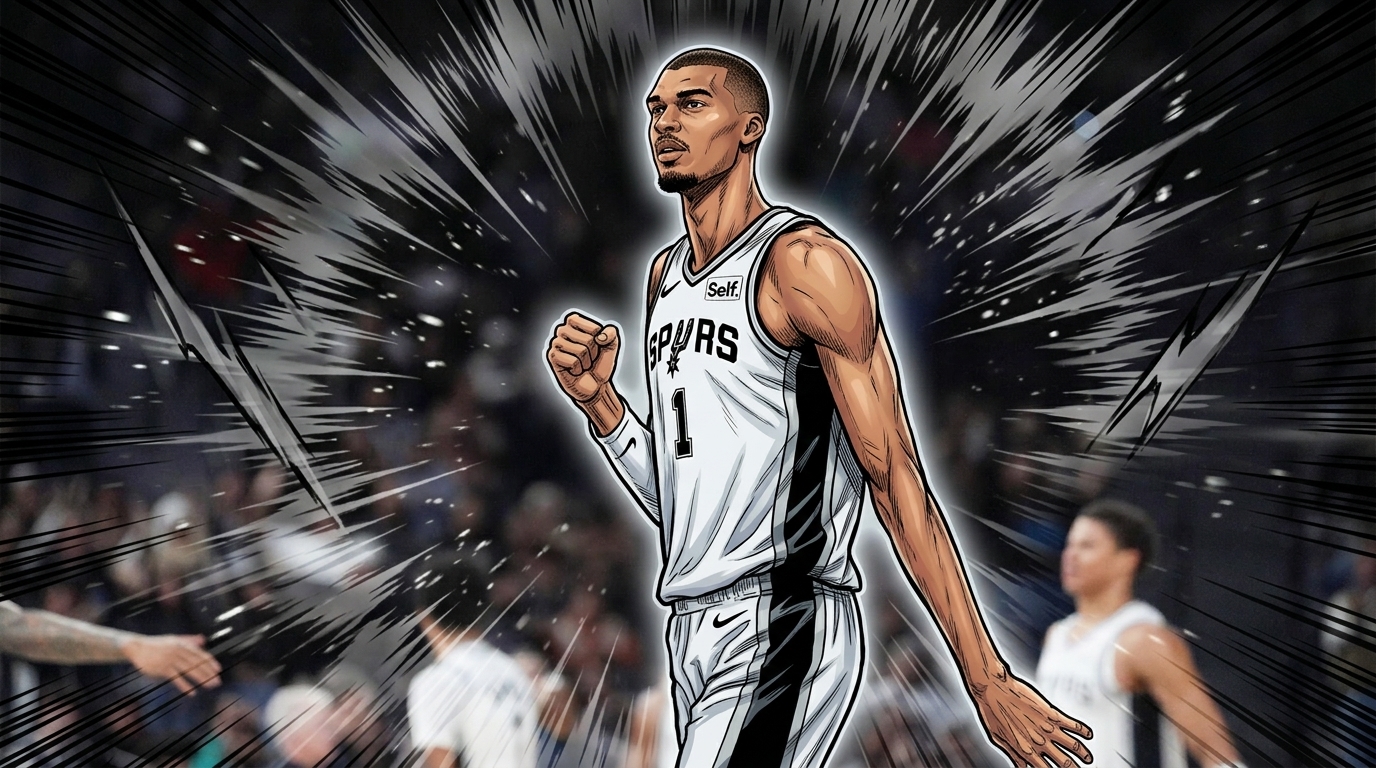
Game 1: 41 points, 24 rebounds, 3 assists, 3 blocks. The youngest player in NBA history to post 40+ points and 20+ rebounds in a playoff game. The context for what that stat line represents is staggering — that wasn’t a stat-padding effort in garbage time, that was two overtimes of Victor Wembanyama refusing to let the Spurs lose.
Game 2 was a comedown — 21 points, 17 rebounds, 6 assists, 4 blocks — but it’s worth understanding why, because the explanation is being underreported. Isaiah Hartenstein played 10 points, 13 rebounds, and 8 offensive rebounds against Wembanyama in Game 2. Eight offensive rebounds. Hartenstein physically wore on Wembanyama in a way that’s harder to see in a boxscore than a 40-point outburst. The Thunder won Game 2 in part because they found a counter-thread: not stopping Wemby, but grinding him down through physicality and second-chance possession work.
That’s a tactically smart adjustment. But it assumes Hartenstein can replicate that performance in San Antonio, in a building where the crowd will be electric, and in a game where the Thunder are now without their second-best player. The conditions that made the Hartenstein counter-thread possible in Game 2 were also partially downstream of OKC’s home environment and offensive rhythm. Wemby on his home floor, in front of his home crowd, carrying a motivation that borders on personal — that’s a different proposition.
Per ESPN, the “lil boy” comment has followed this series into every press availability since Game 1. Wembanyama hasn’t backed off it and hasn’t performed below it. That combination of rhetoric and production is, historically, not something that ages well for the team on the receiving end.
The Dylan Harper Variable
This is the thread that the WCF 2026 preview cycle underfunded, and it’s the one that may end up mattering most.
Dylan Harper is 20 years old. He was born March 2, 2006. He was filling in for De’Aaron Fox — who remains out with an ankle injury — when he posted 24 points, 11 rebounds, 6 assists, and 7 steals in Game 1. That’s not a young-player-has-a-moment performance. That’s a historical one. Per basketball-reference.com, Harper became only the second player after Magic Johnson to post 20-10-5 assists-5 steals in a single playoff game. In the conference finals specifically, only Larry Bird and Julius Erving had done something comparable before him.
The reason this matters tactically is specific. Pre-series, the Spurs’ offensive identity was almost entirely framed around what Wembanyama can do. That framing was accurate when Fox was healthy — the Spurs were essentially a two-man band, and Fox’s absence looked like a significant liability. Harper’s emergence blows that calculus up. If Harper plays through his adductor soreness tonight — he’s listed as questionable heading into Game 3 — San Antonio may actually have a more dangerous offensive alignment than anyone predicted entering the series.
Think about what that means for Oklahoma City’s defensive assignments. Wembanyama as the primary threat is a known problem with some structure to the solution. Wembanyama as the primary threat and Dylan Harper operating as a live secondary creator running point, capable of the kind of 20-10-5-5 game that puts him in Bird and Magic company — that’s a different defensive problem entirely. The Thunder can’t build their rotation around taking away one thing when both things are capable of destroying you.
Harper being questionable introduces its own uncertainty. If he’s compromised or unavailable, the Spurs’ offensive calculus reverts to the Wemby-primary model and Oklahoma City’s defense gets simpler. But if he plays, and plays anywhere near Game 1 form, the Thunder are facing the worst possible version of a Spurs team — maximum offensive complexity with the WCF 2026 Jalen Williams injury on the other side removing the counterweight.
https://twitter.com/ShamsCharania/status/2057558888820380013
What to Watch in Game 3
Three things will tell the story of this series over the next 48 hours.
First: Ajay Mitchell’s minutes and efficiency. Mitchell starting for Williams is the tell. If Mitchell runs the pick-and-roll competently and keeps San Antonio’s defense honest, OKC’s system has enough elasticity to stay competitive. If he struggles, SGA’s defensive attention doubles and the Thunder’s offense narrows to something that a motivated Wembanyama can more easily stifle.
Second: Hartenstein’s physicality against Wemby, road edition. Can the counter-thread translate out of OKC’s building? Hartenstein posted 8 offensive rebounds in Game 2 in an environment where the crowd and the rhythm were in the Thunder’s favor. In San Antonio with a Frost Bank Center crowd primed after Game 1, running the same physical wear-down game against a fresher, more motivated Wembanyama is a much harder assignment. Watch the rebounding split and watch Wemby’s touch shots — those tell you how much the physicality is registering.
Third: Harper’s first-quarter activity. If he’s healthy, Harper will telegraph it within six minutes. His Game 1 performance wasn’t accumulated gradually — he was active, attacking, and engaged from the opening possessions. If he comes out passive or limited, that tells you the adductor is a real issue. If he comes out in Game 1 mode, the Thunder have a serious problem that the WCF 2026 Jalen Williams injury has made significantly worse.
The pre-series analytical frame was built on two functional rosters with two dominant players meeting in a star-vs-star showcase. Shai Gilgeous-Alexander was the MVP. OKC was the -180 favorite. The series had a legible shape.
That shape has changed. Williams out means this is now a Thunder depth test against a Spurs team operating as a two-man freight train with an emerging third option. The series that was supposed to be a predictable showcase has become something harder to model — and the WCF 2026 Jalen Williams injury is the inflection point around which everything else now orbits.
I don’t know who wins tonight. That’s not hedging. That’s the honest assessment of a series that just became genuinely harder to predict.