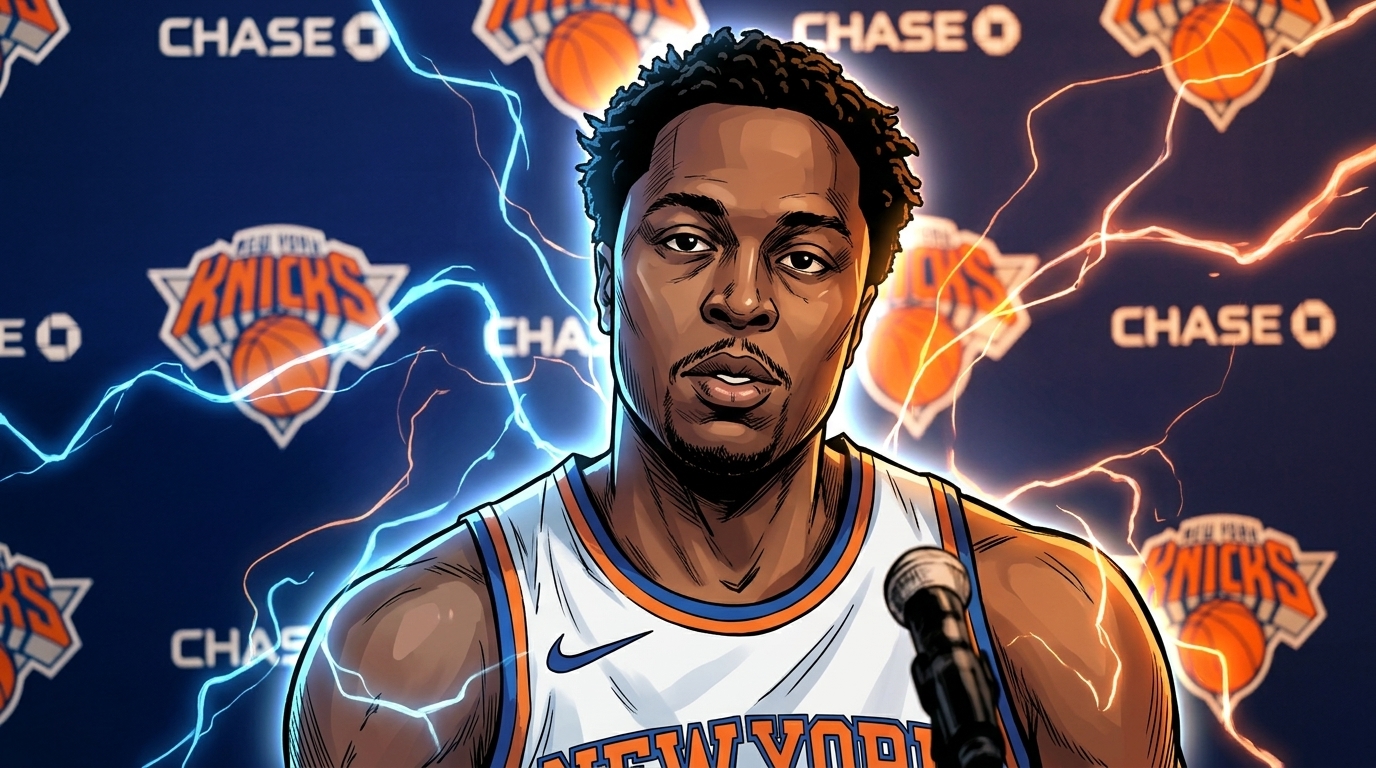

The funniest thing about the Skechers moment isn’t the shoe. It’s watching everyone decide, in real time, whether they’re allowed to care about it. I’ve spent two days watching sneaker Twitter oscillate between genuine awe and a specific kind of defensive irony — the “I was in on the joke before the joke stopped being funny” energy that signals a cultural consensus has just cracked.
The discourse isn’t about OG Anunoby and his SKX Reign “NYC Blue” PEs. It’s about the audience catching itself needing to update a decade-long bit, and not quite knowing how fast to do it. That’s the tell.
Because Skechers was the punchline. Not in a mean-spirited way, just in the way that certain things become consensus without anyone really voting on it. The Shape-Ups. The Dad Shoe. The mall anchor store that smelled like foam. You didn’t need to explain it; the cultural context was pre-loaded. And then, in Game 4 of the NBA Finals, OG Anunoby hit a game-winning tip-in with 1.2 seconds left. Thirty-three points. The largest comeback in NBA Finals history. All of it happening while he wore a pair of Skechers. Then the 53-year drought ended, and the first player in NBA Finals history to play in Skechers had a ring.
https://x.com/nicekicks/status/2066416062128927203
NiceKicks flagged it immediately, and the coverage spread fast. What surprised me was the register of the surprise. People weren’t just noting the trivia. They were recalibrating something.
Here’s what I keep coming back to: Skechers re-entered performance basketball in October 2023. They signed Joel Embiid. OG signed in July 2025, after he’d already established himself as one of the better two-way wings in the league. This wasn’t a desperation signing from a brand trying to buy relevance. It was OG making a quiet bet that brand legitimacy in basketball no longer worked the way everyone assumed it did. He was right, and he has a ring to prove it.
Nike controls more than two-thirds of NBA players. Jordan is prestige. Adidas is the culture bet, the streetwear adjacency, the residue of a decade’s worth of hype co-signs. And Skechers was, until very recently, the answer to a trivia question nobody wanted to be asked. What OG Anunoby did, not by accident and not as a punchline but by averaging 19.5 points and 6.6 rebounds across an entire playoff run, is force a renegotiation of what that hierarchy actually means. The OG Anunoby Skechers NBA championship didn’t fit the script, and now the script has to change.
The Game 3 shoe was the SKX Reign “Foreman,” Timberland-adjacent, NYC work boot DNA, which reads as either very deliberate or very lucky depending on how charitable you’re feeling about Skechers’ marketing team. The Game 4 shoe was Knicks blue and orange, a PE that looks, honestly, kind of great. OG is nearing a personal logo trademark he was already wearing on the Finals sneakers. Sportico reported it quietly. The sneaker community mostly ignored it until the ring changed the math. That’s not a punchline. That’s a brand arc playing out in public while nobody was watching.
Martha Stewart posted about it on Instagram. That either confirms the brand is squarely in dad-shoe territory, or confirms that the culture has flipped so completely that dad-shoe territory is now interesting again. I genuinely don’t know which. I’m not sure the distinction holds anymore.
What I keep thinking about is how brand legitimacy in basketball has always been downstream of winning. Jordan built the Jordan brand by winning. Kobe’s Nike line survived everything because he kept winning. The mechanism isn’t mysterious. But Skechers winning feels different because the premise was that Skechers couldn’t win, not because of the shoe’s performance specs (which are apparently fine) but because of what the brand meant in the cultural imagination. OG didn’t ignore that meaning. He signed anyway. And now the Finals MVP conversation is happening in Knicks blue and orange while Skechers SKX Reigns sit in a display case somewhere.
The real question isn’t whether Skechers is legitimate now. Rings make you legitimate. The question is whether the decade-long consensus about what “legitimate” looked like was ever anything more than an inherited assumption nobody thought to check. Sneaker culture has brand hierarchies the same way any culture has received wisdom — absorbed, reinforced, rarely interrogated. OG Anunoby interrogated it by simply not caring about it, and the consensus cracked.
I don’t think this is the end of Nike’s grip on the league. I don’t think Skechers suddenly becomes the aspirational brand for the next generation of kids who want to be OG. I’m not even sure this matters in five years. But right now, in the weird 72-hour window after the OG Anunoby Skechers NBA championship closed out, with the first player in NBA Finals history to play in Skechers holding a ring, there’s something genuinely interesting happening. The punchline put a ring on it. None of us are entirely sure what to do with that.