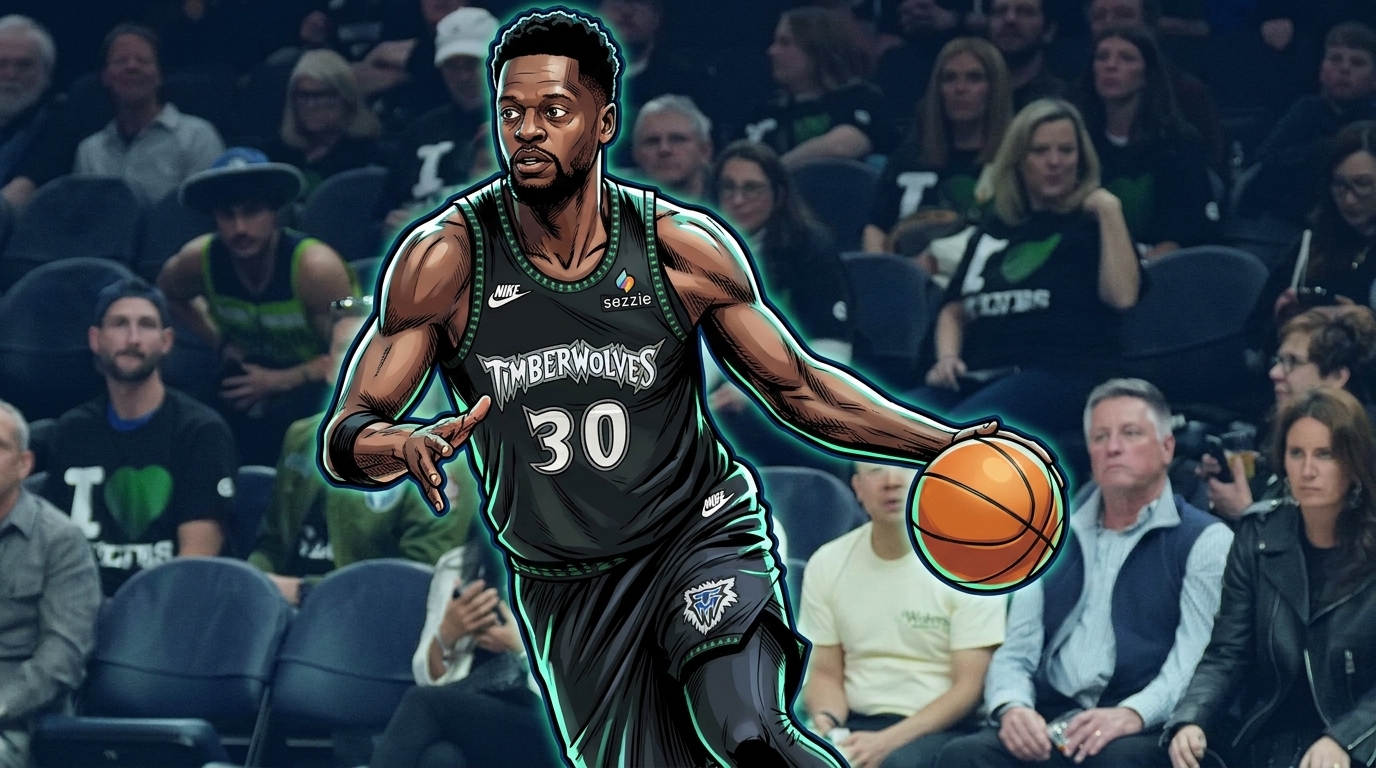

Minnesota traded Julius Randle to Brooklyn, received the 33rd pick in the draft, and somehow this is the correct outcome for everyone involved except Julius Randle.
The trade mechanics are straightforward enough. Wolves sent Randle and the 28th pick to the Nets; Brooklyn funneled Nic Claxton to Chicago in a companion move; Minnesota walked away with cap relief that is either massive or embarrassing depending on how much you paid attention this season. The Timberwolves Randle trade cap space 2026 number lands at roughly $36 million cleared, plus a $33.3 million traded player exception — currently the largest in the NBA — plus immediate re-entry into non-taxpayer MLE territory. The franchise is now approximately $50 million below the first apron. Kevin O’Connor’s read on the whole thing: “Oof Minnesota wanted off Randle BAD.” That’s about right. The Wolves paid a guy $33 million a year and spent the entire playoff run wishing he wasn’t on the damn floor.
https://x.com/ShamsCharania/status/2069242201641517467
Think of the luxury tax not as a penalty but as a building code. The league writes it, teams violate it, and the punishment arrives slowly and bureaucratically — repeated dollar-for-dollar assessments, repeater tax thresholds, restricted roster flexibility — until the building is genuinely uninhabitable. Minnesota had been adding floors without permits. Randle’s contract ran $33.3 million for 2026-27, with a $35.8 million player option behind it; combined with Anthony Edwards’s supermax and Rudy Gobert’s remaining years, the Wolves were staring at a structure that would eventually fail inspection. The trade is the front office filing the variance before the city showed up.
What makes this philosophically interesting rather than merely transactional is the Ayo Dosunmu contract attached to it. Minnesota locked him up for five years and $112 million on the same day it unloaded a 31-year-old who shot 39 percent against the Spurs in the playoffs. Dosunmu had a 43-point bench game in the first round, then managed 9.4 points on 36 percent shooting in five games against San Antonio while nursing a calf injury, per CBS Sports. Cap analyst Yossi Gozlan called the whole package “the prelude to something bigger.” That framing is either optimistic or ominous; the Timberwolves Randle trade cap space 2026 math genuinely supports both readings. You have freed enormous flexibility and then immediately committed $112 million to a player whose playoff ceiling remains genuinely unknown.
The deeper logic here — and it is actual logic, not the post-hoc rationalization franchises usually dress up as strategy — is that Minnesota has correctly diagnosed what it cannot afford. The NBA is a sport where the teams that know their limits consistently beat the teams that pretend otherwise. The Wolves paid Randle to be their star and discovered he was not; paying him $69 million across two more years to confirm that assessment would have been the kind of institutional stubbornness that defines the middle franchises permanently. Instead they absorbed the embarrassment early, while they still have time. You can set this against the broader NBA offseason chaos and the Wolves look like the one front office that actually updated its model when the data changed.
The building code metaphor holds because these decisions always look worse in the moment than they do in retrospect. The permit you pull to fix the foundation is not a story about the foundation being good; it is a story about the alternative being worse. Minnesota has the non-taxpayer MLE back, the traded player exception in its pocket, and no Julius Randle on the books — which is the same as saying it has options. Compare that to the Giannis-to-Miami noise and you understand why flexibility is worth paying for in embarrassment: every team bidding for a superstar is making this same calculation, and the ones without the cap room to act on it will spend the next three offseasons explaining why they stayed patient.
Brooklyn, for its part, received a former All-Star who shot 39 percent against the Spurs. The Nets know exactly what they’re doing, and what they’re doing is collecting picks and contracts and turning them into draft capital; Randle is inventory, not a cornerstone. He may thrive there, freed from a role that didn’t suit him. That would be a fine story. It has nothing to do with whether Minnesota made the right call, which it did.
The rational front office, in the NBA, is the one that recognizes the moment it stops being rational to hold on. Minnesota found that moment on a Tuesday in June and acted accordingly. The building code citation is already filed.