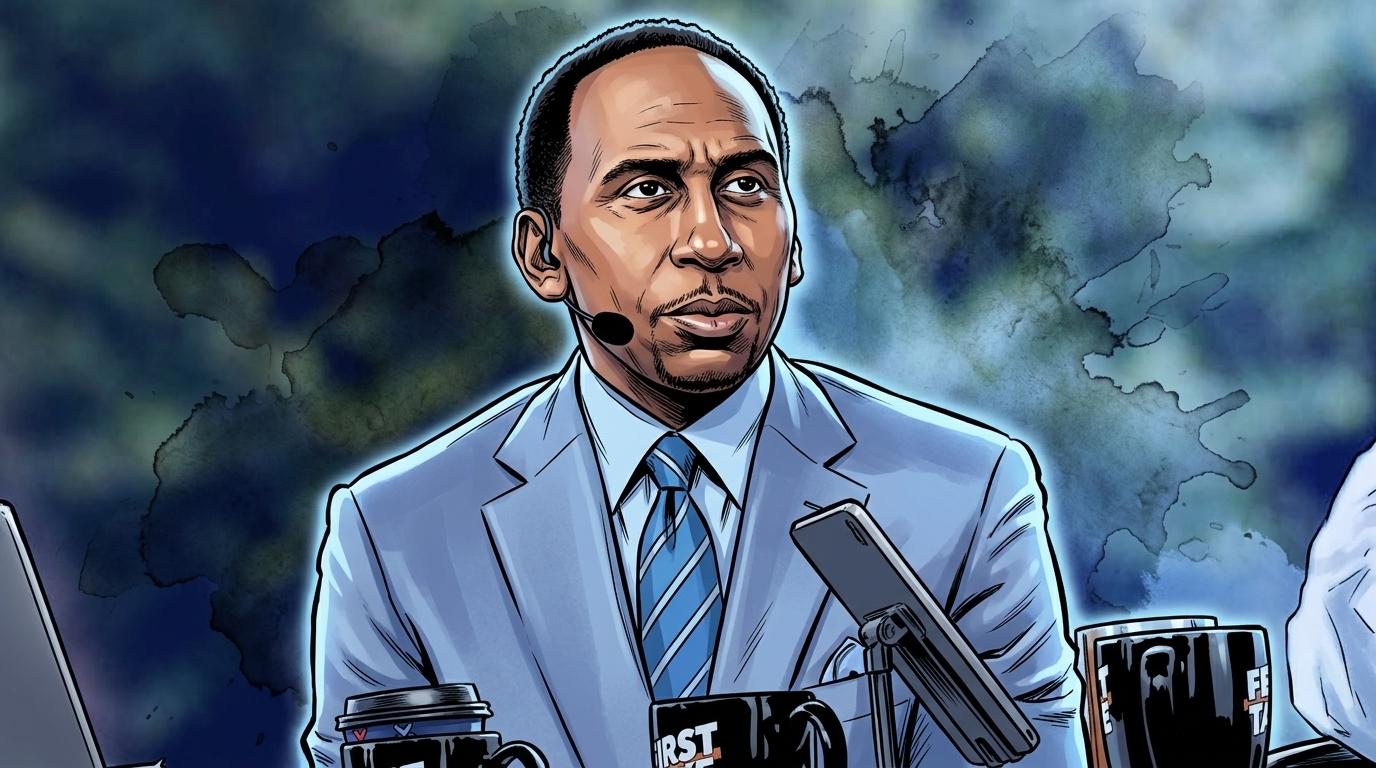

Stephen A. Smith just won an award from the National Association of Black Journalists for being chronically insufferable toward Black women in public life, and his acceptance speech, delivered days later on Sean Hannity’s show and not to NABJ, was a vow of revenge. This is, somehow, the single most predictable outcome available to either party.
NABJ handed out its 2026 Thumbs Down honors on August 16 at the Salute to Excellence gala inside Atlanta’s Marriott Marquis, putting Smith’s face on the ballroom’s screen while reading the charge aloud: he had established, the citation read, “a recurring public pattern of disparaging commentary directed at prominent Black women across politics, sports, and media” that “reinforces harmful narratives” and “undermines the fair and respectful representation of Black women in public discourse.” That’s a specific complaint about a specific pattern, and it’s worth weighing against how differently the media treats the Black women he’s talking about.
NABJ is not a rival network or a cable-news competitor; it’s the professional community Smith has claimed as his own for most of his career, and it just told him, in front of a room full of Black journalists, that he’d broken its rules. That’s why this story has outrun the usual forty-eight-hour Stephen A. controversy cycle. NABJ turned an outside-media dispute into an argument over who inside Black journalism gets to set the terms of respectability, and Smith is answering from outside the room entirely.
Picture the gala as the family reunion where the elders hand out both trophies and reckonings, the institutional cousin of an aunt pulling you aside at the cookout to tell you your mouth has been a problem since 2019. NABJ played the aunt role formally, with citation language and a giant screen. Smith responded like a nephew who got pulled aside at the cookout and decided, instead of hashing it out with his aunt, to drive across town and complain to the neighbors.
The neighbors, in this case, were Sean Hannity’s audience, which has no stake in NABJ’s standards and no reason to weigh the citation’s merits at all. Smith told Hannity, “I think it’s utterly ridiculous; I was raised by five black women,” which answers a question nobody at the gala asked. NABJ’s complaint was never about his upbringing. It was about a pattern of commentary toward specific public women, and Smith met a pattern allegation with a biography.
Smith’s own statement, posted to X the night of the gala, made the neighbors-not-family strategy explicit before Hannity ever entered the picture:
https://twitter.com/stephenasmith/status/2088835965217644854
The strangest part of that post isn’t the threat; it’s the framing. NABJ “wants to call folks out,” Smith wrote, as though issuing a citation for a documented pattern were an ambush and not the stated function of an award literally named Thumbs Down. He isn’t disputing the process. He’s promising a rematch, against opponents he hasn’t named, on a stage he hasn’t booked, sometime after he’s done “shutting his mouth for years,” his words, about a man who hosts four hours of opinion television a day.
None of this happened in a vacuum. NABJ’s patience had already been thinning since the fall of 2025, when Smith criticized Rep. Jasmine Crockett’s Capitol Hill rhetoric and drew pushback from NABJ vice president Roland Martin. Smith apologized then, which makes this month’s Hannity appearance the apology tour he already ran once, except this run doesn’t end in an apology. It ends in a promise to identify who “REALLY” deserves the award instead, capital letters his.
The sharpest read on any of this didn’t come from Fox News or ESPN’s own publicity shop. It came from Word in Black columnist Joseph Williams, who put it plainly: Smith vowed revenge, and did it on white media. That’s the detail that makes this an intra-community fight rather than the usual outside-critics pile-on. The harshest criticism of Smith’s response came from Black media, and Smith took his rebuttal straight to Sean Hannity, skipping every Black platform he’s had access to for years. Even NABJ’s own gala crowd wasn’t unified; attendee Ameshia Cross called the whole spectacle “messy for no damn reason,” which suggests the real argument is Black media arguing with itself about whether to hold one of its highest-paid members accountable, while the same ESPN platform that pays him to say things like this keeps cutting checks regardless.
Smith wasn’t the only name on this year’s list. The Washington Post, CBS News, FCC chairman Brendan Carr, and Circle City Broadcasting’s DuJuan McCoy all picked up Thumbs Down awards at the same gala, but Smith turned his into a serialized threat, and two years ago, he hosted First Take from NABJ’s own stage without incident.
The most Stephen A. Smith outcome imaginable was always going to be this one. An organization built partly to hold Black media accountable to itself handed him a formal, footnoted rebuke, and he responded not by naming a single name but by promising, eventually, to file his own citation against people he hasn’t identified, on a network none of them would call home. NABJ wanted a reckoning. What it got, for now, is a hold-music version of one: Christmas, arriving early, with nothing under the tree yet.