
The most revealing thing about the Stephen A. Smith apology tour isn’t that it happened; it’s that it worked exactly the way it was supposed to.
Smith went on First Take the Monday after the clincher and said what you say when the receipts are undeniable: “I owe this man an apology. I am grateful for what you’ve done for this city… you won’t be hearing any doubts from me anymore, my brother.” He also said, with apparent sincerity, that “national television owes this man an apology.” There is every reason to believe Smith meant it. There is also every reason to understand that sincerity is not the point. The machine doesn’t care whether the operator believes the output. It cares whether the output generates engagement, and a heartfelt public apology from the sport’s loudest voice generates engagement at the same rate as the take that required the apology in the first place. This is not a bug. It is the operating system.
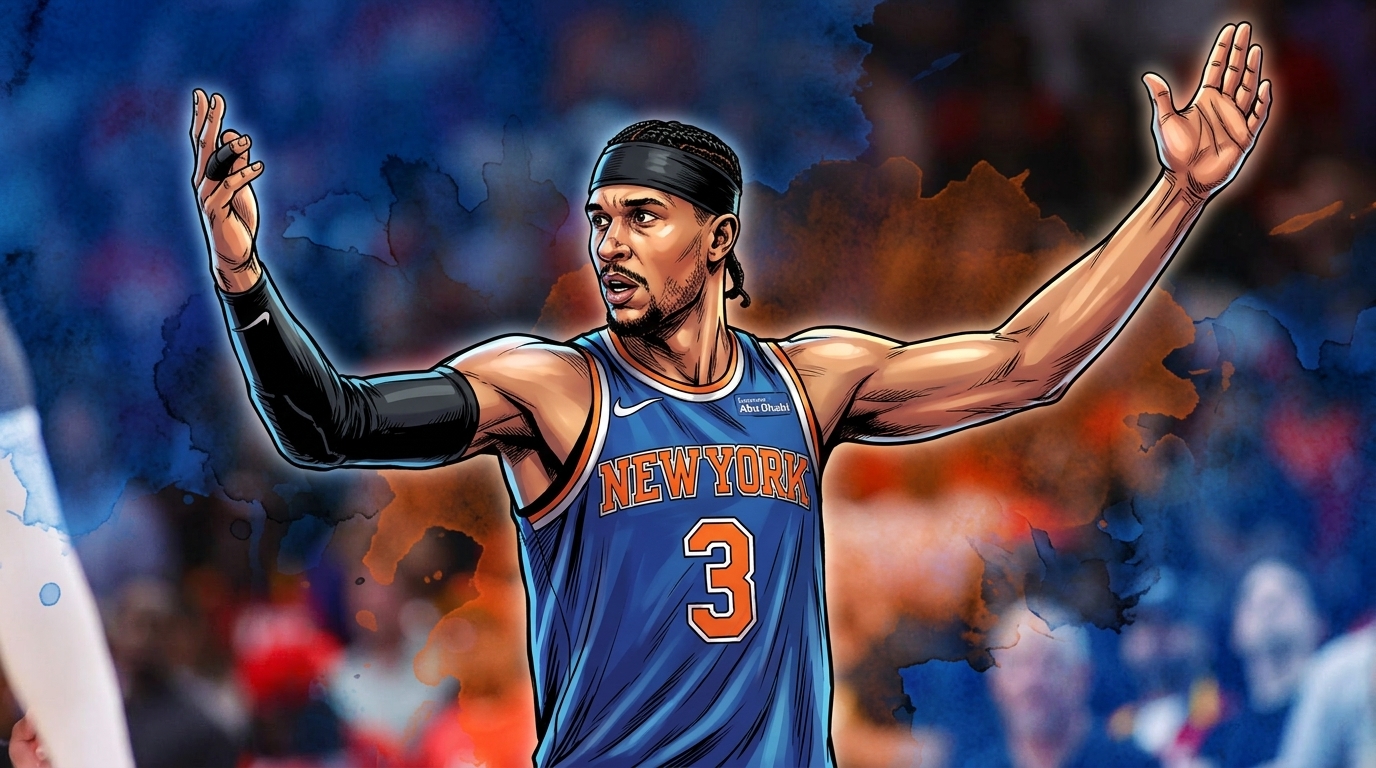
Consider how the cycle actually runs. The machine ingests a player — in this case, Jalen Brunson, unanimous Finals MVP, author of 45 points in the Game 5 clincher, only the fourth second-round pick in NBA history to win a Finals MVP. It does not ingest the player neutrally. It ingests him as a question: Is he real? The question generates takes; the takes generate debate; the debate generates clicks. When the Knicks lost Game 3 to San Antonio and Smith declared that Brunson was “playing to be an MVP rather than playing to win,” that was not independent analysis. That was the machine producing content at the moment when doubt was maximally valuable — when the series tightened and the audience needed something to argue about at 10 AM on a Tuesday. The machine is indifferent to whether the doubt is warranted. It is never indifferent to whether the doubt is timely.
Brunson did not take the gracious exit. He easily could have: a smile, a “thank you, I appreciate it,” and everyone moves on clean. Instead he looked at Smith and said, “We’ll see about that.” At the championship parade he put it cleaner: “When you prove them wrong, you don’t have to say s*** to them.” Both quotes are correct. Both quotes are also, from the machine’s perspective, content. Brunson clapping back instead of accepting the apology didn’t embarrass Stephen A. Smith. It gave him another segment.
https://twitter.com/LegionHoops/status/2066590090525368754
The particularly elegant part of this arrangement is that nobody loses credibility when the machine is wrong; the machine gains engagement. Smith’s Brunson takes were never fundamentally about being correct. They were about keeping the name trending, making sure the NBA Finals mattered as a discourse event before the first tip-off, ensuring that anyone with a casual interest in basketball had a position to hold going into Game 1. The Stephen A. Smith apology is the system accidentally showing its own operating manual: be wrong in a memorable way, generate the viral moment, apologize publicly, generate another viral moment. Brunson won the title and won the argument. The argument was never designed to be won permanently. It was designed to restart.
Smith had said, with full confidence, that Brunson would be “the reason why the Knicks don’t win an NBA championship.” The Knicks went 16-3 in the playoffs with a point differential of plus-283. They ended a 53-year drought. Brunson averaged 32.6 points per game in the Finals and broke Willis Reed’s single-game Finals record, which had stood since 1970. None of this retroactively makes the original take stupid in the way it makes you stupid to be wrong about something you actually investigated; it makes the original take exactly what it was designed to be — a stake in the ground that could be defended or retracted depending on what happened next. The machine is not embarrassed by being wrong because the machine does not experience embarrassment. It experiences viewership.
Come October, when extension talks begin and someone questions Brunson’s max contract number, the machine will have a new Brunson take ready. Stephen A. Smith will deliver it with sincerity. Everyone will watch. And somewhere in Columbus, I’ll be watching too, fully aware of how the whole thing works, clicking play anyway.