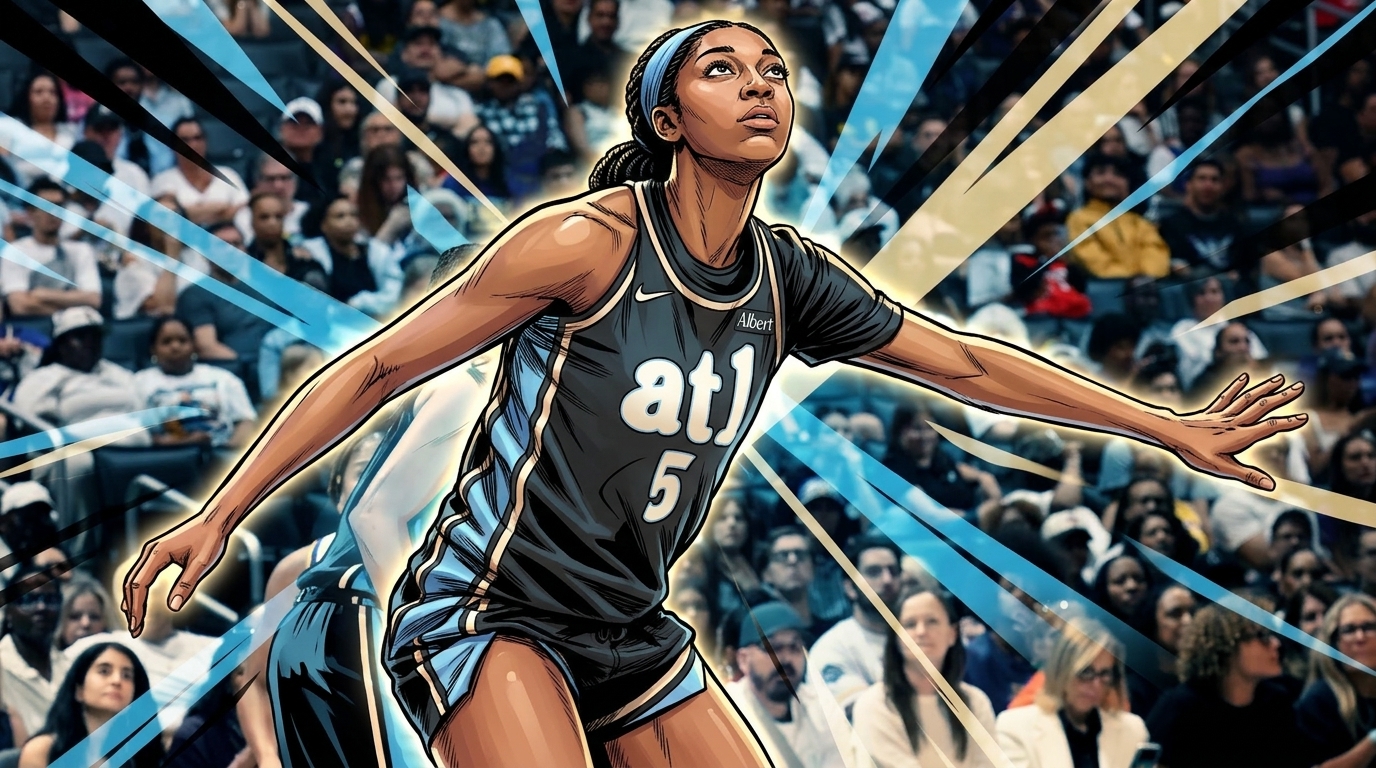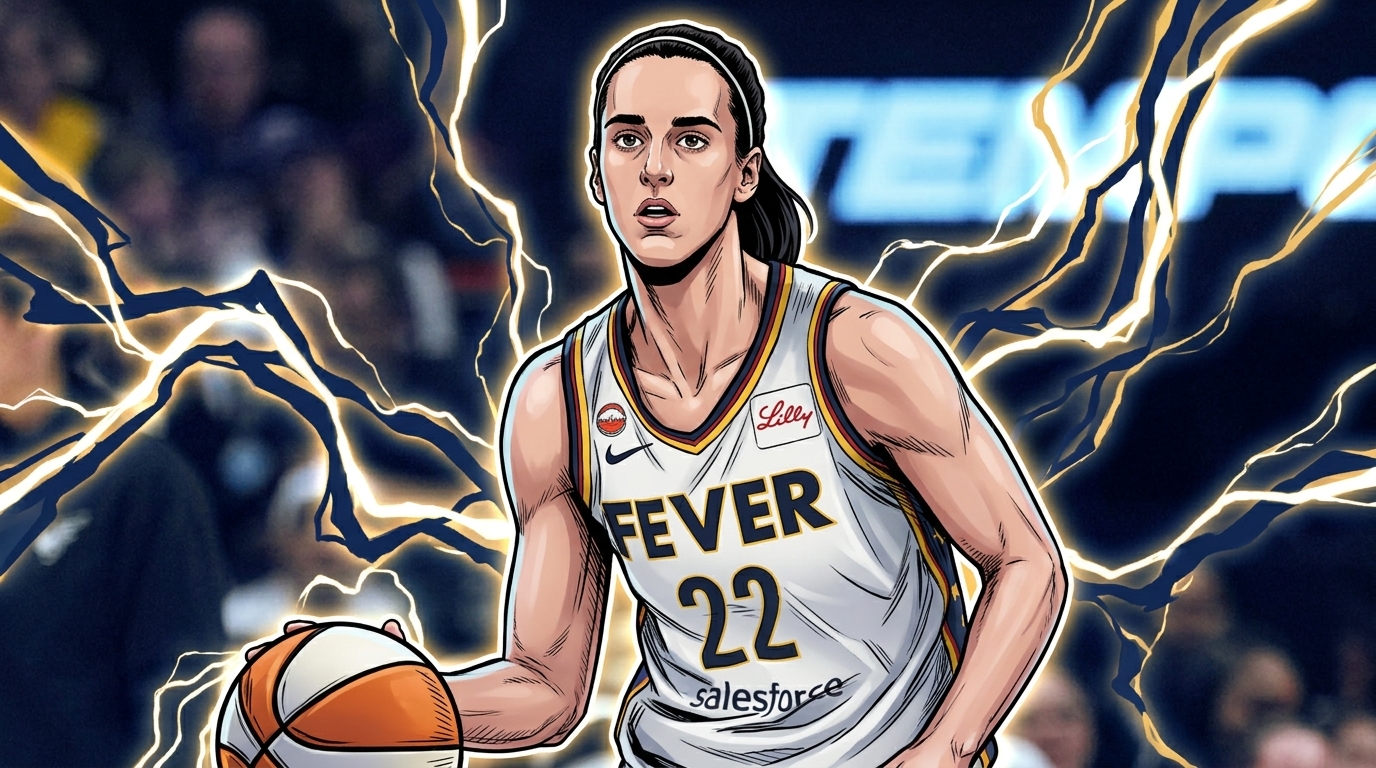

Here is what we need to establish before anything else: A’ja Wilson is the best basketball player in the WNBA, and on Thursday night she dropped 32 points and 9 rebounds to drag the Las Vegas Aces out of a regular-season series sweep for the first time since 2018. The Aces won 99-84 over the Dallas Wings. Wilson shot 12-of-21 from the field, 8-of-11 from the line, and did it against a Wings team that had beaten them by 30 points ten days earlier. None of that is particularly disputed. What is disputed — or more accurately, what goes largely undiscussed — is what it means that this performance will generate roughly one-fifth the media oxygen of Caitlin Clark’s box score from the same night.
That ratio is not an accident. It is a structural feature of how WNBA coverage works in 2026, and it is worth understanding clearly.
Is A’ja Wilson the Best Player in the WNBA?
A’ja Wilson is the WNBA’s most decorated active player, averaging a league-leading 25.6 points, 9.0 rebounds, and 2.2 blocks per game in 2026. She is a four-time MVP, three-time champion, and the fastest player in WNBA history to 6,000 career points — while generating a fraction of Caitlin Clark’s media attention.
The résumé case is not close. Four WNBA MVP awards — a record, no other player has won more than three. Three championships (2022, 2023, 2025). Two Finals MVPs. Three Defensive Player of the Year awards. And last season, Wilson became the first player in either the WNBA or the NBA to win a championship, the scoring title, the DPOY, the Finals MVP, and the league MVP in the same year. That sentence sounds like something someone invented to make a point. It is not invented. Per ESPN’s WNBA awards tracker, Wilson reached 6,000 career points on June 8, doing so in 278 games — thirteen fewer than Diana Taurasi, fifteen fewer than Breanna Stewart. Coach Becky Hammon put it plainly: “The expansion of her offensive floor game has made her virtually unguardable.”
Wilson herself frames it as a completeness project. “I take a lot of pride in it,” she said of her defensive approach. “It’s easy to be good on one side of the basketball, but can you be great on both? That’s what I strive to do every single day.” What she strives to do, empirically, is lead the league in both scoring and blocks simultaneously — which is the basketball equivalent of winning a Pulitzer for both fiction and journalism in the same year and then having people mostly want to talk about someone else’s newsletter.
The All-Star voting, at least, reflects reality. The first fan vote returns show Wilson leading with 308,249 votes. Clark is fifth with 253,602. This is the rare instance where the attention economy and the performance economy align — though it is worth noting that the All-Star voting reveals it clearly only because voting is quantified, which most attention is not.
https://twitter.com/WNBA/status/2067306940850381261
What the TV ratings are actually telling us is something more specific than “Clark is more popular.” The Aces-Wings game Wednesday drew 457,000 viewers on USA Network. Clark’s Indiana Fever against the New York Liberty drew 2.56 million on CBS, peaking at 3.02 million. A Fever-Toronto game on USA Network pulled 1 million. Even an Aces game without the Clark variable — Las Vegas against Minnesota on CBS — drew 872,000, nearly double what the elimination-game Aces pulled Wednesday. (The WNBA hadn’t had a seven-figure broadcast audience for 16 years before Clark arrived; the last comparable number was Candace Parker’s debut in 2008 at 1.07 million on ABC. The league spent sixteen years waiting for that to happen again, and it happened because of one player, which is either inspiring or concerning depending on your tolerance for single-point dependencies.)
The honest version of the two-lane argument is not that Clark’s coverage is undeserved — it is demonstrably earned by viewership — but that the structural effect of that coverage is to compress everything else into a narrower frame. Wilson’s 32-point, 9-rebound performance Wednesday was the kind of game that, in any other media context, would generate a legitimate national conversation about whether we are watching one of the five best players in the history of American professional basketball. Instead, it generated a recap and a handful of tweets from accounts that were already paying attention to the Aces.
The Wings, for their part, gave the Aces a real game before the wheels came off. Paige Bueckers put up 25 points on 11-of-19 shooting — she is, to her credit, having a genuinely excellent rookie season — and Jessica Shepard added 22 points and 14 rebounds. Dallas cut the lead to 53-49 in the third quarter. Then the Aces, anchored by Wilson, simply played better basketball. Jackie Young added 20 points, 8 rebounds, and 6 assists, including a four-point play in the third that probably ended whatever drama remained. Chelsea Gray, in a detail that deserves its own paragraph and will not get one from most outlets, became the fourth player in WNBA history to reach both 4,500 career points and 2,000 career assists — finishing the night with 2,003 assists alongside 12 points and 9 dimes. (Gray is 33. She has been doing this quietly for over a decade. This is thematically appropriate for a piece about undernarration.) Cheyenne Parker-Tyus contributed 13 points and offered the night’s most quotable line to NBA TV: “We came in with the focus to kick their butts.” The Wings also shot 2-of-21 from three, which is the statistical equivalent of arriving to a gunfight having forgotten to load the gun.
The Aces, now 13-5, are still the most probable WNBA champion. They are also the team whose elimination game drew fewer viewers than a Fever road game against a Canadian expansion franchise. These facts coexist without contradiction. What they suggest is that the WNBA has developed, largely by accident, a structure in which its best team and its most decorated player exist in a separate attention lane from its most-watched product. The question this exact pattern played out during the NBA Finals raises is whether that separation is sustainable, and whether it ultimately serves the league’s interest.
There is a version of the argument that says it does not matter — that rising tides lift all boats, that Clark’s viewership numbers are a net positive for every WNBA player including Wilson, and that the league’s broader trajectory is more important than any individual distribution of media attention. That argument has real merit. It is also, conveniently, the argument that requires the least examination of how media ecosystems actually work.
The more uncomfortable version is this: when the WNBA’s best player goes for 32 and 9 in an elimination game and the conversation moves on without her, we have documented evidence that attention and excellence have been formally decoupled. Not because anyone made a bad decision, not because Wilson is doing anything wrong, and not because Clark’s coverage is unjustified. But because the machinery of sports media, once it has located its primary signal, tends to route everything else through that signal’s filter — and Wilson’s career, for structural reasons that have nothing to do with merit, does not pass through that filter particularly often.
The Commissioner’s Cup Final offered a preview of what happens when the lanes converge: a matchup involving both Aces and Liberty generates the coverage that Wilson’s individual performances rarely do. That is informative. The path to Wilson’s work getting the attention it warrants may run specifically through team matchups that force a convergence, rather than through any recalibration of the baseline coverage model.
What comes next: the Aces finished the regular-season series against Dallas 2-1 in the Wings’ favor, avoided the sweep, and will move forward as the team most likely to win the championship in September. Wilson will almost certainly score 25 or more points in the next game, and the one after that. And somewhere in that progression, there will be a moment — a milestone, a performance, a statistical marker — that demands the conversation engage with what Wilson actually is, which is the best player in the sport. The question is whether that moment generates a sustained recalibration or a single news cycle before the algorithm routes everyone back to the other lane. History, at this point, suggests the latter. Wilson keeps playing anyway. That, at minimum, is worth documenting.