
Start with the Instagram Stories post and you get the whole story in miniature. Before Spain beat Austria 3-0 in the Round of 32, Inés García posted “Volviii ❤️ 🇪🇸” from LA — she’d flown back from Spain after missing a group stage match at home, returned across the Atlantic, and was ready to do it all again. The followers kept climbing. She hit somewhere between 435,000 and 600,000 in a matter of weeks. Two months ago, she was a content creator from Seville with a respectable following. Now international outlets are running profiles on her, she’s doing interviews with HOLA, and the question of how she and Lamine Yamal met has become, apparently, a matter of public record.
I find myself thinking about what that transition actually costs. And who paid for it.
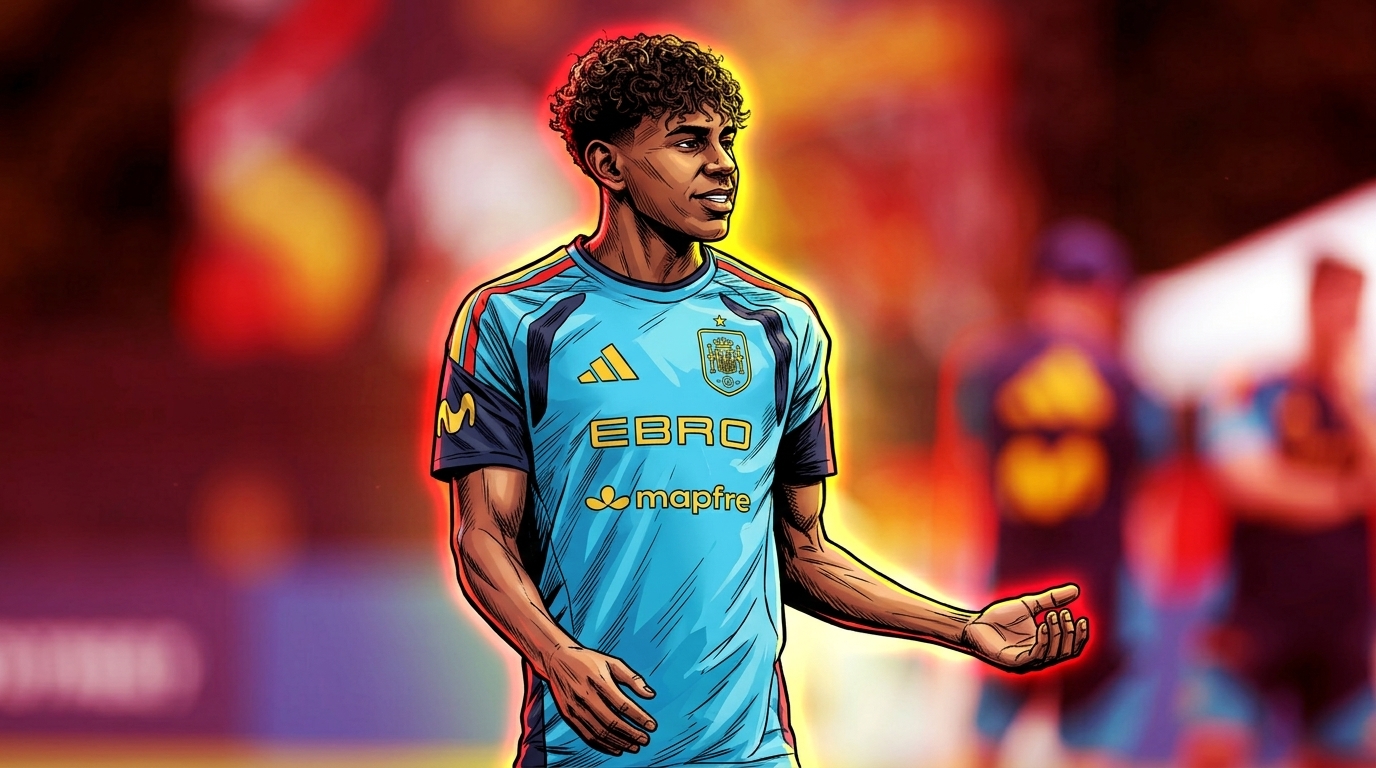
Yamal turns 19 on July 13, in the middle of this tournament. He scored 10 minutes into his first World Cup start, becoming one of the eight youngest scorers in the competition’s history. He had 16 goals and 11 assists for FC Barcelona this season. He is, without meaningful argument, the best player at this World Cup, and the machinery of sports attention is doing what it always does: it doesn’t stop at him. It radiates outward. It finds his phone, his family, the people he’s been photographed standing near in Greece. The relationship was first confirmed publicly at Barcelona’s end-of-season dinner in May. By July, García is fielding questions about it from the Spanish press and explaining, patiently, that they met on social media, not at an airport, as the rumors went. “I’d love to tell you a super crazy story,” she told HOLA. She can’t, because the real one is mundane. They slid into each other’s DMs. That’s it.
The gap between that private fact and its public appetite is the whole thing.
https://x.com/nypostsports/status/2072775614889660479
Here is the counterargument, and it deserves a fair hearing: García is a content creator. She chose that work. She dates a famous person. She flew to Atlanta, despite a genuine fear of flying she’s talked about openly, to attend the World Cup opener wearing his number 19 jersey. She posts about the experience. She does press. At some level, she participated in the system.
https://www.instagram.com/p/DZnlmM4kdBv/
That’s true. And it’s also not quite the point. The WAG economy, which I’ve been thinking about since the machinery started accelerating around this tournament, doesn’t really operate on consent or participation. It operates on adjacency. You don’t have to choose fame; you just have to be standing close enough to someone who has it. García’s follower count jumped by something like 130,000 to 300,000 in roughly two weeks, depending on which count you trust. Those followers didn’t come because she launched a campaign. They came because Yamal scored, and the cameras found his sideline, and an algorithm somewhere decided that knowing who he goes home to is part of knowing him.
https://www.instagram.com/p/DZ2ld_qkSip/
What’s interesting to me, and this is the part the “she chose this” argument tends to skip, is what that follower explosion reveals about the audience, not the subject. We want García because we want to complete the picture of Yamal. We want proof that the best player in the world is, at his core, a regular person who met someone on his phone. García said it herself: “The best player in the world is at 2,000,000%, and he’s also in good hands.” That phrasing is doing a lot of cultural work. It’s humanizing. It positions her, in the grammar of the WAG economy, as the person who holds the private self while the public self belongs to us.
This is exactly how Georgina Rodríguez described refusing the label: she’s spent years insisting she’s not a WAG, but the refusal itself became the story, which is its own kind of proof that the category doesn’t disappear just because you reject it. García, for her part, isn’t rejecting anything. She says she’s “just enjoying this World Cup experience.” The word “just” is doing the same humanizing work. It says: I am a normal person who happens to be here. The audience hears that and doubles down on its interest, because normal people in extraordinary situations are exactly what we want from this kind of story.
She turns 21 on July 9, three days before Spain’s next likely knockout match. She’ll probably post about it. The followers will probably jump again. The outlets will probably file something. The WAG economy is patient like that. It doesn’t require the subject to do anything dramatic. It just requires them to keep existing in the frame.
Whether García finds a way to shape that into something on her own terms is something I genuinely don’t know. Whether she joins the long line of partners who leveraged the moment into something that outlasted the tournament is an open question too. The mechanism that absorbed her doesn’t care either way. It just keeps running.