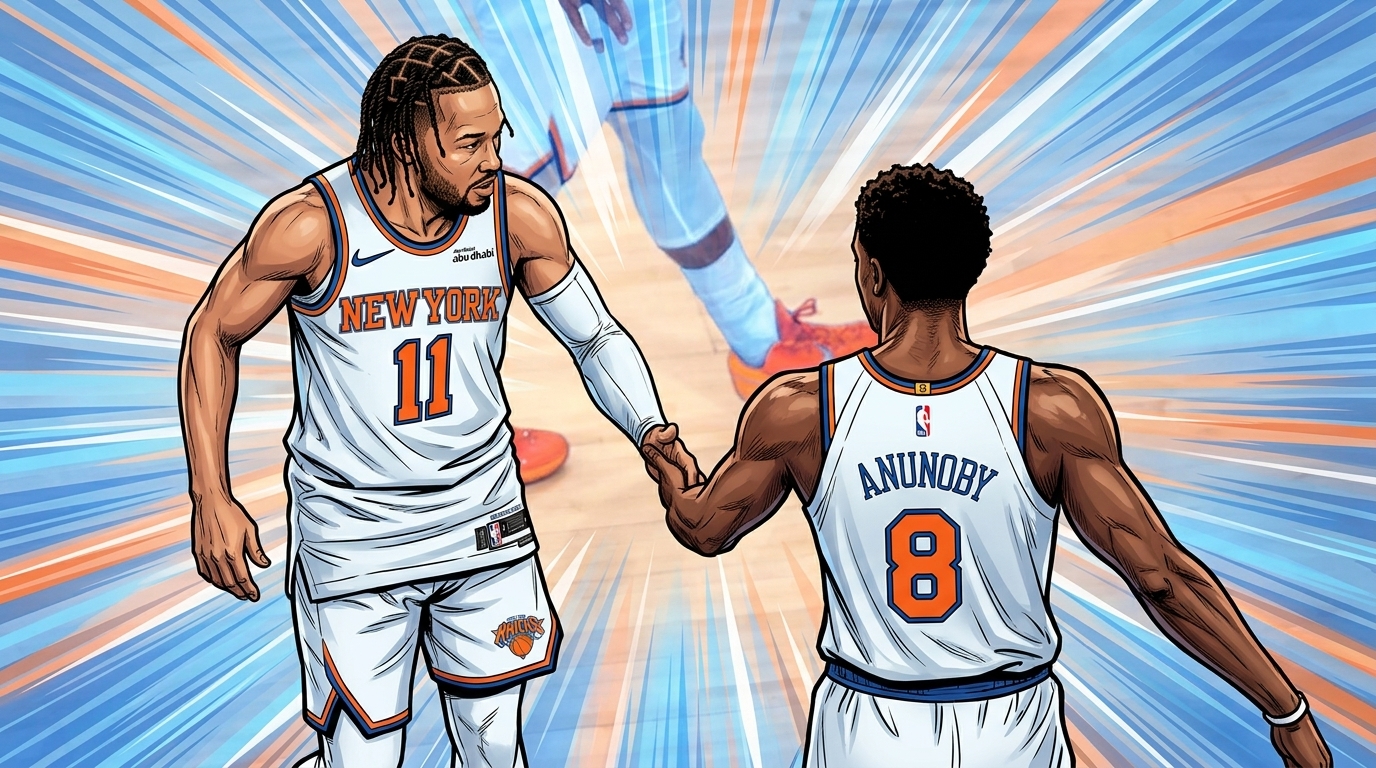

There’s an account on X called @OldTakesExposed, run by a guy named Fred Segal, whose entire value proposition is this: someone says something confidently wrong, the outcome proves it, Fred posts the receipt. It’s simple, it’s satisfying, it’s exactly the kind of thing sports Twitter was invented for. After the New York Knicks erased a 22-point fourth-quarter deficit to beat the Cleveland Cavaliers 115-104 in overtime on Monday night — Knicks ECF 2026 Game 1, Madison Square Garden, the largest comeback in franchise playoff history — @OldTakesExposed had a field day. There were radio hosts who’d mocked fans for buying tickets. There was a WWE personality named The Miz who’d said something ironic about curses. The receipts were abundant. The dunking was plentiful.
I kept thinking: the receipts are not the story. The receipts are never the story. The story is what it means that there are receipts to collect — that people were so certain the New York Knicks would crumble, so structurally committed to their failure, that predicting their collapse felt like stating a law of physics. That’s what 27 years does to a fanbase. That’s what James Dolan does to an identity.
The Knicks trailed 93-71 with 7:52 remaining in the fourth quarter of Game 1 of the Eastern Conference Finals. Jalen Brunson, who finished with 38 points, scored 17 of them in the final 12:49 of regulation and overtime. The team ran a 44-11 burst through the closing minutes and OT. The win probability was 0.1 percent when the deficit peaked. One-tenth of one percent. Teams trailing by 22 or more in the fourth quarter of a playoff game were 1-594 in the play-by-play era before Monday night. This is a Knicks ECF 2026 comeback that will live in the franchise record books.
That’s the game. You can read our NBA coverage for more on the game. What I’m interested in is the gravity well around the game — the particular shape of the disbelief, the texture of the celebration, the way Spike Lee looked in the stands, the way Timothee Chalamet was photographed there in Celebrity Row like this was a fashion moment and a sports moment simultaneously, because at Madison Square Garden in the spring of 2026, apparently it is both. I’m interested in what it means that a city that has spent nearly three decades cultivating an identity around organized suffering is now being asked to update its self-image.
https://x.com/nyknicks/status/1927558564220121580
James Dolan has owned the New York Knicks since 1999 — the same year the franchise made its last Finals appearance, losing to the San Antonio Spurs 4-1 as an eighth seed, the lowest-seeded team in Finals history at the time. That 1999 team was the Patrick Ewing era’s last gasp. What followed is well-documented: the Isiah Thomas era, the coaching carousels that became almost elegant in their dysfunction, the famous ejections and lawsuits, the ban of Charles Oakley from Madison Square Garden in 2017, the reports of facial recognition technology being used to surveil critics at the arena. The dysfunction wasn’t incidental to the Dolan era. It was the texture of it. It was the thing Knicks fandom organized itself around.
There’s an argument, made with sincerity by Knicks fans and their chroniclers, that the team belongs to the city in a way that transcends the owner — that it functions as a salve when the community is hurting, an introduction when the community is fragmented, a shared reference point that Dolan cannot actually revoke regardless of how hard he tries. But there’s a version of that argument that has always let Dolan off the hook by sentimentalizing the suffering. If fandom is resistance, then the suffering is load-bearing. The suffering is how you prove you belong.
The last time the Knicks made a deep playoff run before this one was the 2012-13 season — a Conference Semifinals exit. In the years between, the irony-poisoned Knicks fan became a recognizable type. Not just a sports fan, but a person whose identity was built around the elaborate theater of hope-and-disappointment, around knowing the score before it happened, around being the person in the room who understood that wanting the Knicks to win was itself a kind of joke. There is a whole school of New York sports media that operates in this mode. It is very good at describing failure. It does not have a lot of practice with the alternative.
Which brings me to what I actually can’t stop thinking about. OG Anunoby returned from a hamstring injury and played in Game 1. Brunson said in the aftermath that the message in the huddle was simply “keep fighting” and “keep chipping away.” These are not remarkable quotes. They are the vocabulary of a team that believes in itself, which is unremarkable everywhere except in a place that has spent 27 years building an identity out of not-quite-believing.
The question I keep sitting with is not whether the Knicks can win the Eastern Conference Finals, though they lead the series 1-0 after Game 1. It’s not whether Jalen Brunson is one of the best players alive in a fourth quarter, though he appears to be. It’s: what does a Knicks fan become when the Knicks stop being a vessel for ironic suffering? When the organized humiliation of the Dolan era — still technically ongoing; the owner has not changed; the surveillance program presumably still exists — collides with a team that keeps winning in the most defiant ways imaginable?
What I’m watching in New York right now is a city in the early stages of a very uncomfortable identity renegotiation. The suffering was real. It was also useful. It gave people something to organize around. Now the possibility of genuine joy is on the table, and genuine joy is, culturally speaking, much harder to write about than losing.
Jalen Brunson hit shots with a 0.1 percent win probability. The crowd at Madison Square Garden fed something back into the players that turned into 44 points in less than eight minutes. That is a real thing that happened. The memory of 1999, the last time this building held a team with a plausible path to the Finals, is 27 years old. A lot of people watching Monday night weren’t alive for it.
I don’t know what the Knicks become if they keep winning. I don’t know what happens to an identity built on loss when the losing stops. I’m not sure anyone does. But I can’t stop thinking about @OldTakesExposed posting those receipts, and everyone laughing, and how the laughter had this particular quality to it — relief and vindication braided together in a way that only makes sense if the skepticism was never really about basketball at all.