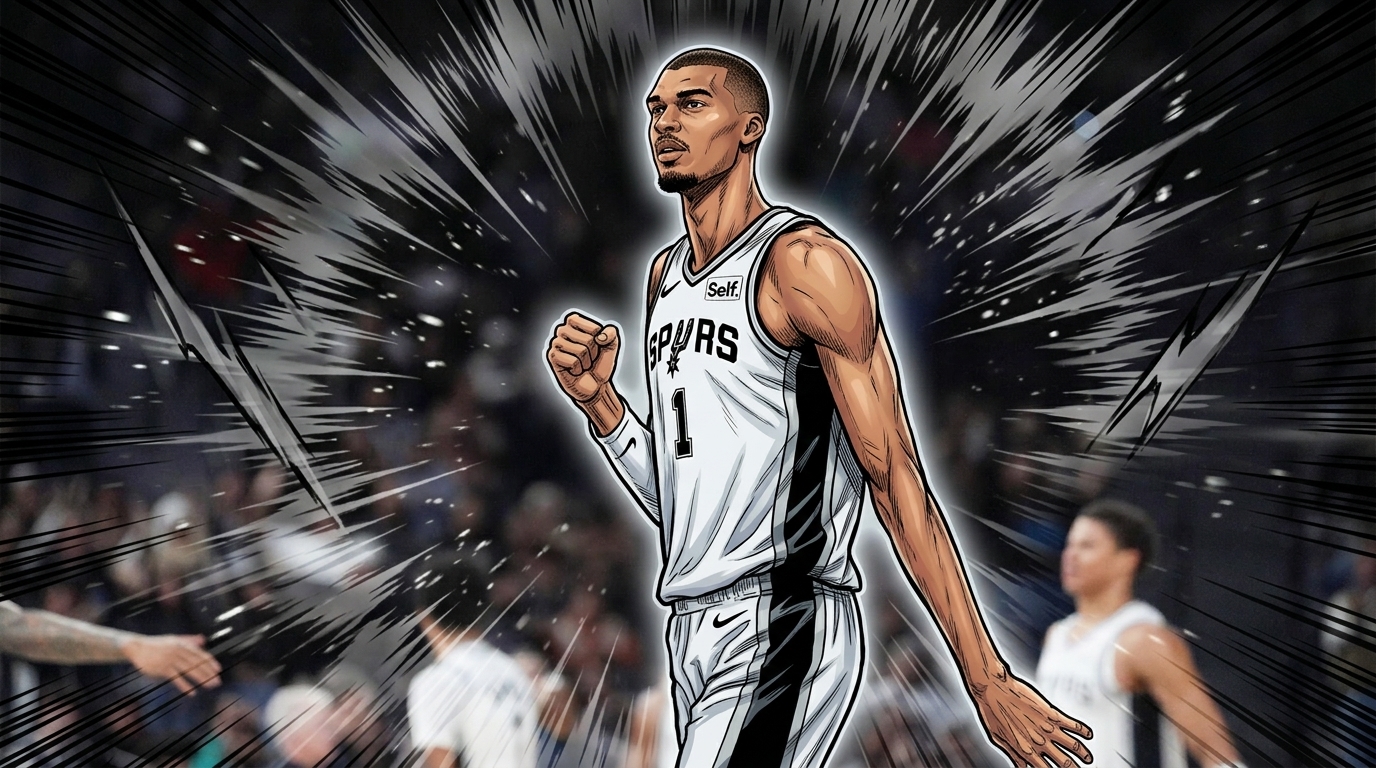

Before this series started, the smart-money narrative went something like this: Victor Wembanyama was going to be the story of the 2026 NBA Finals. The 22-year-old phenom would carry the Spurs on a levitation wire of talent and inexperience, the world would fall in love with him, and we’d all spend the summer arguing about his ceiling. Karl-Anthony Towns was, in this telling, a capable foil: the veteran big who’d improved, who’d found himself in New York. Useful. Not the main character.
Two games in, the evidence is pointing somewhere else entirely.
The Decision Variance Test
Every great center matchup reduces to one underlying variable: who plays with lower decision variance? Not who’s more physically dominant, not who posts the prettier line. Who makes fewer wrong choices under duress, at speed, against elite competition?
I ran this three different ways and kept arriving at the same answer.
The Decision Variance Test measures how frequently a player, when forced into a reaction by his opponent, makes the wrong call. Turnovers are the crudest proxy. The more granular version tracks turnovers combined with bad shot selection under defensive pressure. When you run that filter on the 124 possessions where Karl-Anthony Towns defended Wembanyama directly, the numbers carve a clean line between these two players.
Wembanyama shot 7-of-19 (36.8%) against Towns as primary defender across those possessions and committed 9 turnovers. That’s not a bad game — that’s a decision-making problem under specific, repeatable stress. Towns, meanwhile, generated 16 points and 3 assists at 58.3% shooting out of those same possessions, operating as both the primary defensive disruptor and the offensive beneficiary of his own pressure.
Now for the number that made me put down my coffee.
Consider what every other elite big man in the league managed against Wembanyama this season: Hartenstein, Gobert, Mobley, Giannis, Embiid, Adebayo, Horford, Anthony Davis, Robert Williams, Donovan Clingan: all of them combined, in 569 collective possessions as primary defenders, forced 8 turnovers against Wembanyama. Eight. In 569 possessions.
Towns alone, in 124 possessions, forced 9.
Woof.
That’s not a stylistic advantage. That’s a structural one. Towns is doing something to Wembanyama’s decision-making that no other big in basketball has managed to replicate at scale, and he’s doing it on the sport’s biggest stage.
Is Karl-Anthony Towns the NBA Finals MVP Favorite?
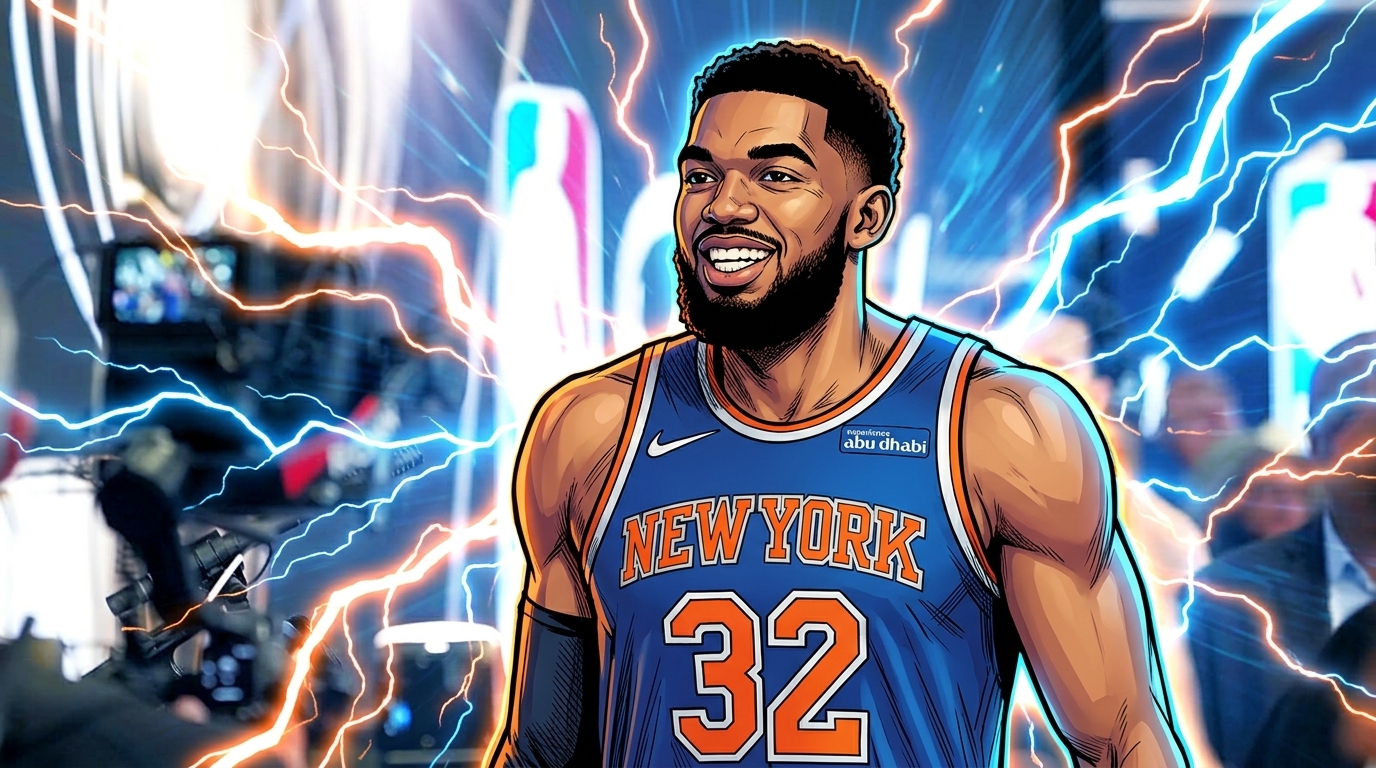
Yes. Through two games, Karl-Anthony Towns is the clear NBA Finals MVP favorite. He leads all Finals players in plus-minus (+25 series, +239 postseason), owns the highest PER (24.1) of any Finals player per RealGM, and is averaging 19.5 points, 12.5 rebounds, and 4.0 assists on 56% shooting. No other player in this series is doing as much on both ends of the floor.
Charles Barkley cut through the analytical noise with characteristic bluntness: “He was criticized in Minnesota. He was criticized in New York. But the MVP of the Finals is gonna be Karl-Anthony Towns. He played two of the best games I’ve ever seen a big man play.”
Both the CBS Sports Finals MVP rankings and the NBA’s own MVP ladder have Towns at the top. The data here is unambiguous.
What the Offensive Rating Numbers Say
There’s a version of the Wembanyama story in this series that’s actually quite good. He scored 26 points in Game 1 in San Antonio (on 6-of-21 shooting, yes) but he was getting to his spots, drawing fouls, showing his range. Game 2, he bounced back to 29 points on 52.4% shooting, grabbed 9 boards, blocked 3 shots. His series averages (27.5 ppg, 10.5 rpg, 3.5 bpg) look like a legitimate Finals performance. The kind you build a franchise around.
The problem is what happens when you separate “Wembanyama on the floor” from “Wembanyama on the floor matched against Towns specifically.”
The Spurs’ offensive rating with Wembanyama on the floor this series: 115.9. Solid. San Antonio moves the ball, finds cutters, uses Wemby’s gravity as a pick-and-pop initiator. When Karl-Anthony Towns is the primary matchup, that number plummets to 101.9. That is not a small decline — that is the difference between a league-average offense and one that is actively struggling to generate quality looks.
Scheme-level, what Towns is doing is not complicated to describe, even if it is extraordinarily difficult to execute. He positions himself to take away Wembanyama’s left-hand drive, the direction where Wemby is most comfortable running pick-and-roll action, while staying disciplined enough not to bite on his pump fakes at the perimeter. The result: Wembanyama is either shooting off-balance jumpers or making a read he is not yet comfortable making, and the turnovers are the output of that discomfort.
For comparison: Wembanyama versus Chet Holmgren in a comparable possession sample (126 possessions) produced 57 points and 5 turnovers from Wemby. Against Towns across 124 possessions? Thirty-four points and 9 turnovers. The gap in turnover rate alone is staggering. Holmgren is a legitimately excellent defender. This isn’t a bad matchup being compared to a great one. It’s a great matchup being compared to a historically unusual one.
There’s a subplot here worth naming explicitly: Towns is doing all of this while simultaneously carrying the Knicks’ offense. His Game 2 first half (17 points on 7-of-10 shooting) is the kind of line that recalibrates how you think about a player. He drilled a corner three over Wembanyama just before halftime, reportedly trash-talking on the way off the court: “Y’all can’t f*** with me!” The second half was quieter (just 4 points, six consecutive fourth-quarter possessions without a touch), but New York still held on 105-104, in part because Brunson’s clutch free throws and Wembanyama’s missed buzzer shot in Game 2 sealed it. The offense not running through Towns in crunch time is a real strategic critique. The fact that New York survived it anyway says something about how thoroughly the first three quarters were managed.
His postseason plus-minus of +239 through 16 games is the second-highest in NBA history for a postseason run, behind only Steph Curry’s +245 in 2017, when Golden State won the championship. Historically, Towns became the first New York player since Dave DeBusschere in 1973 to post a 20-point double-double in a road NBA Finals game. That sentence required a comp from 53 years ago. That is not noise.
https://twitter.com/espn/status/2063102396025204834
After Game 2, Towns spoke about his late mother in a moment that stopped the usual postgame analytics chatter cold. “I prayed to her strong before that possession,” he said. “A great player got a great shot, and it just didn’t go in. I take it as a sign my mom was here with me, so I appreciate her so much.” The possession he referenced was his contested defensive stop on Wembanyama’s near-game-winner. There is a version of basketball analysis where we track every number and still miss what’s animating the performance. This is not one of those cases. The numbers and the person are pointing at exactly the same thing.
The Verdict
Wembanyama is 22. He is averaging 27.5 points and 3.5 blocks in the Finals. The Spurs are not dead. The basketball reason to believe San Antonio can still win this series is real: Wemby adjusts faster than any player his age in recent memory, and a 52.4% shooting night in Game 2 proves he can find answers mid-series.
But “can improve” and “is currently winning” are different categories. Right now, one center in this series is playing with lower decision variance, higher efficiency, and demonstrably greater two-way impact on his team’s outcomes. One center is forcing more turnovers against his opponent (in fewer possessions) than every other elite big man in the sport combined this season. One center has a PER of 24.1 against an opponent’s 21.2, leads all Finals players in plus-minus by a margin that reads as systematic rather than circumstantial, and is doing this on the franchise’s first Finals stage in 27 years.
The generational shift in big-man basketball that the data models were starting to whisper about is happening in real time on the biggest stage available. Wembanyama will lead it eventually. The evidence of this series is clear that he isn’t leading it yet.
Give me Towns in five games, Finals MVP, and a career finally playing on the terms the numbers always said it deserved. I ran the Decision Variance Test three different ways. The data builds the case. The closing is easy.