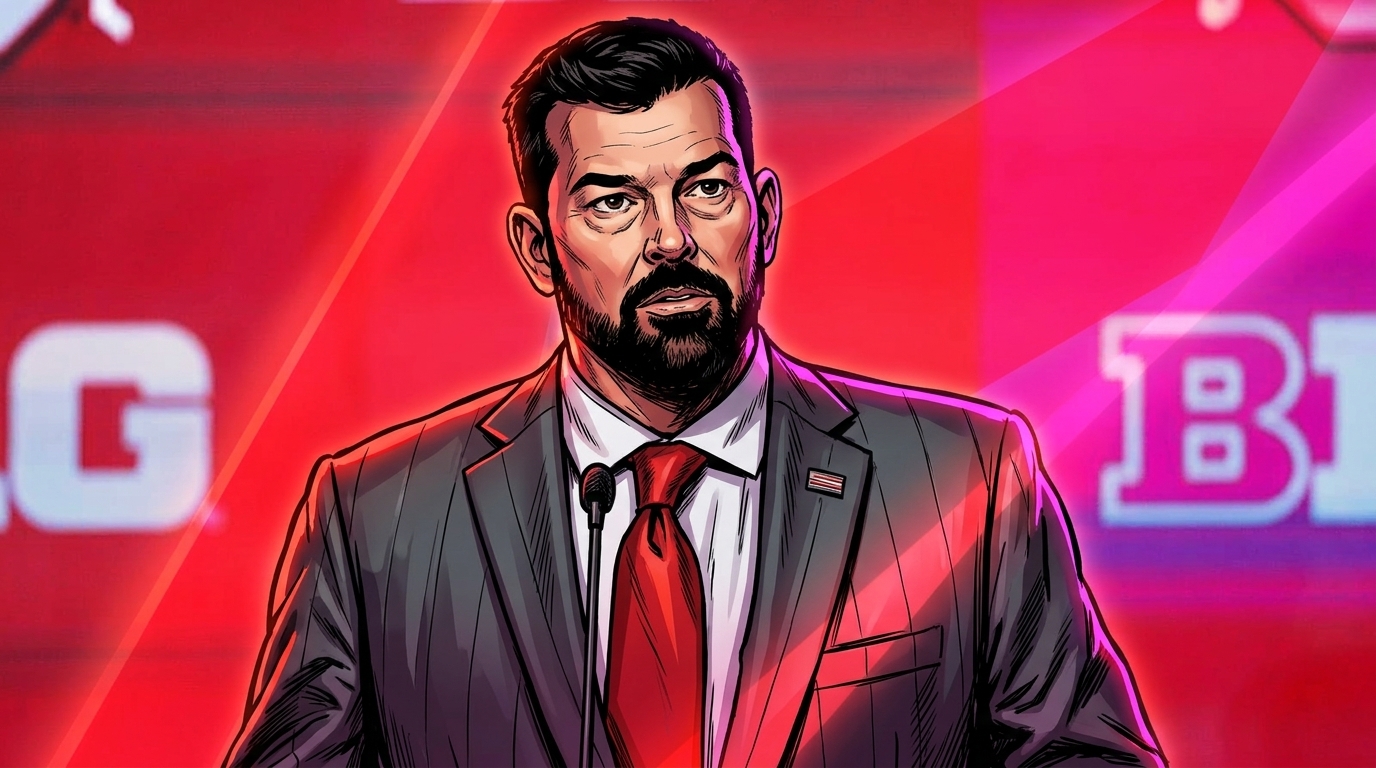

There’s a stat buried in Ohio State’s quarterback history that matters more than anything Julian Sayin does with his arm this fall: he’s only the third guy in Ryan Day’s eight years as head coach who gets to walk into camp already holding the job. Justin Fields had it in 2020. C.J. Stroud had it in 2022. Everyone else, every other August in the Day era, started with some version of a competition: a depth chart question, a transfer portal addition thrown into the mix to keep the starter honest.
Julian Sayin’s 2026 outlook at Ohio State isn’t interesting because of his ceiling. It’s interesting because of what he’s not: an open question. He threw for 3,610 yards, 32 touchdowns, and 8 interceptions at a 77.0% completion rate last season — the third-best single-season completion mark in FBS history and an Ohio State single-season record. That’s the surface story. The real one is that Ohio State finally gets to build on a season instead of replacing a starter.
What Makes Julian Sayin Different From Ohio State’s Last Two QB1s?
Julian Sayin is Ryan Day’s third returning starting quarterback, following Fields and Stroud — both of whom improved in year two and led Ohio State deep into the postseason. What’s different this time is that Sayin isn’t just running it back. He’s doing it with a new offensive coordinator and an expanded role at the line of scrimmage.
Fields and Stroud are useful precedent, not proof. Fields went from a good sophomore season to a Heisman finalist as a junior. Stroud went from a solid first year as a starter to the last Ohio State quarterback Ryan Day trusted with the keys in a national title race. Both jumps happened because the offense stopped teaching fundamentals and started building complexity. Sayin gets that same runway. He’s not learning a new system in fall camp; he’s adding layers to one he already knows, which is a fundamentally easier problem than the one most Power Four quarterbacks are solving in August.
How Much Did Sayin’s Numbers Actually Slip Against Elite Defenses?
Sayin was sacked just six times and threw five interceptions across Ohio State’s first twelve games, a 12-0 regular season that included a road win over Michigan. In the two losses that ended the year, the Big Ten Championship against Indiana and the CFP quarterfinal against Miami, he was sacked a combined ten times and threw three interceptions.
Run those two numbers side by side and the shape of the problem gets clearer: pressure went up, and Sayin’s decision-making got worse under it, which tracks with almost every young quarterback’s tape. That’s a pass-protection story before it’s a Sayin story. Ohio State’s issue in the two losses was giving him time, not the reads he made once his pocket collapsed. Worth remembering before anyone builds a full regression narrative off two bad games in a 14-game season.
Is Julian Sayin Really a 2026 Heisman Frontrunner?
Julian Sayin finished fourth in the 2025 Heisman voting and enters 2026 as the only returning finalist in the field, with preseason odds sitting around +1100 to +1300. That combination of proven production and thin competition at the top is exactly what oddsmakers price into an early favorite, even before a snap of the new season.
Being the only returning finalist matters more than the raw odds number. Heisman races reward name recognition built on a prior season’s tape, and Sayin is the only player in the field who already has that tape in the bank. Bettors and outlets are picking up on it early:
https://x.com/CollegeSportsCo/status/2085137416566804982
That’s not a guarantee of anything. Heisman races get reshuffled by October more often than they get decided in August. But Sayin starts this one from a position nobody else in the field occupies, and that’s a real, quantifiable head start.
What Does Arthur Smith’s Offense Change for Sayin?
Ohio State brought in Arthur Smith as offensive coordinator for 2026, and the headline change for Sayin is autonomy: more checks and adjustments at the line of scrimmage than he had as a first-year starter. Day has noticed the difference physically as much as schematically. “He had great success last year,” Day said, via 247Sports, “when you look in his eye now, you see a different person, a different body. He’s worked hard, gotten stronger.”
Sayin’s own language backs that up. “It’s fun to have that responsibility as a quarterback at the line of scrimmage,” he said of the added control under Smith. He’s framed the offseason less as chasing a bigger stat line and more as sharpening what already worked: “I just want to take the experience I had for my first year and improve on that. I just can’t wait for the season to start.” He’s also pointed to a shift in how he leads the huddle, saying, “I think I just stepped up more as a vocal leader.” Handing a quarterback more presnap control usually means more RPO and run-pass check freedom, and more freedom usually means more variance, good and bad, which is exactly why the sack and interception numbers from the two losses are worth tracking again in September.
The schedule will test all of this fast. Ohio State’s 2026 slate includes Texas, Indiana, Oregon, USC, and Iowa, a run that offers almost no easy weeks to work out early kinks. If Sayin’s fall camp gains at quarterback actually hold up for Ohio State, that schedule is the proving ground, not a hypothetical.
Give me Sayin as a Heisman finalist again, and give Ohio State a Big Ten title defense that gets further than last year’s. The continuity Day has been chasing since Fields left is finally sitting in the quarterback room, and a program that stopped rebuilding at that position is a genuinely different bet than the one oddsmakers were pricing a year ago. Check out the rest of our college football coverage as fall camps open around the country.