
When I was covering women’s basketball in 2022, I noticed something about the way arena cameras worked. There would be a tight play at the elbow, a contested jumper, the game’s actual content — and then the broadcast would cut away to a celebrity sitting courtside, catching them mid-reaction, or mid-phone, or mid-conversation. And for a beat, the celebrity became the story. Not a sidebar. The story. The camera had decided.
I thought about that a lot watching the coverage coming out of Game 1 of the NBA Finals.
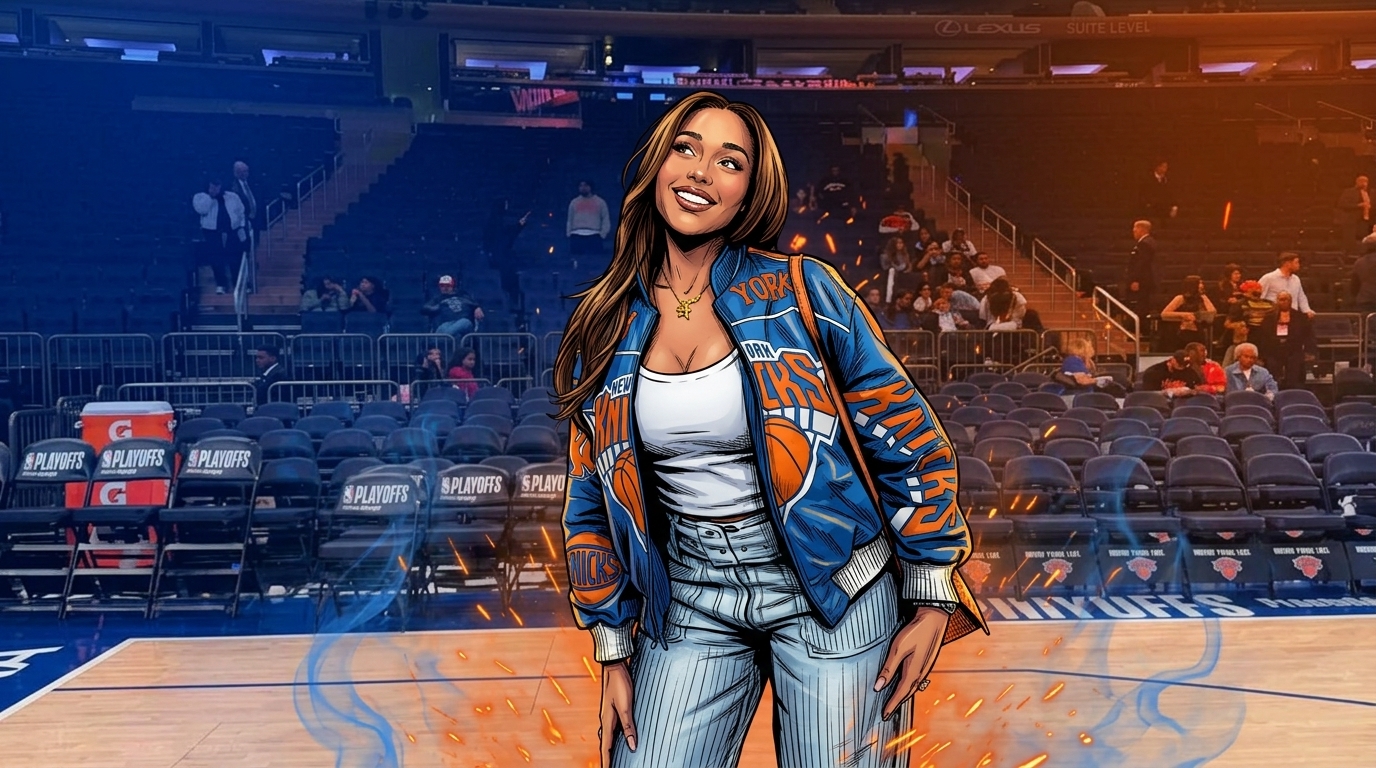
The Knicks beat the Spurs 105-95 at Frost Bank Center — Jalen Brunson dropped 28, Karl-Anthony Towns had 25 and 8. It is, for the record, one of the more culturally loaded Finals matchups in recent memory (the Knicks vs. Spurs NBA Finals 2026 carries different weight if you know the 1999 history). And somewhere inside that basketball game, Jordyn Woods sat courtside in custom orange corset and light-wash denim with “TOWNS” lettered across the back in orange panel, white feathery heels, a white jacket, and a clutch from her own line that Page Six has already elevated to the status of lucky charm.
The clutch. The clutch became a courtside superstition, per Page Six. We are covering the clutch.
https://www.instagram.com/jordynwoods/reel/DXTDKC-jGvD/
I want to be precise about what the WAG economy actually is, because the term gets thrown around loosely. The WAG economy — in 2026 — is the system by which a professional athlete’s partner generates media coverage, social engagement, and brand revenue that exists in parallel to and sometimes in competition with coverage of the game itself. It runs on a few inputs: the athlete’s prominence, the partner’s independent cultural footprint, the algorithm’s tendency to serve celebrity content to audiences who arrived for sports, and the partner’s ability to produce content that feeds back into the loop. It is not new. It is, however, newly professionalized.
Woods is interesting in this context because she doesn’t quite fit the standard WAG template, and the coverage can’t decide what to do with that. The usual genre — partner photographed at game, partner photographed with other partners, partner’s outfit described, partner’s reaction to pivotal play captured — treats the partner as a satellite object whose orbit depends entirely on the athlete at the center. That works when the partner’s cultural weight is smaller than the athlete’s. It stops working when Clutch Points is running headlines that frame KAT as “Jordyn Woods’ fiancé.”
She arrived at the Knicks’ playoff run with 11 million Instagram followers, an Amazon Fashion collaboration, a TikTok GRWM series that she’s been running all postseason, and the kind of post-Kardashian cultural backstory that people who don’t follow the NBA at all already know. The 2019 Tristan Thompson scandal, the Red Table Talk appearance, the years of publicly rebuilding her brand outside the circle she’d been expelled from — that’s a seven-year cultural arc with its own audience. She didn’t become interesting because of Karl-Anthony Towns. She became interesting at a different time, for different reasons, and the Finals just placed two separate media gravitational fields in the same arena seat.
https://www.instagram.com/reel/DJ-ZU2CNz4D/
What the coverage does with this is genuinely interesting to me as someone who’s written about how women’s celebrity cuts through sports media. The sports coverage wants to file her under “KAT’s partner,” which is the established genre. The celebrity/entertainment coverage wants to file her under “Jordyn at the game,” which is its own established genre. Neither genre fully accounts for the fact that she’s actively producing content that monetizes her own presence — the GRWM TikToks, the clutch placement, the Amazon Fashion drop timed to the Finals run. She’s not just being covered. She’s working.
She told Vogue: “Once playoffs start, everything becomes part of the ritual if we keep winning. We’re nine wins in, and now I have my lucky Woods by Jordyn bag, my game-day GRWMs on TikTok, and a watch I refuse to take off.” That’s a PR quote, yes, but it’s also a precise description of how the content loop operates. The ritual isn’t just personal. It’s a product. The superstition is brand integration. The coverage that Page Six runs about the lucky clutch is, in a fairly direct way, advertising.
None of which is a critique, exactly. This is what you do when you’re Jordyn Woods in 2026. What’s interesting is the friction it creates in the coverage — the way the WAG genre keeps trying to absorb her into a supporting role and keeps not quite succeeding.
The Timothée Chalamet thing from earlier in the playoffs made this clearer in a funnier way. NBA Twitter labeled him a WAG.
https://twitter.com/heloshivered/status/2059124447852843059
The joke worked because it named the mechanism honestly. The coverage machine doesn’t actually need you to be a partner. It just needs you to be courtside, famous, and camera-adjacent. The algorithm will do the rest. Whether the subsequent coverage is about you or about your relationship to the athlete at the center is almost an afterthought — the machine generates it either way.
The Wembanyama backboard moment in Game 1 will live in highlight reels for years. The score was 105-95. Towns had 25. These are the durable facts of the game. And also: an orange clutch became a superstition, and a woman who survived a very public cultural exile seven years ago sat courtside at the NBA Finals in an outfit she designed herself that contained her own brand name, and people covered it breathlessly and couldn’t quite agree on what they were actually covering.
I grew up watching Tim Duncan play the most boring, beautiful basketball ever invented. The Spurs didn’t generate WAG storylines. They barely generated storylines. I’m not sure what it means that Game 1 of the NBA Finals played in my hometown produced both the Wembanyama moment AND the Jordyn Woods media cycle simultaneously, each running at full speed, neither quite aware of the other. I don’t think it means something bad. I’m also not sure it means something good. I just can’t stop watching how the cameras move.