
The Guggenheim Museum — founded 1939, designed by Frank Lloyd Wright, home to Kandinsky and Brancusi — has exhibited Jordyn Woods’ orange faux-ostrich clutch, and the sentence requires no further elaboration to make its point.
The bag in question is the Tux Clutch Mini from Woods by Jordyn, priced at $125, colorway Summer Citrus. Woods, the fiancée of Karl-Anthony Towns, carried it to every Knicks home playoff game. The Knicks won those games; the sole exception arrived in Game 3 of the NBA Finals, when the President of the United States attended Madison Square Garden and the enhanced security protocol prohibited bags, leaving the Tux Clutch Mini at home. The Knicks lost Game 3. They won every other game Woods attended with the bag. These are the facts as reported, without editorial adjustment. You may make of them what you will; history has already decided.
After Game 4 — a 29-point comeback win — KAT posted an Instagram reel and issued a formal institutional recommendation: “The bag did its thang tonight! I ain’t gon’ lie to you. We gotta put this in like the Whitney or the Guggenheim.” This was understood, at the time, as the kind of exuberant hyperbole that follows a 29-point comeback; it was not understood as a policy proposal with a realistic implementation timeline.
https://www.instagram.com/p/DZsXxt7RFYF/
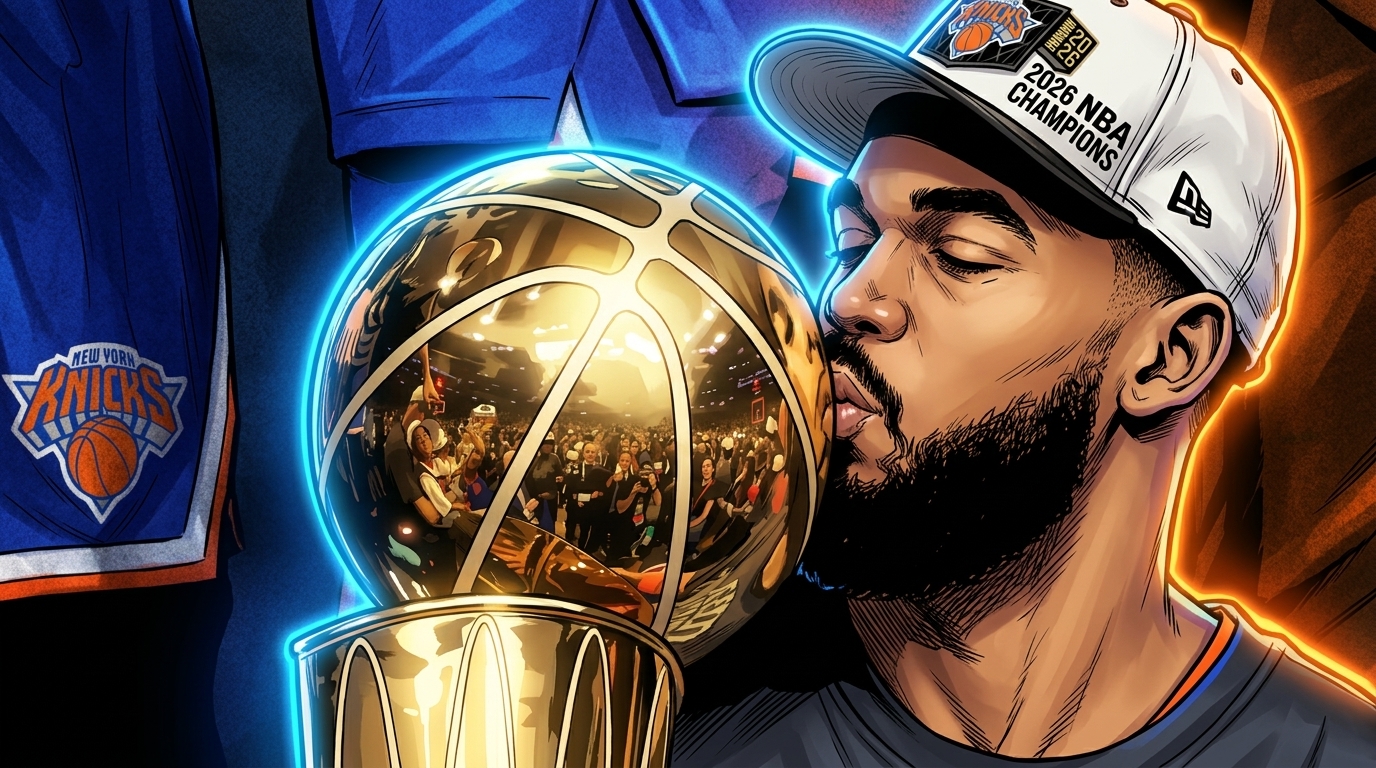
Guggenheim director Mariët Westermann replied: “We’re delighted and on it.” The bag was subsequently exhibited at Café Rebay on the museum’s third floor from June 24 through June 28 — a five-day run, eleven days after the Knicks won their first championship since 1973 by defeating the San Antonio Spurs 94-90 in Game 5. KAT, at the championship celebration, delivered remarks that could credibly serve as wall text: “Hey, Papa, we got the bag. The bag made it. The bag’s undefeated, man.” And then: “I want everyone in New York to know that bag won the championship.”
https://www.instagram.com/p/DZu2XfylTyc/
This is the extended metaphor the situation provides, and it is not a metaphor at all — it is the literal sequence of events. A fashion accessory made the journey from influencer handbag to championship talisman to press-released museum artifact in approximately three weeks; the collaboration, the Guggenheim noted in materials, emerged from Woods and Westermann’s friendship, “which began during our Rashid Johnson exhibition.” The bag sold out at $125. It spawned a Target Curated By collaboration, with KAT selecting Bicycle playing cards, Uno Retro, and blue-and-orange Gatorade, and Woods selecting beauty essentials. The institutional apparatus that typically processes significant cultural objects — the acquisition process, the curatorial framing, the press release, the wall placement — processed a Summer Citrus faux-ostrich clutch, and the apparatus did not notice anything unusual, because by then nothing was.
You can read this as commerce masquerading as culture, and you would not be wrong; the WAG economy the Finals built has been extraordinarily efficient at converting playoff adjacency into brand equity. But the counterargument is that the Guggenheim has always been in the business of deciding what counts, and what it decided, in late June 2026, was that the original bag story had sufficient cultural weight to warrant five days on the third floor. The museum’s assessment and the market’s assessment aligned. That alignment is either evidence that the distinction between art and commerce no longer holds, or evidence that it never did.
https://x.com/NYMag/status/2069548439642464691
Jordyn Woods said that being able to lend “a piece of history — and luck — back to the city is truly an honor,” and that she never imagined something she designed would one day be on view at the museum. The sentence is sincere. The situation it describes is genuinely unprecedented. The satirists arrived at the story and found it already complete; reality had rendered the punchline before anyone could set up the joke, and the Guggenheim issued a press release, and the bag was undefeated.