
Every few years an NBA transaction shows up that looks rational from one angle and genuinely alarming from another. James Harden declining his $42.3 million player option to negotiate a new multi-year deal with the Cleveland Cavaliers is exactly that transaction. I built what I’m calling the Three Tests (assist-dependency, aging curve, motivation variable) and ran the numbers in each direction. The answer kept coming back the same way: complicated, but not crazy.
https://twitter.com/ShamsCharania/status/2071582018119389273
First reported by Shams Charania on June 29, the expected new deal sits around $30 million per year for two seasons. Harden turns 37 in August. The Cavaliers just got swept in four games by the Knicks in the Eastern Conference Finals. Cleveland’s team president Koby Altman called it anyway: “We’re not in the conference finals without James.” That quote is doing a lot of work. We’ll get to why.
Does Harden Actually Fill Mitchell’s Playmaking Gap?
Yes, and the gap is bigger than Donovan Mitchell’s raw numbers suggest. Mitchell posted 5.7 assists per game in 2025-26, a number that sounds solid until you learn it ranked 28th among NBA regulars. That’s roughly the assist rate of a wing player who can occasionally create for others, not a true primary ballhandler. Cleveland’s offense ran through Mitchell’s scoring. The playmaking burden was real, and nobody on the roster was built to carry it.
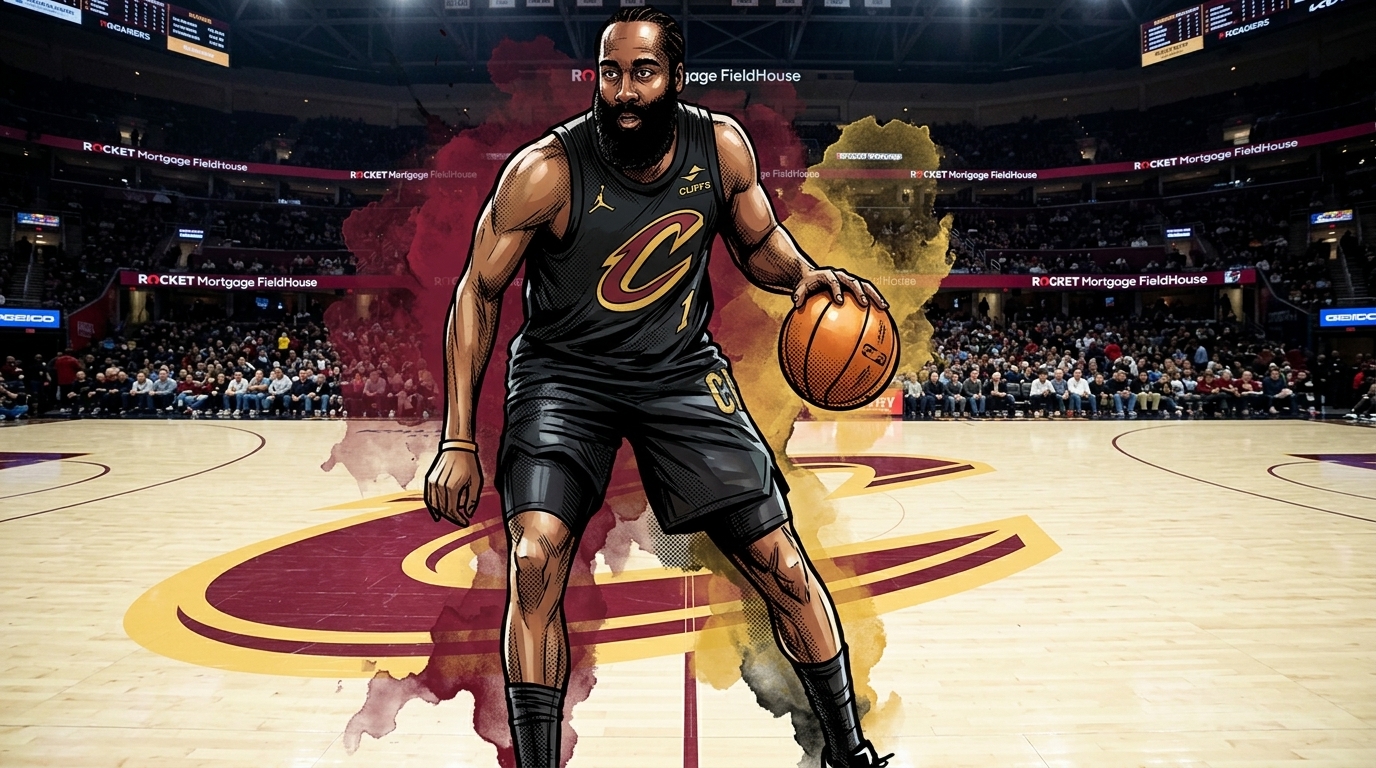
Harden averaged 7.7 assists per game across 26 regular-season games after the trade. That’s not a pace artifact. That’s the gap filled in real time, on a real roster, with Mitchell as the co-star. The fit here isn’t theoretical. It already happened. The data from those 26 games: 20.5 points, 7.7 assists, 46% from the field, 43.5% from three. That’s the version of Harden that makes this deal make sense.
Test one result: the assist-dependency case is real. Mitchell needs a true creator beside him, and Harden is one of the ten best playmakers in NBA history at that role. This part isn’t ambiguous.
What Happens to Aging Primary Creators at 37?
Harden turns 37 in August, which is the part of this analysis that gave me pause. The aging curve for primary scorers at 37 is not encouraging. But Harden completed his transition from scorer to distributor years ago. At 29, he was averaging 36 points per game. By 33, his primary identity was 8.5 assists per game. Those are two different players with two different aging profiles.
The historical data on aging distributors is more forgiving. Chris Paul led the entire league in assists at 36, posting 10.8 per game, because vision and decision-making age differently than first-step quickness. Steve Nash remained effective at 37, though his turnover rate crept from 2.7 to 3.3 per game as his ability to escape pressure declined. Playmakers lose burst first. The reading of defenses stays sharp.
The concern in the playoff data isn’t the age, though. It’s 4.7 turnovers per game and 29.9% from three across those 18 playoff games. His ECF performance against New York was the data point that made me run this twice. A 29.9% three-point rate isn’t a slump. That’s a sample suggesting the step-back pull-up has a durability question attached under playoff pressure.
Nash’s cautionary arc matters here. The turnovers crept. They don’t usually un-creep.
Test two result: ambiguous. The distributor-aging case is genuinely more favorable than the headlines suggest. The playoff data introduces real uncertainty about which version of Harden shows up in a seven-game series.
The Variable Nobody Wants to Model
This is where the analysis gets honest about its own limits. I ran a few career-arc regressions on this before writing, and the pattern that kept emerging wasn’t about age or role. It was about context.
Harden’s career statistical outputs have tracked strongly with his perceived importance in each situation. With the Clippers, operating as a third option behind Kawhi Leonard and Paul George: 16.6 points, 8.5 assists, minimal offensive burden. Traded to Cleveland, handed the keys, told he was the missing piece: 20.5 points, 7.7 assists, 46% shooting. I’m not claiming insider knowledge about his mental state. I’m saying that if you treat the career splits as a motivation proxy, the signal is consistent enough to model. Context changes his output. Dramatically.
Koby Altman saying “We’re not in the conference finals without James” is exactly the kind of institutional validation that has historically preceded Harden’s best basketball. That quote is the variable. Cleveland’s structural ceiling got exposed in the ECF sweep, and yet Altman isn’t treating it that way publicly. He’s treating Harden as the reason they got there. That framing matters.
Mitchell’s own commitment to Cleveland removes the co-star uncertainty that plagued earlier Harden situations. He’s not playing alongside a disgruntled star or a franchise in transition. He’s the established playmaker alongside a committed scoring partner, in an organization that just told him he was the difference-maker.
My sister thinks this is a terrible idea. “He had 4.7 turnovers a game in the playoffs, Naveen.” She’s not wrong about the number. But she’s modeling the April version, and I keep coming back to the 26-game regular-season version.
Test three result: favorable, with a large error bar. The motivation variable has historically been the central variable. Cleveland is offering exactly what the data says unlocks Harden.
I ran this three different ways, and the answer keeps resolving to the same thing — the variable that doesn’t fit cleanly in a regression. The playmaking fit is real. The aging concern around playoff execution is real. The turnover rate in April earned its place in this analysis.
But the career splits tell a consistent story: James Harden, told he is the reason for something good, tends to become the reason for something good. Koby Altman gave him that framing in public. Cleveland is offering a two-year deal at a number that says “we want you,” not “we’ll take you.” That’s the signal the data says matters most.
The evidence suggests this works. Give me Cleveland.