
The Cleveland Cavaliers are down 3-0 to the New York Knicks, and if you are surprised by this, you have not been paying attention to Cleveland sports for very long.
This is not a collapse. Collapses require something to collapse from. What happened in this Eastern Conference Finals — what is still happening — is more like a confirmation: the Cavaliers built exactly the team they built, and it turns out that team has a ceiling, and the ceiling is lower than the regular-season standings suggested, and Cleveland fans should have recognized this feeling by now because we have been here before. We have been here so many times that the disappointment has acquired a certain texture, a kind of familiar weight that settles in around the third quarter of a playoff loss and doesn’t move.
The 1988-89 Cavaliers went 57-25, second-best record in the East, and lost in the first round because Michael Jordan elevated from the free-throw line and shot us through the heart. This year’s team went 52-30, fourth seed, and is about to lose in the conference finals because they have spent three games trying to hold Jalen Brunson to a manageable number while the Knicks shot 55.8 percent from the field in Game 3. The details change. The geometry of the loss is identical.
Kenny Atkinson said after Game 3 that the Knicks were “the most physical team” and “the much better team.” He also said, regarding a comeback from 3-0 down in a series no NBA team has ever survived, “get one, and then we’ll go from there.” This is the Cleveland process: identify the next small step, focus on controlling what you can control, trust the work. Every Cleveland team has a process. The process ends in a familiar place.
https://x.com/cavs/status/2058330892381135114
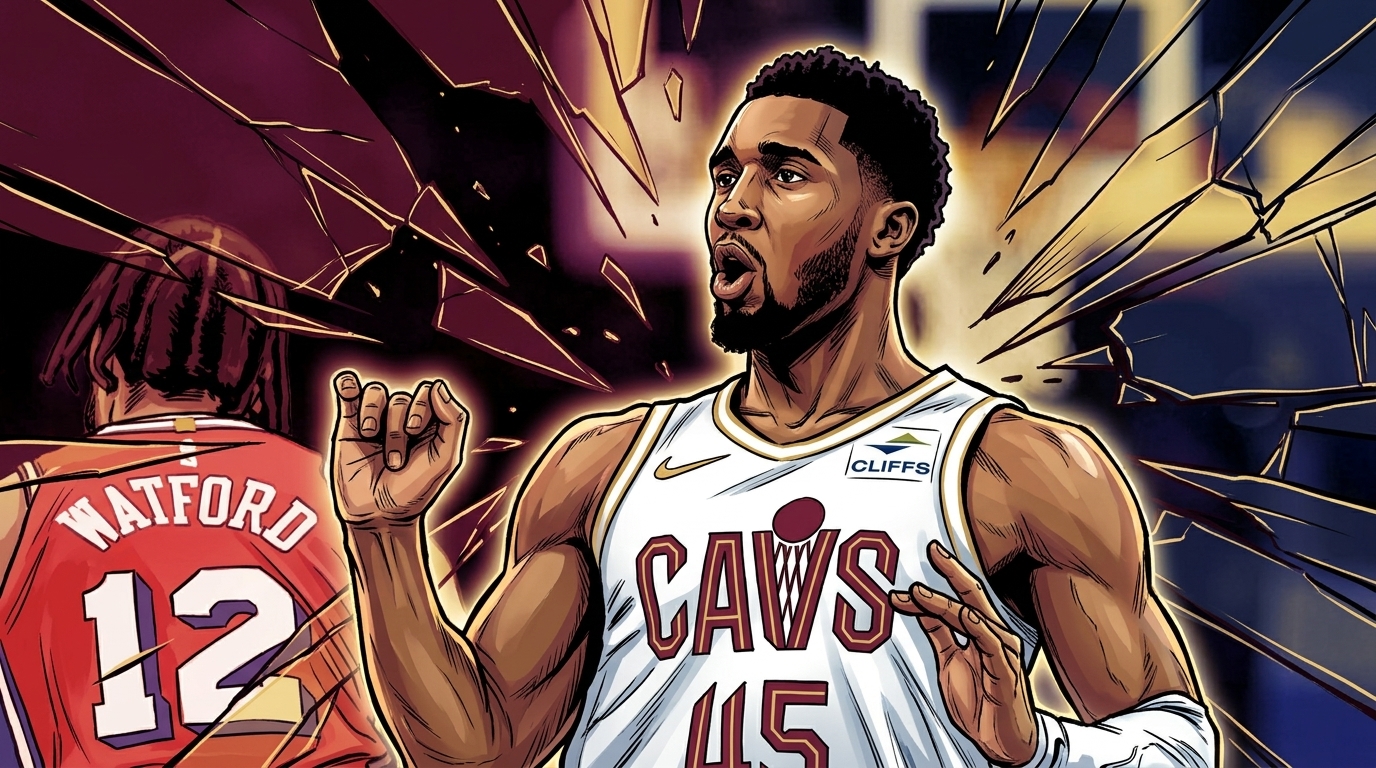
Donovan Mitchell scored 23 points on 9-of-21 shooting in Game 3, and 26 in Game 2, and 29 in Game 1, and the declining numbers feel less like a slump and more like a depletion. Channing Frye, who played for this franchise and watches this team closely, said after Game 1 that he does not see that burst from Mitchell — that “something gotta be up with his legs.” The team has issued no official injury update, only the reassurance that things are being “monitored,” which is how Cleveland communicates that something is wrong and management would prefer you not dwell on it. A video circulating after Game 1 sparked enough concern that people who follow this team for a living started asking questions the team hasn’t answered. Mitchell has a documented history of lower-body issues — he missed two games against Boston in a previous series with a strained left calf. Without him in the regular season, the Cavs went 7-5 and their net rating dropped from +4.7 to +0.9. He is clearly playing. He is clearly not fully there.
Mitchell said after Game 1 — the game where the Cavaliers blew a 22-point lead in the fourth quarter and overtime and got outscored 44-11 in the final seven minutes and forty seconds — “We lost, we blew it. It’s one game. We could have lost by 40. Still would have been 1-0.” This is accurate. It is also the kind of thing you say when you are trying to maintain a functional locker room in the aftermath of something that has shaken you at a cellular level.
James Harden has turned the ball over at least five times in each game of this series — six in Game 1, five again in Game 3. Whatever the exact count, it is a lot of turnovers from the man who was supposed to fix things, with the Cavaliers never once holding a lead in any of those games. Harden was acquired at the trade deadline in February, Darius Garland and a second-round pick to the Clippers, the move that was supposed to complete this roster. He scored 19 points in Game 3, added five assists and five turnovers, and spent approximately 41 minutes watching New York run actions through whichever side of the floor he was standing on. After Game 2, when the Cavs shot roughly 29 percent from three for the series, Harden said: “We just hit no shots. We had a lot of open looks. Make shots, hit a couple of those, win the ball game.” This is technically true. It is also not a diagnosis.
The Cleveland Cavaliers shot 29.3 percent from three in Game 3. They have five players who have logged more postseason minutes in this series than any single Knicks player. They built a team with legitimate regular-season depth, enough to absorb Garland’s departure and still go 52-30, and that depth has been ground down over three games against a team that is simply more physical and more locked-in and more ready for what a playoff series actually requires. This is a structural problem, not a hot-shooting problem. Atkinson said after Game 1 that he thought they got a little unlucky, quite honestly.
I have been a Cleveland fan long enough to know that “unlucky” is doing a lot of work in that sentence.
The ceiling the Cavaliers thought they raised this year was real. It was just the floor of the next problem — and the next problem was the New York Knicks, and the problem before that was the Indiana Pacers, who beat last year’s 64-win team four games to one. We keep building regular-season machines and running them into May, where they encounter something the regular season cannot simulate: a team that is built slightly better for this specific moment, playing with slightly more desperation, on the right side of the variance in every close sequence.
No NBA team has ever come back from 3-0. The Cavaliers will not be the first.
Kenny Atkinson says get one, and then we’ll go from there. That’s the process. We’ve seen the process. We know where it goes.