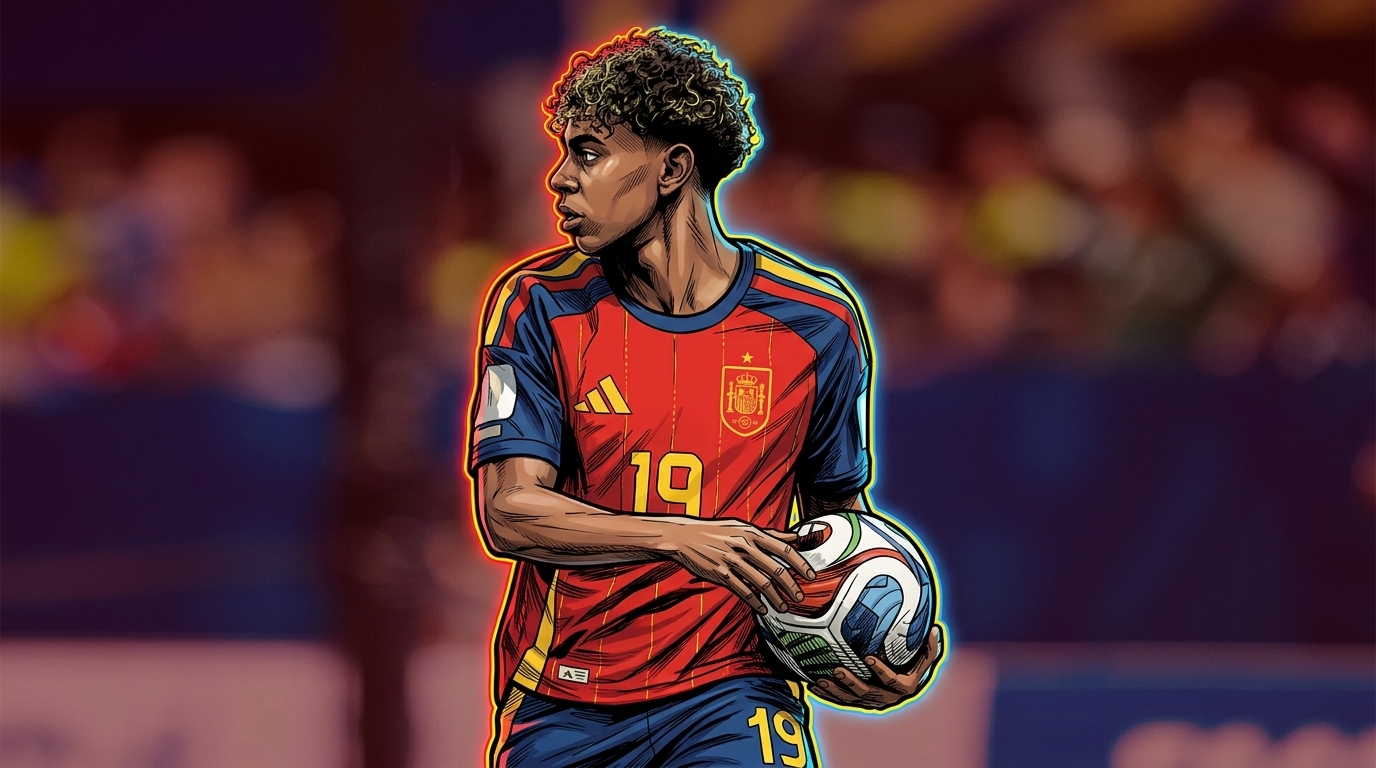

There’s a particular kind of story the sports media industrial complex has always loved: the woman in the stands. She gets discovered. The tournament finds her. She becomes legible to an audience that didn’t know she existed until the cameras cut away from a missed penalty and landed on her face. I’ve been watching this story get told for twenty years, and what’s interesting right now, genuinely rather than rhetorically, is that it’s becoming structurally obsolete.
Inés García was in the stands in Atlanta on June 15 when Spain drew 0-0 with Cape Verde in their World Cup opener. She wore Lamine Yamal’s #19 jersey. She posted a series of photos to her Instagram with a caption that was entirely emoji: hearts, the Spanish flag, a handshake. No words. Just signal. The internet took it from there, because the internet always does.
https://www.instagram.com/p/DJbpxIEowY5/
But here’s what the coverage keeps burying in paragraph four: García is 21, from Seville, and she had roughly 360,000 Instagram followers and 800,000 TikTok followers before the World Cup put a camera near her. She was already in the influencer economy (fashion, beauty, lifestyle content) before Yamal became the tournament’s most-watched player. She had already done the work. The WAG industrial complex has been disintermediated, and Inés García is a clean example of what that looks like in practice.
The old model, the one Victoria Beckham lived through in Germany in 2006, required the tournament to function as a distribution mechanism. Tabloids assigned you a number. Magazine spreads told you who you were. Your existence as a public figure was entirely mediated through editors who decided what the audience needed. Beckham was already famous, which made her exceptional; most WAGs in that era went from private individuals to briefly scrutinized curiosities and then back again. The pipeline ran one direction and it ran through institutions.
What García represents, alongside Georgina Rodríguez (65 million Instagram followers, a Netflix series) and Antonela Roccuzzo (42 million), is something categorically different. These women are now their own media channels. Inés García went from a private-ish account to 360K+ on the basis of fashion and beauty content that existed independently of whatever Yamal was doing on a football pitch. The World Cup is a distribution event for her, not an origin story.
This distinction matters more than it sounds. When we talk about WAG coverage, we’re usually really talking about the audience: what it reveals about how sports media understands women adjacent to athletes. The discourse around García in the last 72 hours has been largely warm, even celebratory: she’s savvy, she’s building something, she went public with Yamal at Barcelona’s La Liga dinner in May and timed the visibility smartly.
https://www.instagram.com/p/DZn6ZLmjwj9/
But that warmth is still organized around her relationship to a male athlete. She’s legible because of who she’s dating. The question her career is starting to ask, whether she intends it loudly or not, is how long that framing holds.
Fabrizio Romano marked Yamal’s World Cup debut like a historic transfer announcement.
https://x.com/FabrizioRomano/status/2066578105305596203
Yamal came on as a 70th-minute substitute against Cape Verde, returning from a hamstring injury. He created a big chance for Merino, registered two shots, completed ten passes into the penalty area. Spain still couldn’t score. None of that is García’s story, except that it contextualizes the scale of the event she just attached herself to: a tournament featuring an 18-year-old who finished the La Liga season with 16 goals and 11 assists in 28 appearances and who is a credible candidate for most-watched young player on earth. She was in the building. She made content from it. The content went everywhere.
This is the part where a certain kind of piece tells you what to think: whether García is savvy or calculated, whether we should admire the entrepreneurial clarity. I’m not sure that’s the interesting question. The interesting question is what it means for the machinery when the person being funneled through it already has her own funnel. We’ve written about how the WAG economy has restructured around Georgina and Antonela at the top end, and how the WAG category itself is getting contested by athletes who refuse the label entirely. García exists somewhere between those poles. Not yet at Georgina scale. Not refusing the category the way Trinity Rodman does. But not dependent on the tournament to make her visible either.
What strikes me, watching the coverage pile up, is that the audience seems to understand this too. The comments aren’t primarily about Yamal. They’re about her. Her style. Her caption choices. There are profiles like this World Cup WAG roundup that contextualize her alongside a dozen other partners, but the traffic is going to her account directly. People are following García. Not just following the story of García.
https://www.instagram.com/reel/DY0MHOZRvu7/
Whether that holds after Spain’s run ends, whether the 360K becomes 1.2 million or quietly plateaus, is genuinely unknowable. The World Cup can make and dissolve cultural moments inside of 72 hours. García posted emoji and the internet built a narrative around it. She’ll post again. The machine will decide what it means.
I find myself less interested in the “next Georgina” question, which is almost always about the ceiling anyway, and more interested in the fact that she doesn’t need it answered to keep building. The World Cup found Inés García. She was already there.