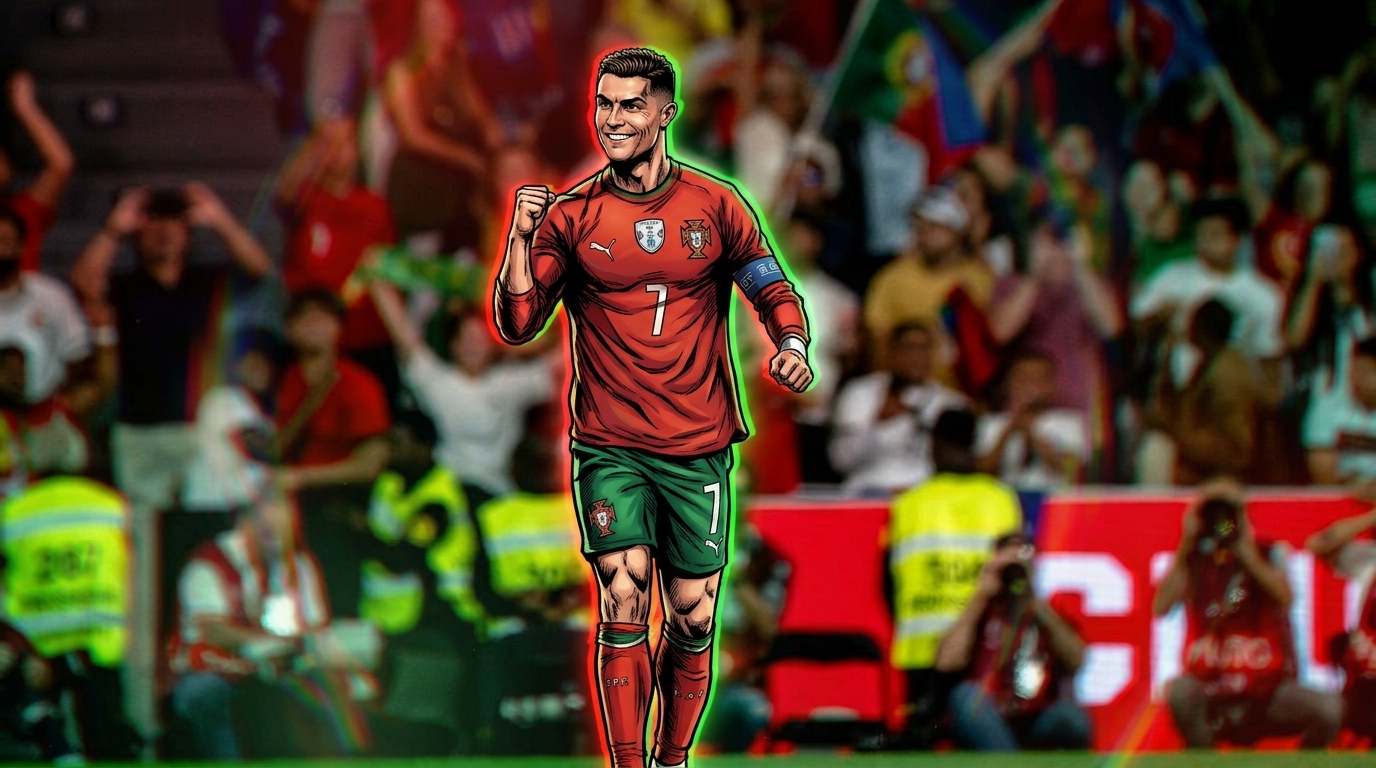

The tournament-defining question was never whether Portugal could win the 2026 World Cup; it was whether Cristiano Ronaldo could make himself matter while they did. Ninety minutes at NRG Stadium in Houston gave us the first data point, and it is this: João Neves scored in the sixth minute, DR Congo’s Yoane Wissa equalized in first-half stoppage time, and Ronaldo — six minutes into his sixth World Cup, 41 years old, the oldest outfield player to start a match in the tournament’s history — watched from the right wing as the opening chapter wrote itself entirely around him.
This is not a eulogy. Portugal controlled 80 percent of possession, attempted to grind out three points against a DR Congo side making its first World Cup appearance in 52 years, and finished with a single point and a result that nobody had pre-written for them. But the underlying numbers are the kind of detail that lodges itself and won’t leave: Portugal generated 0.07 expected goals; Congo DR generated 0.49. The team with 20 percent of the ball created seven times the expected threat of the team with 80 percent. Portugal did not so much control DR Congo as monopolize possession while failing to threaten the goal. The machinery whirred. The headliner did not.
Think of the last-dance narrative as a screenplay already in production — not a story that gets discovered, but one that gets cast. Sports media had already distributed the roles before a ball was kicked in Houston. Ronaldo is the aging auteur with one more shot at the only thing missing from his resume; the media apparatus covering this tournament had pre-written the scenes in which he either delivers his crowning masterpiece or exits, dignified, into the twilight. The problem with pre-written screenplays is that the players haven’t read them. Neves hadn’t. He met a Pedro Neto cross at 12 yards, headed it into the net in the sixth minute, and thereby became the first sentence of a story the narrative machine had not budgeted for. Then Wissa scored in stoppage time — Congo DR’s first-ever World Cup goal — and that story had a complication the machine hadn’t budgeted for either.
Ronaldo’s clearest moment came in the 29th minute — a diagonal ball from Cancelo that he couldn’t bring under control, a near-miss that the cameras caught and catalogued for later use. That image will be replayed in the event his tournament ends scoreless; it will be largely forgotten if he scores a hat trick against Slovenia. The archive is selective that way. What is harder to selectively forget is how comprehensively the tactical shape of this match worked around him rather than through him: 80 percent possession generating 0.07 expected goals suggests a team that knew how to keep the ball and not much else about what to do with it.
https://twitter.com/FOXSports/status/2067293460193837305
Eight career World Cup goals across 22 appearances — the record is real, and it matters. But a player whose tournament is framed entirely around personal statistical legacy creates a particular kind of tension when the team draws without him scoring. Argentina and Portugal are supposedly on a collision course toward an inevitable final; the collision requires both men to be present and legible as protagonists when it arrives. Ronaldo needs to produce something before that narrative can be assembled. Right now, what he has produced is a 1-1 draw against a team that hadn’t been to a World Cup since 1974, zero goals, and a near-miss in the 29th minute that will mean everything or nothing depending on what comes next.
None of this is failure. A point is a point; Portugal are still in the group. The result sits in the standings the same way regardless of who scored, and a 21-year-old midfielder and a Congolese striker named Wissa writing the match’s two decisive moments does not diminish the tournament as a whole. What it does is complicate the story in the way that the first act of anything real complicates a logline. The screenplay called for a hero’s entrance. What it got instead was an 80/20 possession split, 0.07 expected goals, a stoppage-time equalizer from a nation playing its first World Cup match since Richard Nixon was president, and Cristiano Ronaldo walking off the pitch in Houston with a share of the points and nothing to show for himself.
The narrative machine is patient. It has five more matches to get the story it ordered.