
For years, the question of Haaland versus Messi at a World Cup was purely hypothetical — the sporting equivalent of arguing about what would happen if you introduced two animals that have never shared a continent. We’ve been sitting with this debate, watching it calcify into bar-stool certainty on both sides, waiting for a tournament that would finally force the issue into the open. On June 16, 2026, both men showed up to the same World Cup on the same afternoon and both scored. The theoretical debate is now empirical. The scorecards are open.
Haaland went first. Then Messi answered. Then Haaland, watching from wherever you watch the world’s most famous soccer player when you are the world’s second-most-famous soccer player, typed four words on Snapchat and called it a night. The words were: “Messi is a madman.” With a crown emoji. It is, perhaps, the cleanest possible encapsulation of where this rivalry actually stands — respectful, competitive, slightly in awe. That’s not a bad place to begin.
What Norway’s 28-Year Wait Means for This Moment
Norway’s last World Cup appearance was France 1998. Erling Haaland was born July 21, 2000 — which means the last time his country played in this tournament, he did not yet exist. He has spent his entire life growing up alongside a national team that kept missing the dance, compiling goals in international friendlies and qualifiers for a side that qualified for nothing that mattered. (Norway’s all-time leading scorer spent his peak years watching the World Cup on television. There is a specific kind of absurdity to that fact that the Norwegian federation would probably prefer we not dwell on.)
The 28-year wait had its own cultural weight before a ball was kicked in Foxborough. Norway’s Viking photo shoot before the tournament became something of an internet moment — the squad leaning into the mythology, because when you’ve been absent for nearly three decades, you might as well arrive with some theater. What the photo shoot promised, Gillette Stadium had to deliver.
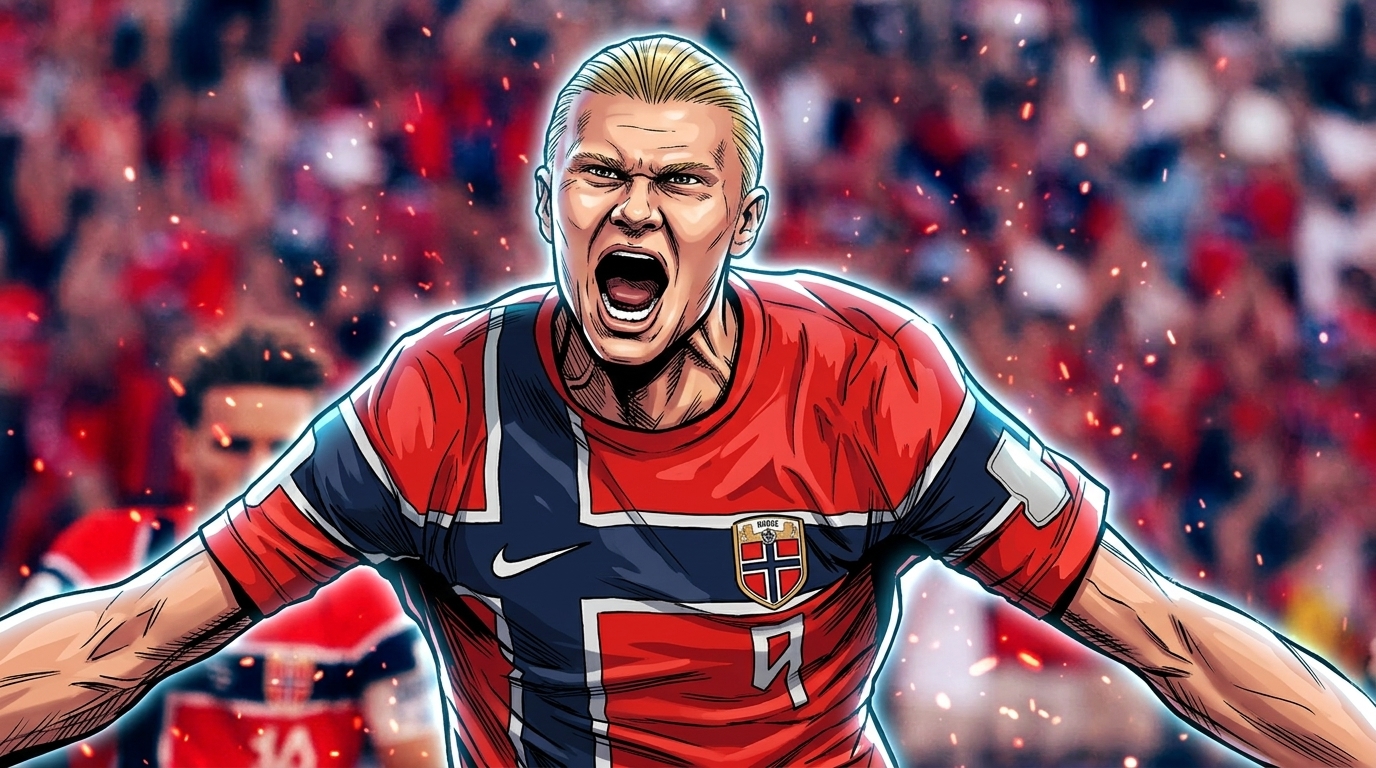
According to NBC News, Norway beat Iraq 4-1 with Haaland scoring in the 29th and 42nd minutes, Leo Ostigard adding a header at 76, and an own goal from Aymen Hussein in stoppage time. The Iraq goal — Hussein’s header at 38 minutes that briefly made it 1-1 — provided approximately seven minutes of narrative tension before Haaland put it to rest just before the break. Coach Ståle Solbakken had predicted a “very big impact” from his striker before the tournament. He was correct about that.
What the result obscures, though, is the texture of how Haaland actually played. He registered only 20 touches across the full 90 minutes — a number that looks, on the surface, like a quiet game. It was not a quiet game. It was a precise one. The first goal was a tapped cross from David Moller Wolfe, finished with a right heel. The second came from Iraqi goalkeeper Jalal Hassan’s back-pass going soft; Haaland was where a striker with his instincts is always going to be, and the net moved accordingly. Twenty touches, two goals. That is not inefficiency. That is a forward who understands his job description at a level that makes the job look easy.
“I’m incredibly proud to make my World Cup debut and to win Norway’s first World Cup match in 28 years,” Haaland said after the match. It is, by World Cup quote standards, fairly understated — which tracks for a man who responded to questions about the best scorer in the world by naming Harry Kane and Kylian Mbappé before himself. (Mbappé scored a brace for France against Senegal in a 3-1 win the same afternoon. Norway leads Group I on goal difference. The group is already somewhat chaotic, which is the natural state of groups containing both Haaland and Mbappé.)
Is the Haaland vs. Messi Debate Finally Over?
No — and anyone claiming otherwise after one round of group stage games is doing the same thing we’ve always been doing, which is drawing conclusions from insufficient data. Messi has 16 World Cup goals across five tournaments. Haaland now has two across one. The counter has started, the gap is real, and the gap is what makes this interesting for the next several weeks.
That said: June 16 was as good an opening statement as Haaland could have made. Two goals, clean sheet contribution, team win. When Haaland then watched Messi drop a hat trick against Algeria in Kansas City — Messi’s hat trick against Algeria tied Miroslav Klose’s all-time World Cup scoring record of 16 goals and came on Messi’s 200th cap for Argentina — the response from Gillette Stadium’s most famous output of the afternoon was four words on Snapchat.
https://x.com/FabrizioRomano/status/2067083426008580501
Fabrizio Romano shared the Snapchat story. “Messi is a madman,” with a crown emoji. It landed, as these things do, as both genuine admiration and implicit competitive acknowledgment. You don’t post the crown emoji about someone you aren’t trying to catch.
Heavy.com noted the moment felt like a public declaration from a competitor who is secure enough in his own position to be openly impressed — and confident enough in where the tournament is headed to treat Messi’s hat trick as a benchmark rather than a ceiling. That reading might be generous. The four words might also just mean Haaland watched a 38-year-old man score three goals in one World Cup game and had no more sophisticated reaction than the rest of us. Both readings are probably true.
The longer context here is that the generational rivalry question has always involved a third party. The Messi vs. Ronaldo collision course is its own separate tournament storyline — those two men have been running their parallel careers for so long that even Haaland’s arrival into the conversation is technically a disruption of an existing order. The question of whether Haaland eventually replaces Messi as the definitive answer to “who is the best player in the world” was already complicated by the fact that Messi keeps refusing to be replaced. A hat trick on his 200th cap at age 38 is not the act of a man who is winding down.
When asked directly about the best scorer distinction, Haaland demurred in the specific way that makes the question stick: “I would say I’m up there. I don’t think I scored the most goals this season, so statistically no. Harry Kane and Kylian Mbappé scored more than me.” It is a remarkably sober answer for a player who just scored twice in his first World Cup game while his nearest rival in the debate was tying a 20-year-old all-time record on the same afternoon. Either Haaland has genuinely good perspective on where he stands, or he is extremely good at not saying the quiet part out loud. (These are not mutually exclusive.)
What June 16 established is this: the debate is no longer theoretical. Both men are in the same tournament. Both scored on the same day. The gap in World Cup goals is 14. That gap will either shrink over the coming weeks, or it won’t. We finally have the conditions to find out.
What Comes Next for Haaland at This World Cup
Norway’s group stage picture is now cleaner than it was 24 hours ago. Leading Group I on goal difference after a four-goal opening win is not a bad position, and the structure of Solbakken’s team — built specifically around giving Haaland useful spaces to operate in rather than asking him to manufacture chances from nothing — looks like it translated from qualification to tournament soccer reasonably well.
The question for Norway across the next two group matches is whether the team can sustain this output against higher-quality opposition, or whether the Iraq result was partly a function of the gap in class. Iraq’s goalkeeper gifting Haaland the second goal did not exactly test the limit of what Norway’s striker needs from his teammates. The real stress test comes later.
For Haaland personally, the baseline is now set. Two goals in a debut World Cup game — the first goals Norway has scored in the World Cup since 1998 — is the kind of performance that closes the door on the “but he’s never done it at a World Cup” argument. That argument existed in good faith for years. It was a fair critique. It is now retired.
What remains genuinely open is the ceiling. Messi’s 16 goals came across five tournaments, starting in 2006, and the record he tied on Monday was one most people assumed would stand essentially forever. The idea that Haaland could threaten that number in a single career requires Norway to keep qualifying, which is its own project — the 28-year gap between France 1998 and now is not an anomaly; it is the baseline from which Norwegian soccer has been operating. One good tournament does not guarantee the next invitation.
But that is the long game. The short game is Group I, and Norway leading it, and Haaland with two goals and momentum and an apparently functional psychological relationship with the existence of Lionel Messi. (He called him a madman. He meant it as a compliment. The crown emoji confirmed it.) The World Cup has four words of established Haaland-on-Messi commentary, a 14-goal deficit in all-time tournament scoring, and at least four more group stage matches across the two sides before the bracket begins.
We’ve been waiting since France 1998 for this version of Norway to exist. We’ve been waiting since Haaland was a teenager for this version of the debate to be real. Both things arrived on the same Tuesday afternoon in June, in Foxborough and Kansas City simultaneously, which is either a remarkable coincidence or the natural result of two extraordinary careers arriving at their moment of overlap at the same time. Either way, we are no longer arguing about what would happen. We are watching it happen. The only question left is what the scoreboard looks like when it’s over.