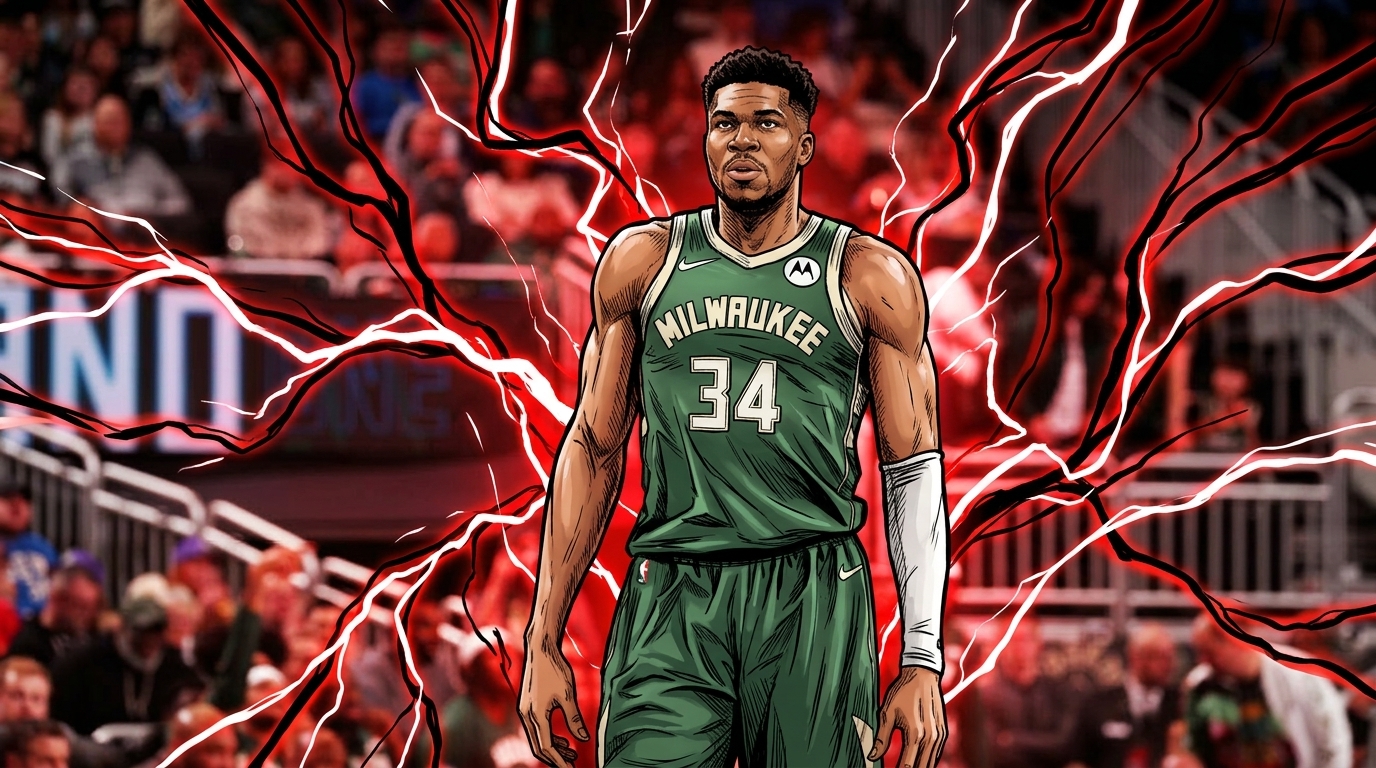

Here is a number worth sitting with: 7.3 feet. That is Giannis Antetokounmpo’s average shot distance this season — a career low, and not a rounding error. The man has essentially stopped existing beyond 10 feet. He drives, he finishes, he operates in paint-adjacent space because that is where he is almost impossible to stop. His 62.4% field goal percentage is a byproduct of that choice. So is his 33.3% from three on 1.25 attempts per game — effectively no perimeter presence at all. Giannis has looked at the perimeter, decided it is not for him, and moved on.
Miami just paid three unprotected first-round picks plus Tyler Herro to acquire him. The Heat are thrilled about this. They should be — Giannis is still a 27.6-point, 9.8-rebound, PER-32.6 force of nature. But the question that got buried under all the earthquake coverage is the one that actually matters: what does this roster look like now, and does the geometry work?
https://x.com/ShamsCharania/status/2069266716551508221
What Does Miami’s Roster Actually Look Like Right Now?
Giannis arrives alongside Bobby Portis, a physical big who helps with rebounding and toughness but does not move the needle on three-point shooting. The guards behind the deal are Davion Mitchell and Dru Smith, which Brian Windhorst accurately described as a “meaningful” drop-off from Herro. Miami has five open roster spots and roughly $18 million in cap space to fill them.
That is the actual roster. A 31-year-old two-time MVP who operates exclusively below the free-throw line, a backup big, two replacement-level guards, and a pile of open spots. Windhorst put it plainly: “They’re not a complete team.” Championship odds moved from 30-1 to 18-1 at DraftKings, which is a reasonable reaction to acquiring Giannis. It is also a reminder that 18-1 still means Miami is not the favorite.
The asset cost is worth acknowledging before moving past it. The Bucks extracted unprotected firsts in 2031 and 2033 plus the No. 13 pick this year plus a 2030 swap plus Herro and three young players. Milwaukee got a genuine haul.
https://x.com/ShamsCharania/status/2069266941722726873
Can Bam and Giannis Share the Same 12 Feet of Real Estate?
This is the actual puzzle. Bam Adebayo is under contract for three more years at escalating salaries — $51.2 million in 2026-27, $55.3 million in 2027-28, $59.4 million in 2028-29 if he picks up his player option. He shot 31.8% from three on 5.5 attempts per game this season, which is the number that defines the coexistence problem.
Bam’s role in Miami’s half-court offense is to be the hub: elbow mid-range, dribble handoffs, pick-and-roll as the initiating ball-handler. He is good at this. The issue is that Giannis requires the same real estate to function. When Giannis receives a pick and attacks the paint, defenses collapse on him and kick defenders toward the perimeter. Against Brook Lopez — the center Giannis built his best Milwaukee seasons alongside — that kick-out was a live wire. Lopez shot 36.0% from three during their time together, more than four percentage points better than Bam, on a volume that made defenses genuinely choose.
Defenses will not genuinely choose with Bam on the floor. They will sink into the paint, dare Adebayo to fire from 23 feet, and live with that 31.8%. The spacing issue that was flagged when the trade was first reported at the start of the Giannis-to-Miami negotiations was not media skepticism — it was geometry.
The ask here is not small. Miami is essentially asking Bam to either shoot well enough that defenses respect him (his three-point numbers have not moved in four seasons) or to accept a reduced role as a secondary ball-handler who operates while Giannis rests. That second option is the one Avery Johnson was gesturing at when he asked publicly, “Who’s gonna spread the floor?” It is a real question with no obvious answer on the current roster.
Bobby Portis does not solve this. He is a capable big who will give Miami toughness and some mid-range production. He is not a Lopez-type gravity shooter.
What Spoelstra Has to Figure Out
The strongest version of the counterargument is Erik Spoelstra. He is probably the best coach in the league for unconventional roster puzzles, and he has a track record of papering over alignment problems with creative rotation design. The LeBron years in Miami were not perfect on paper either — those rosters had real holes — and Spoelstra leveraged LeBron’s versatility across four Finals appearances. The Wiggins-as-spacer hypothesis for Miami’s open spots is one version of how the $18 million could be deployed to fix the perimeter problem.
There are also legitimate tactical answers. Stagger Bam to the second unit, where he remains the half-court hub without competing with Giannis for paint space. Run Giannis as the primary ball-handler with four shooters spread around him — his 5.4 assists per game this season suggests the playmaking role is not a stretch. Use inverted sets where Bam initiates and Giannis cuts, exploiting his off-ball athleticism rather than his preferred downhill role. None of these are obviously wrong.
But the concern persists for a straightforward reason: Spoelstra needs shooters to execute any of these schemes, and he does not have them yet. The roster has to be built first. Windhorst’s framing — “it may even take another year to truly get them in position” — is probably the honest assessment. Giannis’s defensive decline (no All-Defensive selection in four years, steals and blocks both below 1.0) means Miami cannot lean on his two-way impact to compensate for a thin roster the way Milwaukee once could.
The Heat have their first true superstar since LeBron left in 2014. That is real. They also have a center who wants the ball where their superstar wants the ball, a perimeter that does not yet exist, and a coach who is brilliant at solving puzzles as long as someone hands him the pieces.
The pieces are not all there. When they are, this conversation changes. Until then, the geometry problem Miami has is as real as a 7.3-foot average shot distance — and just as hard to ignore.