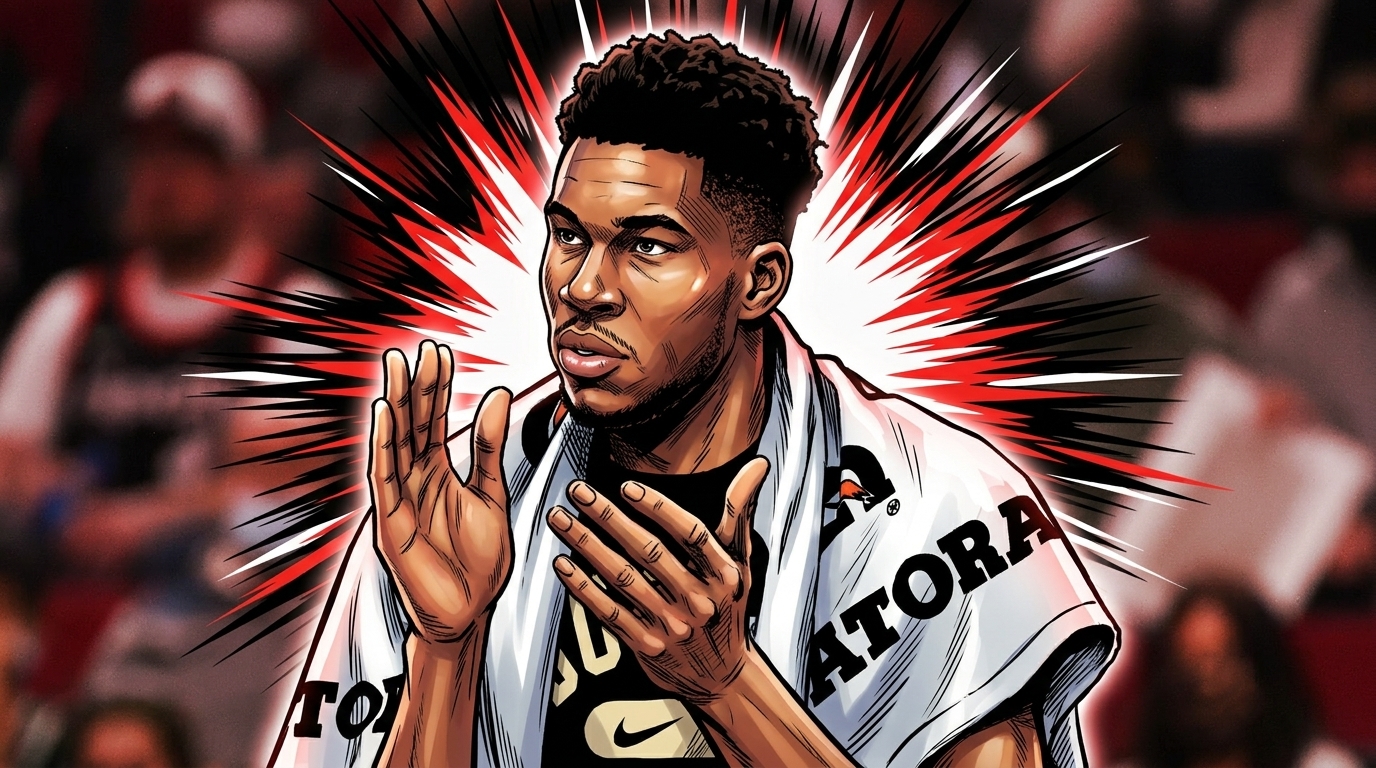

Here is a question worth sitting with before the Heat open training camp: when was the last time a team with three non-shooters in the frontcourt won an NBA championship?
Not a team with one non-shooter. Not a team that leaned on defense and made it work in a specific matchup. A team whose two best players on the perimeter — the ones who are supposed to stretch defenses — collectively averaged fewer three-point attempts than a backup shooting guard and shot a combined 30% from distance. That team. When did they win?
Pat Riley apparently has an answer. Miami just gave Andrew Wiggins a 3-year, $64M extension to be their starting small forward, locking him in alongside Giannis Antetokounmpo and Bam Adebayo as the core of the most physically imposing frontcourt in the league. The Giannis trade cost them Tyler Herro (20.5 points per game, their primary shooter) and Jaime Jaquez Jr., among others.
https://x.com/BleacherReport/status/2069267643152879774
The championship odds moved from 30-1 to 18-1. Third-best in the East, behind the Celtics and Knicks. Riley called it a defensive transformation. The data calls it something more complicated.
What the Three-Point Numbers Actually Say
Start with Giannis. His career three-point percentage sits at roughly 28.5%, and since 2022 he has averaged under two three-point attempts per game. That is not a player defenses game-plan around from distance. When Giannis posts up or attacks the rim, the help defender does not have to sprint back to a corner three — because there is no credible threat of a corner three. NBA defenses have been loading up on Giannis in the paint for years, and nothing in his game has changed that calculus.
Bam Adebayo is the more instructive case. He attempted 5.5 threes per game in 2025-26 — the most of his career, a genuine effort to add range to his game. He shot 31.7% from three. According to The Ringer’s Michael Pina, Bam ranks 89th out of 98 players who have attempted at least 600 threes over the past two seasons. To translate that: Bam Adebayo, attempting more threes than ever before at the peak of his offensive development, is among the nine worst volume three-point shooters in basketball. Defenses do not need to honor a 31.7% shooter at high volume. They will sag, they will pack the paint, and they will make Bam prove he can beat them from 24 feet — which the data says he mostly cannot.
Wiggins is the exception. His 41.4% from three last season is legitimate floor-spacing at high efficiency, and his extension makes sense on those terms alone. But one genuine spacer in a three-man frontcourt is not spacing. It is a single exit on a closed highway.
The One Team That Proved Defense Beats Spacing
Before dismissing Miami entirely, it is worth acknowledging the most obvious counterargument, because it is a real one.
The 2020-21 Milwaukee Bucks won the championship with Giannis as the centerpiece. He shot 29.3% from three that postseason. He attempted 3.6 three-point attempts per game in the regular season. Nobody was terrified of Giannis pulling up from the logo. Milwaukee’s entire offensive identity was built around putting the ball in his hands 20 feet from the basket and daring defenses to stop him in space and at the rim.
They won. Chris Middleton was brilliant. Jrue Holiday was everywhere on defense. But the framework held: dominant two-way play, a non-shooting superstar, and enough complementary pieces to make it work.
If you are Pat Riley, this is your precedent. This is the historical exception that justifies the gamble.
Why Miami Is Not That Team
The Bucks precedent is worth examining more carefully, because the more carefully you examine it, the worse it looks for Miami.
Milwaukee’s center in 2021 was Brook Lopez. In his prime seasons, Lopez shot between 37-39% from three. Defenses had to respect him at the arc — genuinely, not as a courtesy. When Giannis drove, Lopez’s presence as a credible shooting threat meant the weak-side help could not fully collapse. The spacing was not coming from Giannis. It was coming from the center.
Bam Adebayo shooting 31.7% from three is not Brook Lopez shooting 37%. Lopez at 37% is a player defenses guard. Bam at 31.7%, 89th of 98 in efficiency among high-volume shooters, is a player defenses concede. The gap between those two percentages is not aesthetic — it is the difference between a defense that has to make a choice on the weak side and a defense that can ignore the corner and load up on whoever has the ball.
Miami also traded away Herro. The Bucks had Middleton, shooting 41% from three and demanding defensive attention as a genuine secondary scorer who drew genuine defensive attention. Miami’s Middleton equivalent was Herro — and Herro is now in Milwaukee. The one team that apparently proved defensive dominance can overcome spacing concerns actually succeeded because they had real spacing from the center position and a secondary scorer who forced defensive decisions. Miami has neither of those things now.
My sister once argued with me for forty minutes that the 2016 Cavs proved you could win a title with one shooter if that shooter was Kyrie Irving. She was not wrong. She was also describing a specific exception that required a once-in-a-generation point guard hitting impossible shots in Games 6 and 7. Miami’s version of that argument requires trusting that Bam will suddenly become a credible floor spacer, or that Giannis will remodel his three-point shot at 31 years old. The evidence suggests neither is imminent.
Can the Heat Win a Title Without Spacing?
Direct answer: probably not in the current configuration.
The defensive ceiling is extraordinary. Giannis plus Bam is the most destructive defensive frontcourt in the league — two players who can switch, protect the rim, and make life genuinely miserable for every Eastern Conference offense. Pair them with Wiggins, who is a legitimate two-way wing, and Miami will be among the top three defensive teams in basketball. That matters enormously in a long playoff series.
The offensive problem is structural. Teams with this kind of spacing deficit tend to become predictable in the half-court, and predictable half-court offenses in the playoffs — especially against the Celtics and Knicks, both of whom have sophisticated defensive schemes — get exposed in seven-game series. The Heat moved to 18-1 championship odds, which reflects the genuine leap in their defensive quality. But 18-1 also means the market still gives them roughly a 5% chance of winning it all, and a lot of that discount is the spacing concern priced in.
For our NBA coverage heading into next season, this Heat team is the most fascinating stress test of the decade: can elite defensive construction offset a spacing profile that hasn’t produced a champion in the modern three-point era? The Draymond Green’s decision to opt out reshuffled the Western Conference, which helps Miami’s path if they get there — but they still have to get through Boston or New York first.
There is one roster move that changes the calculus: Miami signing a genuine stretch 4 or finding a point guard who shoots 38%+ from three. One more shooter who forces defensive decisions would transform this team from a fascinating experiment into a legitimate favorite. Without it, the data says Riley is betting on an exception that the historical record — including his own best analogy — does not actually support.
Give me Miami at 18-1 as a futures bet only if they add a shooter before camp. As currently constructed, give me the Celtics.