The question I want to answer isn’t whether Dylan Harper is good. The stats settled that Monday night against Oklahoma City. The question is structural: does the age construction around Harper and Victor Wembanyama represent something we’ve never actually seen work before?
That’s the framework — the Dual-Cornerstone Window — and before we get there, we need to establish exactly what Harper just did, because the Bird and Erving comp that’s circulating on NBA Twitter is real, it’s verified, and it deserves more than a paragraph.
https://twitter.com/NBA/status/2056590554163540170
What Harper Actually Did in Game 1
The verified threshold is this: 20+ points, 10+ rebounds, 5+ assists, and 5+ steals in a single conference finals game, going back to 1973-74, the first season for which complete steal data exists.
Before Dylan Harper, two players had done it. Larry Bird. Julius Erving.
That is the complete list. The Dylan Harper Bird Erving stat comp isn’t hyperbole from a fan account — it’s from basketball-reference.com conference finals game logs, and the data here is unambiguous.
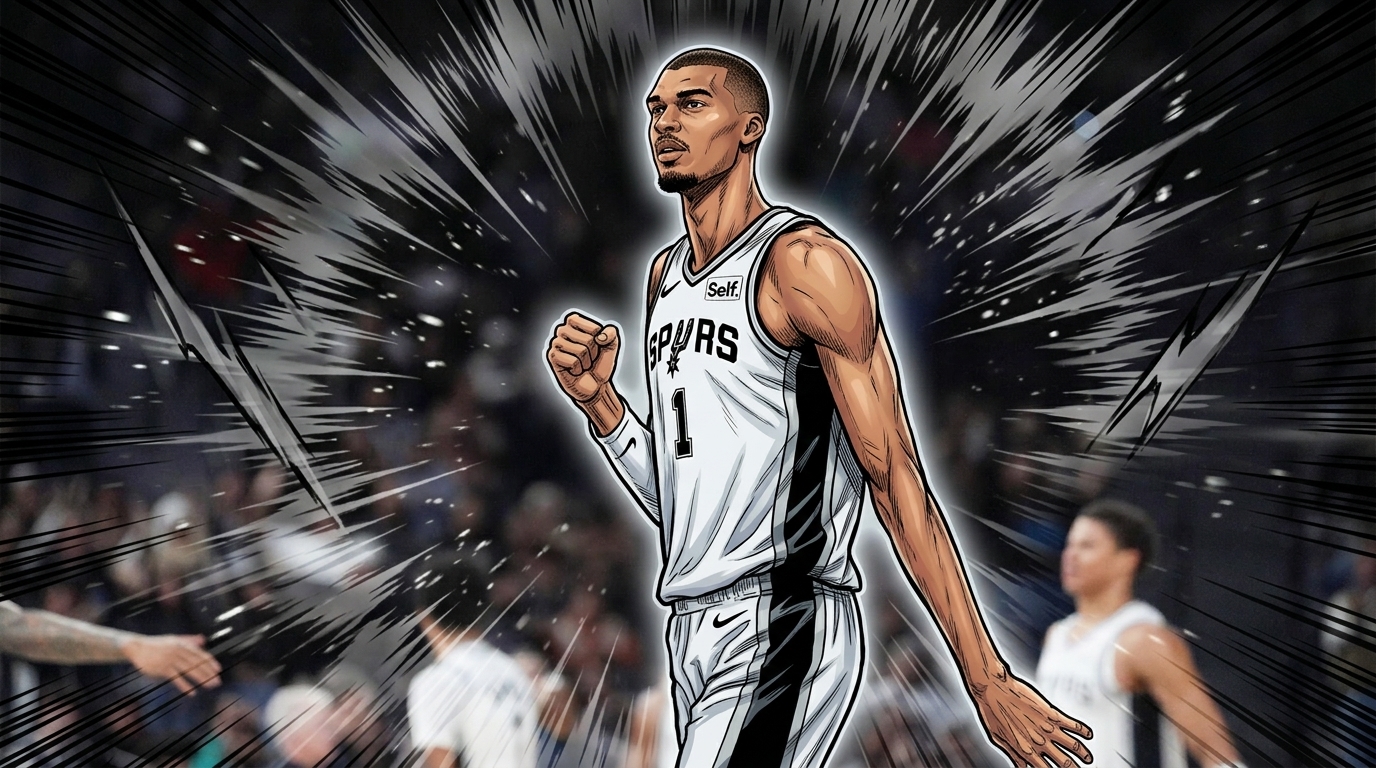
Harper’s actual line was 24 points, 11 rebounds, 6 assists, and 7 steals in 47 minutes during a 122-115 double-overtime win. He cleared the 20/10/5/5 threshold by meaningful margins across every category. Eight field goals. Seven-for-seven from the free throw line. The steals total alone — seven — would be a career night for most NBA players in a regular-season context.
For additional context: Magic Johnson posted a 20/10/5/5 line as a Laker rookie in the 1980 Finals. Harper did it as a Spurs rookie in 2026 — in a conference finals. The company is that small.
The context makes it stranger still. De’Aaron Fox was out with an ankle injury. Harper was filling in as the starting point guard for the first time in his postseason career — fifth career start, period. San Antonio played Game 1 of the Western Conference Finals without its starting point guard and its starting small forward, and won in double overtime. Harper started it. Wembanyama finished it.
The Dual-Cornerstone Window
Here is the framing that matters for the long arc.
Wembanyama is 22 years old (born January 4, 2004). Harper is 20 years old (born March 2, 2006). The gap between them is almost exactly two years and two months.
When we talk about franchise cornerstones, we’re really talking about peak overlap — the number of seasons two players can both be operating at or near the top of their individual performance curve simultaneously. Stars typically peak somewhere in the 26-28 range, though modern conditioning has extended that window. The relevant question isn’t peak individually; it’s peak jointly.
With Wembanyama and Harper, the math looks like this: if Wembanyama peaks between roughly 26 and 31 (ages 2030-2035), Harper will be 24 to 29 during that same stretch. The overlap of their individual prime windows is approximately six seasons — a long time, in NBA franchise terms. That’s the Dual-Cornerstone Window, and it’s what makes this pairing structurally different from everything that came before it.
One more data point anchoring the partnership’s future: Wembanyama’s 5-year, $252M max extension is projected to start July 6, 2026, with up to $303.3M including incentives (per Bobby Marks, ESPN). He’s not going anywhere. This is a deliberate, long-horizon build.
Why Durant and Westbrook Don’t Compare
Kevin Durant and Russell Westbrook were both born in 1988. They were both 23 years old when they reached the 2012 Finals together. Their age gap was zero.
That sounds ideal, but zero gap is actually the wrong construction. When two players peak at the exact same time, their contract timelines converge simultaneously. Their satisfaction timelines converge. Their ego timelines converge. You get one compressed window of greatness and then, if the chemistry sours — which it did, catastrophically — you have two superstars who both need to be paid max contracts at the same time and neither of whom can afford to subordinate his role.
Durant and Westbrook made one Finals together. Then they fell apart. Zero age gap means zero phase offset. One player can’t carry the other through a developmental period because there is no developmental period — they’re growing up at the same time, competing for the same oxygen.
Harper at 20 and Wembanyama at 22 have two years of phase offset. When the Spurs won Game 1 against Oklahoma City, Wembanyama was already the player he’s going to be for the next decade. Harper is still becoming that player. That’s not a weakness. That’s a structural asset.
The Payton-Kemp Problem
Gary Payton and Shawn Kemp had roughly a 1.3-year age gap. They were both 26-27 years old when they reached the 1996 Finals against Chicago, which everyone agrees was their peak as a partnership. The Sonics took seven seasons of development to get there.
Seven seasons. And then Seattle traded Kemp.
The Payton-Kemp parallel gets cited a lot when people talk about young duo timelines, but it’s worth naming what actually went wrong: the development curve was too long, the financial pressure arrived before the team was ready to win, and management made a decision that prioritized present payroll over future championship windows.
The Spurs, coming off a decade of Wembanyama-era infrastructure investment, are not the 1997 Seattle SuperSonics. They have organizational stability, a clear identity, and — critically — they’re already in the conference finals with a 20-year-old rookie filling in for their injured starting point guard. This isn’t a seven-season build. This is Season 1 of something that already works.
The Payton-Kemp Problem teaches us that age gap alone doesn’t guarantee sustained championship contention. Organizational decision-making does. The Spurs have the age gap right and the culture right. They have Wembanyama locked in through his extension. The question is whether they protect both cornerstones from the Kemp scenario — and so far, everything points to yes.
So What Does San Antonio Have?
The most structurally optimized dual-cornerstone construction in NBA history. Wembanyama and Harper aren’t just two great players. The two-year age offset means Wembanyama enters his prime while Harper is still developing into his — giving the Spurs approximately six seasons where both players are in the top quartile of their individual performance curves simultaneously. No prior pairing has had this combination: a sub-21 second cornerstone, a clear organizational system, and a franchise anchor already locked in on a max extension.
Durant and Westbrook had zero offset and made one Finals. Payton and Kemp had 1.3 years and the front office dissolved the partnership at its ceiling. Wembanyama and Harper at 22 and 20 may be the answer to the question neither duo ever got to fully answer: what happens when you build a dual cornerstone the right way?
Curry was 28 and Thompson was 26 at peak — a two-year gap, but both already established veterans. There was never a moment in their dynasty where one of them was a 20-year-old rookie putting up the Dylan Harper Bird Erving stat comp in a conference finals game. The Warriors were great. This is something different.
The Spurs won Game 1 in double overtime. They won it without their starting point guard. Their 20-year-old filled in and became the third player in 52 years — joining only Larry Bird and Julius Erving — to post a 20/10/5/5 in a conference finals game. And then Wembanyama, the franchise’s primary cornerstone, goes and locks in a five-year max.
The Dual-Cornerstone Window is open. It will stay open for at least six more seasons.
Commit to that conclusion. The data demands it.
Stats via basketball-reference.com. Wembanyama extension figures per Bobby Marks / ESPN. Conference finals historical threshold (20/10/5/5 since 1973-74) per basketball-reference.com conference finals game logs.
Related: Is Wembanyama the best player alive right now? | SGA vs. Wembanyama: the WCF MVP heir apparent debate