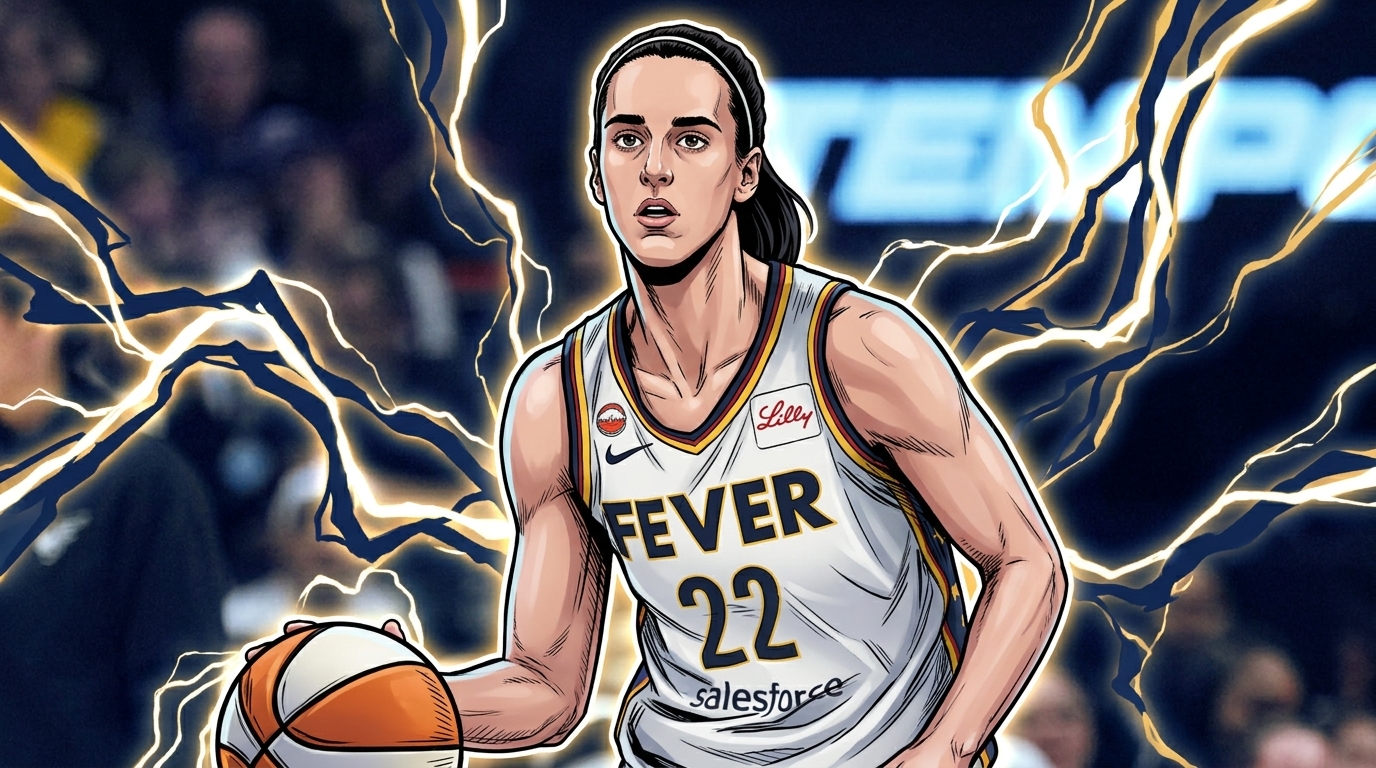

Caitlin Clark is one technical foul away from a number the WNBA has never had to reckon with for a player this famous: an automatic suspension. She’s tied for the league lead in technicals with Angel Reese at seven apiece, and there are seventeen games left after the All-Star break for either of them to find out what happens at eight.
Call it the Technical Threshold — the rate at which “Clark plays with fire” stops being a personality read and starts being a math problem with a suspension at the end of it. Seven through this stretch of the season holds up under either interpretation: either the WNBA has an officiating-consistency problem hiding behind its most bankable star, or the league is about to watch its most-watched player miss a game for reasons that have nothing to do with basketball.
None of this was supposed to be the headline Wednesday night. The Indiana Fever put up 123 points against Connecticut at Gainbridge Fieldhouse, a new franchise record that broke the mark of 114 the Fever set in overtime on June 11 against Chicago. It’s the third-highest scoring game without overtime in WNBA history, and Indiana’s 11th 100-point game of the season ties the league record for a single team in a season. The Fever led 70-46 at the break, the biggest halftime margin in franchise history, and finished 11-of-22 from three as a team.
Two nights after a 45-point outburst in Seattle that had the entire discourse machine running in overdrive, Clark backed it up. Her own line justified the moment: 27 points and 11 assists, 8-of-13 from the field and 5-of-9 from three, with 21 of those points already banked by halftime. Kelsey Mitchell added 23, Aliyah Boston had 22, and Monique Billings and Tyasha Harris each put up 12 as Indiana improved to 17-10, a half-game up on the Atlanta Dream for first place in the East.
That’s the half of the story that should be dominating the morning after. Twenty-one and seven at the break against a real defense is the type of stretch that gets its own screenshot cycle.
https://twitter.com/CC22stats/status/2080096241309147560
The stat trackers caught it before the box score even finalized. Clark is playing the best basketball of her career right now, and that’s exactly why the other number attached to her night deserves more scrutiny than a shrug.
What the Scoreboard Technical Actually Cost Her
Clark’s seventh technical came late in the third quarter, with Indiana already up big and the scoreboard reading 95-67. She and Connecticut’s Saniya Rivers had been trading words on a possession, and after Rivers told her she was locking her up, Clark gestured at the board. Both players were hit with technicals on the exchange. In Clark’s own words afterward: “She said she was locking me up, so I said, ‘Scoreboard,’ and the ref didn’t like that.”
The technical itself barely mattered to the score. Indiana was already cruising by more than 20 points. What it actually cost Clark was a rung on a ladder that ends in a suspension: she’s now one technical away from missing a game automatically, which turns every high-leverage possession for the rest of the season into a small referendum on her temper, fair or not.
Is Caitlin Clark Really the Most Combustible Player in the WNBA?
Statistically, she’s tied for the answer. Clark and Reese share the WNBA lead in technical fouls at seven apiece heading into the All-Star break. But the rate says less about temperament than about how the league’s most-watched, most-physically-engaged stars are being officiated relative to everyone else on the floor.
Reese, now with the Atlanta Dream after her April trade from Chicago, has drawn her seven fouls the same way Clark has drawn hers: through contact, contested calls, and a level of physicality officials have decided to flag more than almost anyone else in the league. Kahleah Copper is the closest thing to company at six, and she didn’t get there quietly either. Copper drew her own $1,000 fine and league warning letter on her way up the board, the same discipline track Clark and Reese have already been down.
The Field Isn’t Even Close
Three players are living on the same ledge, and none of them got there by accident. Clark and Reese at seven, Copper one behind at six — every one of them a max-usage scorer who spends her nights absorbing contact she isn’t always credited for drawing. That’s not a coincidence of temperament. It’s what happens when the league’s most heavily-guarded stars get whistled the same way for pushing back.
This isn’t the first time the pattern has drawn scrutiny. Clark’s fourth technical came with a $1,000 fine for kicking a ball in frustration. Her fifth, for clapping at a foul call a few days later, triggered the warning letters the league sent both players in June, back when Clark and Reese were both sitting at five apiece. Two more technicals for each of them since then, and whatever the letters were supposed to do, it didn’t happen.
What Happens When Technical Number Eight Arrives
Seventeen games remain after the All-Star break. That’s seventeen more chances for a foul call Clark disagrees with, a chippy exchange with a defender, or a whistle that goes the other way and ends with a raised voice. The math is simple even if the outcome isn’t: one more technical, at any point, in any game, triggers an automatic one-game suspension for the WNBA’s biggest ratings draw.
The league has two options here, and both are uncomfortable. One is to look hard at whether Clark, and Reese right alongside her, is being officiated more tightly than comparable stars doing similar things on the floor — a review the gap between them and the rest of the leaderboard all but demands. The other is to let the pattern run its course, in which case the league spends a fall week explaining why its most-watched player is standing courtside in street clothes instead of running an offense that just set a franchise scoring record.
Bet on the second outcome. Officiating reviews move slowly and rarely happen mid-season, while technical fouls have piled up on Clark at a pace of better than one a month since mid-June. The suspension probably lands before the WNBA finishes reviewing anything, and when it does, the conversation around it will have nothing to do with 123 points in Indianapolis and everything to do with a scoreboard, a stray comment, and a threshold the league office didn’t move fast enough to address.