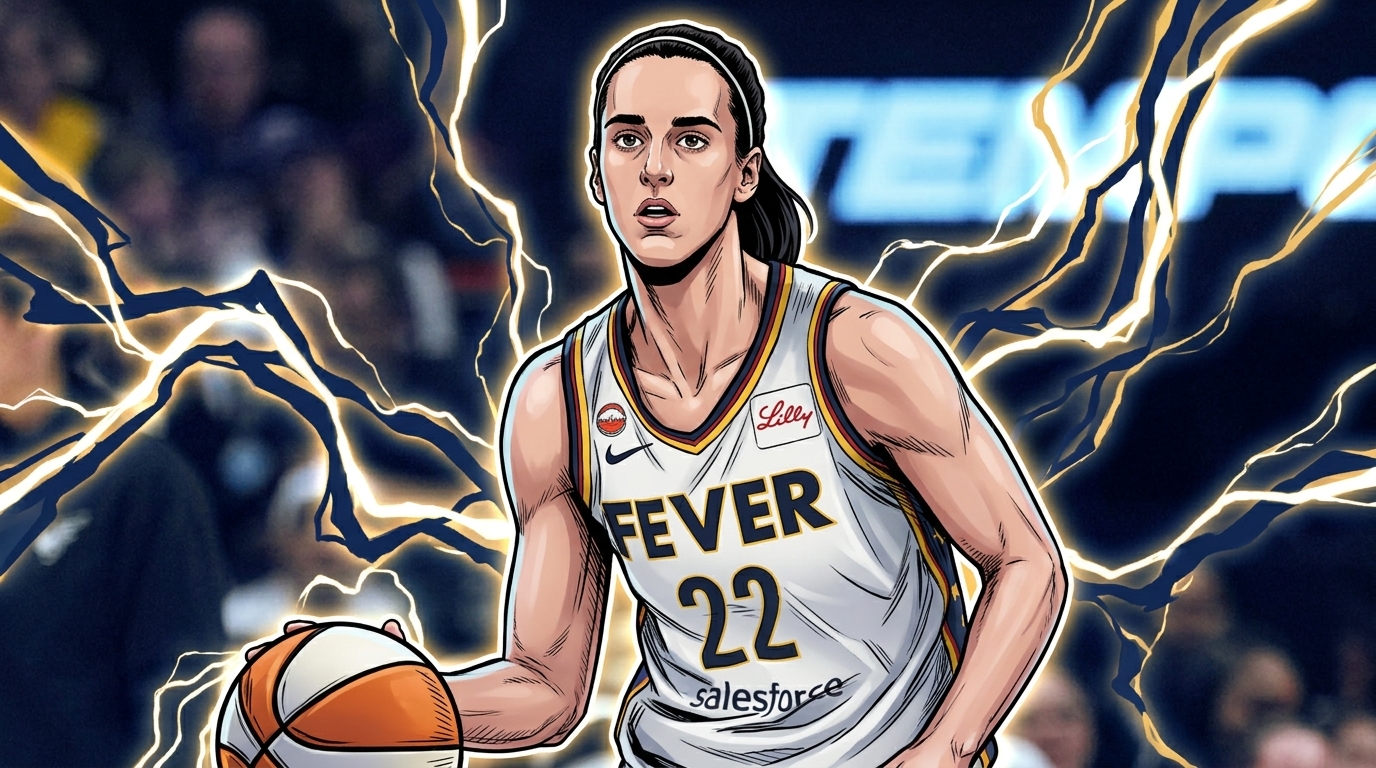

There’s a number from Sunday night that should worry whoever runs the WNBA’s next media rights negotiation more than any front-office memo will: 3.31 million. That’s the average audience for Caitlin Clark and the Indiana Fever’s 113-90 win over a Chicago Sky team that came in nine games under .500, and it made this the most-watched WNBA regular season game since the league’s opening weekend in 1997.
Clark also happened to have the best shooting night of her career while all of that was unfolding, which is either a coincidence or the entire point, depending on how much credit you’re willing to give a league that keeps acting surprised by its own audience.
How Many People Actually Watched the Fever-Sky Game?
Averaged across the full broadcast, 3.31 million people watched on NBC and Peacock, peaking at 3.82 million, per Sports Media Watch. That’s the most-watched WNBA regular season game since the league’s 1997 debut season, trailing only two games from that original schedule: Liberty-Sparks (5.04 million) and Sting-Mercury (3.59 million).
Clark scored 37 points on 13-of-24 shooting, made a career-high eight threes on 12 attempts, and added 10 assists, a stat line that would be a career night for most guards even without the threes attached. Kelsey Mitchell scored 30 of her own, and between the two of them the Fever made a franchise-record 18 three-pointers as a team. None of that happened against a contender. Chicago sat at 15-24, fifth in the Eastern Conference, on the wrong side of the standings all season.
The numbers were still making the rounds a day later:
https://twitter.com/CClarkReport/status/2092645838598091142
Three million people did not tune in because the standings promised drama. They tuned in because Clark was playing, and at this point that’s basically the whole premise.
Why Does This Keep Happening on Every Single Network?
Because it’s not confined to one network’s marketing push. Awful Announcing has tracked a Fever-driven viewership record on NBC, CBS, ESPN, Prime Video, Ion, and USA Network this season alone, which means the same audience keeps showing up regardless of who holds the broadcast rights that night.
NBC and Peacock had already set their own high mark this year with Fever-Aces at 2.64 million. CBS’s Fever-Liberty broadcast pulled 2.58 million, the most-watched WNBA game the network has ever aired. ESPN’s Fever-Dream game drew the largest cable audience the league has produced. Prime Video’s Fever-Wings broadcast, at 1.07 million, is the most-watched WNBA game the streamer has carried. Ion hit 1.62 million for a Fever game, its biggest audience for anything since August 2022, and USA Network’s Fever-Valkyries broadcast is still the highest-rated WNBA game in that network’s history. Six distribution deals, six different record books, one explanation running through all of them.
Stack those six records on top of each other and this stops looking like six coincidences. A channel’s ratings usually track its own promotional muscle, its lead-in programming, whatever its normal Sunday audience looks like. Nothing about that explains why a broadcast network, a legacy cable outlet, a streaming service, and two smaller broadcast partners have all hit their individual ceilings inside the same four-month stretch. The one variable that stays constant across all six is Clark being on the floor.
Put it against the number everyone already treats as the ceiling: last year’s entire WNBA Finals, four games spread across ESPN’s networks, averaged 1.5 million viewers combined. One regular season game between a good team and a losing one beat that by more than double, on a Sunday, in August, with the other team fighting just to stay relevant.
The reaction from people who watch basketball for a living matched the data. LeBron James posted his own praise afterward, and ESPN’s Sam Block put it more bluntly: “Any word other than generational is an insult.” My sister still thinks I trust a spreadsheet more than my own eyes, and most nights she’s right to give me grief for it. This is the rare case where the data and the eye test are saying the same thing.
What Does This Mean for the WNBA’s Next Media Rights Deal?
It means the league’s own internal valuation of Clark’s audience is behind what the ratings have already proven six times over. Every rights holder that has carried a Fever game this year now has its own record to point to, and the next negotiation has to price in an audience that shows up no matter which channel it’s on.
That gap matters because it’s the same league that still won’t pay for a 50-game season even as its highest-drawing player fills windows on networks that used to treat the WNBA as filler programming between real events. It’s also the league’s complicated relationship with just how much it needs her that keeps this from getting addressed directly instead of one press release at a time. This season also has two other historic seasons happening at the same time in scoring and rebounding, and neither is pulling a fraction of this audience. That’s not a knock on those seasons. It’s the actual size of the gap the next television deal has to account for.
Pricing that in means treating a Clark-driven audience less like a bonus and more like the baseline the next contract gets negotiated around, the way any league builds a media deal around its biggest draw. Right now the WNBA is still treating each record as its own standalone headline instead of connecting the six of them into a pattern. That gap between how the league is talking about this and what the ratings have already shown is exactly where the next rights fee gets left on the table or gets captured.
This pattern didn’t need a full season to prove itself. Six different broadcast partners have each posted their own Fever-driven record inside one WNBA season, against winning teams and losing ones alike, most recently against a team fighting to avoid the bottom of the East. The WNBA’s next media rights deal has to be built on that floor, not on the hope that Sunday was a one-time bounce. Six networks have already told the league what Clark’s audience is worth. Give me the higher number every time.