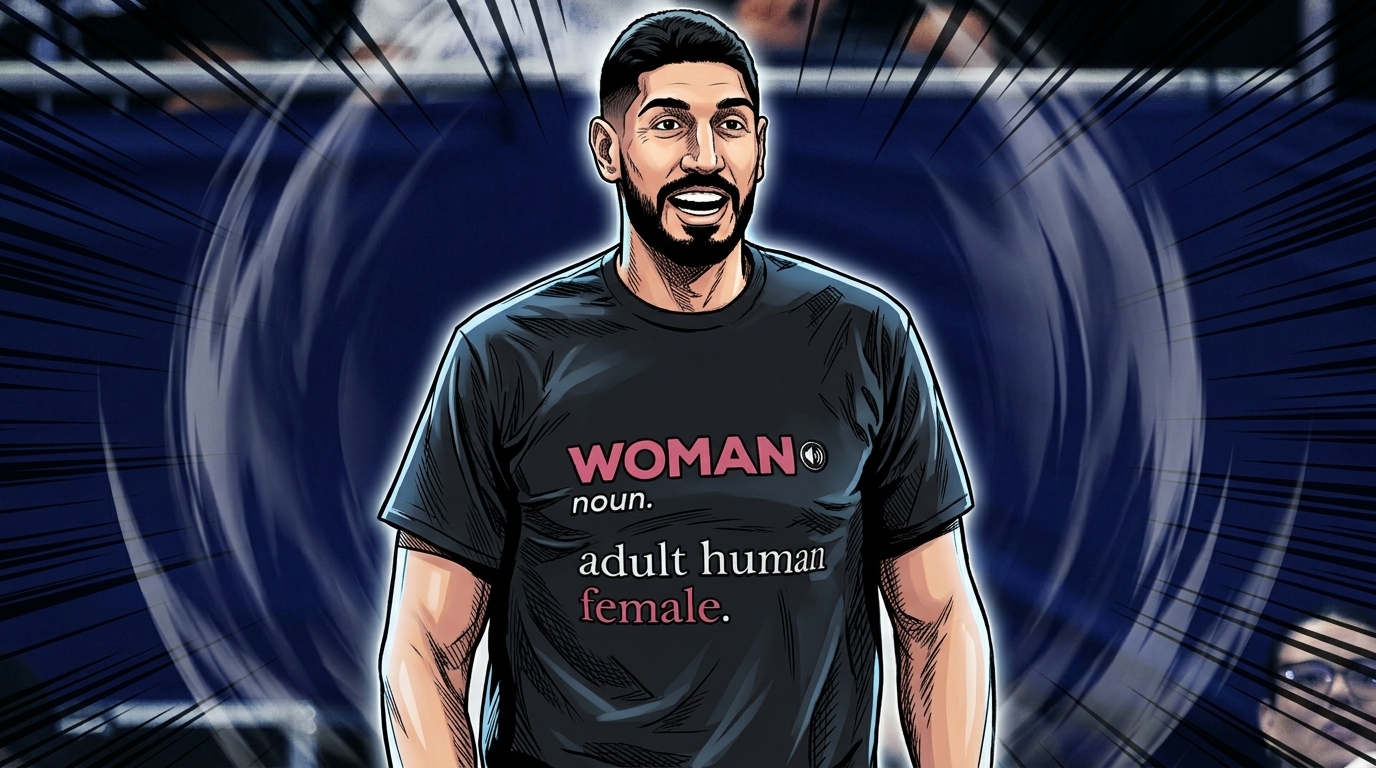

The WNBA ruled Enes Kanter Freedom and Royce White ineligible for the 2027 draft on Aug. 24, and we’ve spent two weeks waiting to hear the standard behind that ruling. We’re still waiting. A league source told Front Office Sports the declarations were “simply publicity stunts” and that the WNBA “will not give oxygen to efforts designed to mock the league or use this topic to demean and marginalize others.” That’s a verdict, not a rule, and the gap between the two matters more today than it did two weeks ago, because now there’s an actual decision on the books that needs justifying.
I made the underlying point at length in this site’s Aug. 10 coverage of the rule Kanter Freedom invented in the first place, so I’ll keep it brief here for readers who’ve followed along. The CBA’s Article XIII, Section 1(a) says “only players who are women are eligible to play in the WNBA” and defines nothing else about it: no test, no cross-referenced policy, no footnote. That absence is the whole opening Kanter Freedom and White walked through when they filed draft declarations built on a self-identification standard that doesn’t exist anywhere in the actual document governing WNBA eligibility.
What the WNBA Actually Said
What’s new since Aug. 10 is that the league stopped discussing and started ruling. Per Front Office Sports, a league source told the outlet that Kanter Freedom and White are not eligible to play, characterizing both declarations as bad-faith stunts rather than genuine attempts to join the league. OutKick’s writeup, independently corroborating the FOS reporting, adds a detail worth sitting with: the ruling came through unnamed league sources, not a formal statement carrying the league’s name. (A decision significant enough to make national headlines, apparently not significant enough to attach a name to.)
The league also said no immediate eligibility matters require further action, and that it won’t let “outside pressure or manufactured controversy dictate league processes.” That’s a reasonable defense against this specific stunt. It says nothing about the eligibility standard for the next person who files a similar declaration, because the WNBA never described a standard. It described a motive, and a motive isn’t a rule you can point to twice.
Every other draft eligibility rule in professional sports works because it points to something measurable: age cutoffs, college experience, international contract status. A prospect either clears the bar or doesn’t, and the league can show its work. The only standard the WNBA has applied here is a label attached after the fact to two specific people, which is an entirely different category of rule. It tells you who got disqualified. It doesn’t tell you what qualifies anyone else.
Why Won’t the League Point to a Rule?
My read: the WNBA would rather be caught dodging a definition than be stuck defending one. Writing an actual eligibility standard — sex assigned at birth, hormone thresholds, some other legal test — is a fight the league doesn’t want on paper, because any language it picks becomes a target the moment it’s published. “Publicity stunt” costs the league nothing. A written standard costs political capital on every side at once, and the WNBA has evidently decided that avoiding that cost now outweighs closing the gap that let this happen.
I think that’s a defensible short-term call. I don’t think it’s a sustainable one. The Kanter Freedom and White declarations were transparently bad-faith, obvious enough that even the task force the league routed this to two weeks ago barely needed the full meeting to reach a conclusion. (This is the same task force that had been on the calendar before any of this started, which made the two-week wait feel more like scheduling than urgency.) Then came his ejection from Wintrust Arena during the Aug. 23 Fever-Sky game, after a confrontation with Chicago Sky guard Natasha Cloud, which gave the league an unrelated second reason to want Kanter Freedom out of the news cycle. None of that changes the underlying problem. “This particular attempt was obviously bad-faith” is a character judgment about two specific people. It is not an eligibility standard, and it doesn’t function as one for anybody who comes next.
There’s a practical cost to leaving this open, too. Team executives, agents and college coaches now have to operate on an unwritten standard, guessing at criteria the league has never spelled out in any public document. That works fine right up until a case shows up that doesn’t sort itself as easily as two players who spent more time on cable news than on a WNBA roster. The league office is betting nobody with a legitimate claim tests this in the next year. That’s the bet a lot of institutions make right before it stops paying off.
The story moved fast once the ruling landed, with the sports aggregator PopBase relaying the Front Office Sports report within minutes. (The internet’s turnaround time remains undefeated.)
https://twitter.com/PopBase/status/2092012601169392093
What Happens the Next Time Someone Tries This
Picture the next declaration filed in good faith, by someone with a real claim under whatever standard the WNBA is actually applying but has never published. The league has no document to hand that person, and no document to hand its critics either. What it has is precedent: two rulings delivered through anonymous sources, justified by motive instead of definition. That precedent works exactly once per bad-faith actor. It collapses the first time somebody files a declaration the league can’t wave off as an obvious stunt.
This is the same prediction I closed the Aug. 10 piece with, and Monday’s ruling is that prediction showing up early. The league resolved the practical question and left the definitional one exactly where it found it. Write the standard, and the next version of this story becomes a routine eligibility review that nobody outside the league office notices. Leave it unwritten, and the next version becomes another round of unnamed sources explaining a decision the WNBA still can’t fully justify on paper. Nothing about this week suggests which way the league is leaning. Two weeks of history on this specific situation suggests they’ll wait until they’re forced to answer again.