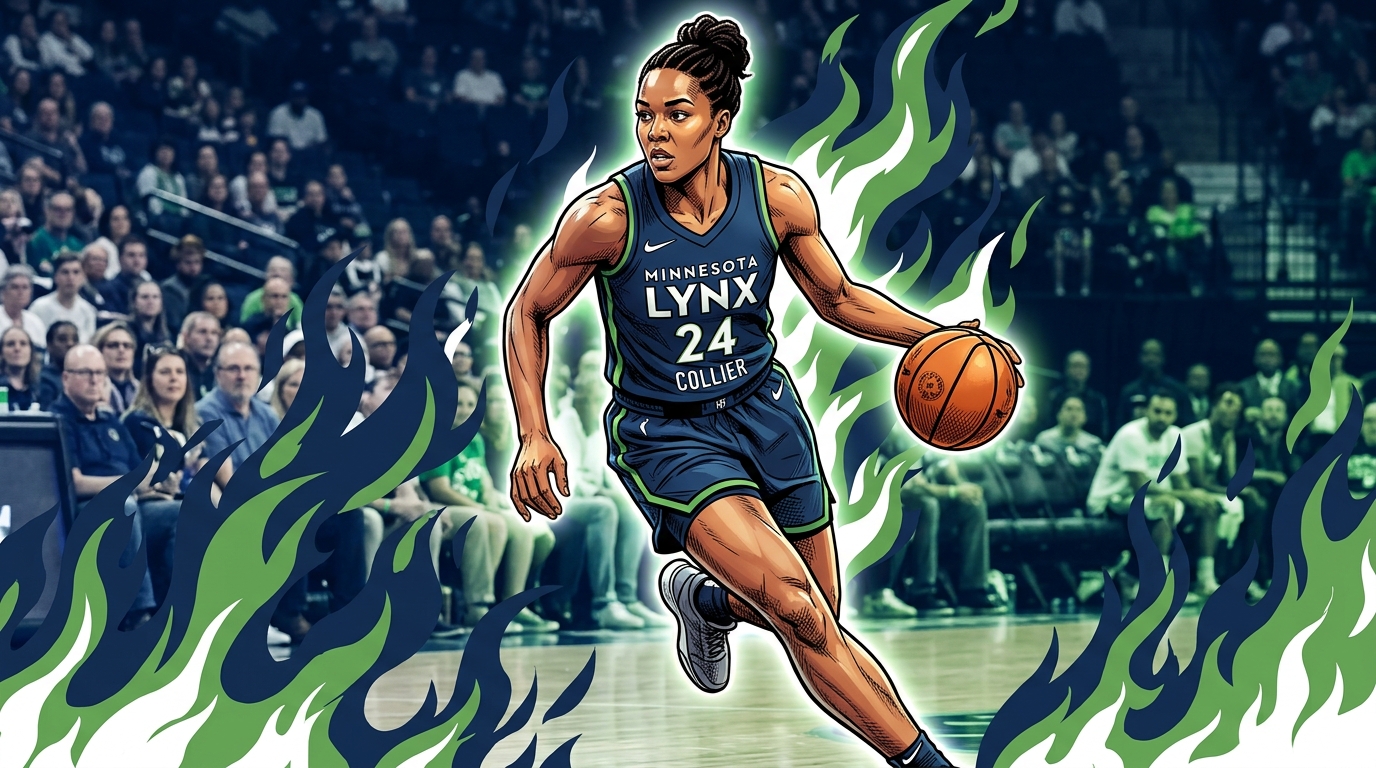

Caitlin Clark made eight three-pointers and dished ten assists in the same forty minutes Sunday night, and box scores aren’t supposed to let a player do both. She finished with a career-high 37 points on 13-of-24 shooting as the Fever beat the Chicago Sky 113-90, and by the final buzzer, Indiana had also set a franchise record for three-pointers made as a team. Two separate peaks landed in the same box score, and almost nobody was watching by the time it counted.
What Actually Happened in the Box Score
Clark shot 8-of-12 from three, a clip that works out to 67 percent on the same night she set a career high in threes made. She added 3-of-4 from the free-throw line, three rebounds, and a steal to go with the 10 assists, and her 13-of-24 mark from the field lands at 54 percent. That’s usually a line split across two different players on two different nights, not folded into one guard’s game. It isn’t even the first time Clark has rewritten the Fever record book on a night the rest of the news cycle swallowed whole; the last time Clark broke a Fever scoring record, the final stat line got buried by whatever else was happening that day too.
Kelsey Mitchell matched the outburst with 30 points on 6 made threes, and Indiana finished with 18 threes as a team, a new franchise high, with Clark alone responsible for eight of them. Lexie Hull chipped in 14 points and 2 threes off the wing, and Makayla Timpson controlled the interior with 12 points on 6-of-7 shooting and 9 rebounds, missing exactly once all night, per SI’s game takeaways.
Indiana pulled this off while playing without Aliyah Boston, its starting center, who sat out with a right leg injury, on the back end of a 3-2 road trip that crammed five games into eight days and snapped a two-game losing streak. NBC Sports had Chicago getting 16 points and 7 assists from Natasha Cloud and 14 points and 8 rebounds from Azura Stevens, and none of it was close to enough.
ESPN’s live reaction captured how absurd the line looked in real time:
https://twitter.com/espn/status/2091698183986356571
That tweet is also close to the entirety of the national attention this game got, which says everything about how the next 24 hours went.
Why Did Caitlin Clark’s Career Night Get Overshadowed?
Clark’s career night got buried because Enes Kanter Freedom was ejected from the same game in a courtside incident that dominated the national conversation within hours, leaving a 37-point, 8-three, 10-assist line that would normally lead every WNBA recap barely cracking the news cycle.
Strip away that noise, though, and the box score reads less like a hot shooting night and more like proof of concept for how this offense is built to work.
The Playmaking and the Scoring Peaked at the Same Time
Usage and playmaking usually pull against each other for any high-volume guard. The possessions you spend creating your own shot are possessions you aren’t spending setting up somebody else’s. This game refused to make that trade. Clark’s scoring volume went up and her assist total went up right alongside it, inside the same 40 minutes, which is the part that should be getting more attention than the shooting percentage.
When a primary ball-handler is drawing that much defensive attention and still finding cutters and shooters, defenses can’t sag off the catch-and-shoot man to help on the drive without conceding an open look, and that hesitation on the closeout is how a team ends up with a franchise record in made threes instead of just one big scoring night from its best player. Indiana can roll out three All-Star starters on one roster, and when Clark’s playmaking is operating at this level, Mitchell, Hull, and the rest stop looking like complementary scorers and start looking like the actual point of how the roster was built.
I track my own three-point splits during pickup runs at the Berkeley rec center, and the tradeoff is real even at a recreational level: the nights I get hot from deep are usually the nights I stop looking for the extra pass, because I’m too locked into my own rhythm to see it. Watching someone do both at once, at the highest level of the sport, in the same 40 minutes, is rare enough to notice even from a box score.
That’s the bigger idea sitting underneath the ejection headlines. A franchise-record shooting night from the team and a career night from the engine of the offense aren’t two separate stories that happened to land on the same date. They’re the same story, told from two angles, and the alignment itself is what’s rare, not either number on its own.
What a 25-14 Record Actually Buys Indiana
The Fever entered Sunday at 24-14. The win pushed Indiana to 25-14 and the No. 5 seed, per ESPN’s standings, while Chicago dropped to 15-23 and was eliminated from playoff contention in the same game. None of that is dramatic on its own in late August. A team already holding a top-five seed doesn’t need every star cylinder firing against an opponent that’s already out of the race, and Indiana got it anyway.
Find this same alignment again in October, when the opponent isn’t already eliminated and the possessions actually carry playoff weight, and Indiana stops being a dangerous five or six seed. It starts being a team nobody wants to see across two rounds. Bet on them finding it.