
The sports media ecosystem is a machine built to sort signal from noise, and on Thursday night it worked perfectly — it just classified the wrong thing as noise.
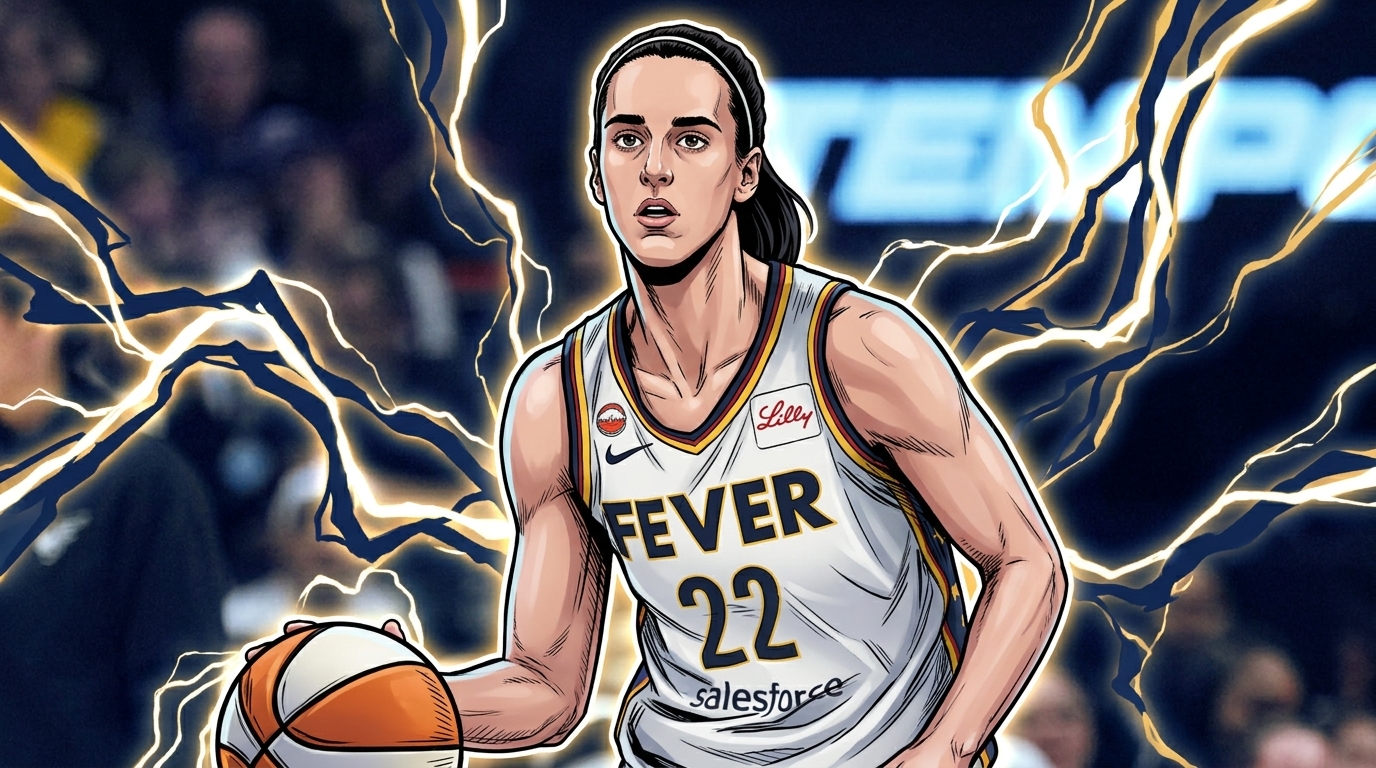
While Caitlin Clark was putting up 32 points and 10 assists against the Chicago Sky, per ESPN’s Michael Voepel, becoming the first player in WNBA history to record three career games with 30-plus points and 10-plus assists, the machine was pointed somewhere else. Game 5 of the NBA Finals was two days away. The Knicks were about to end a 53-year title drought. The amplification apparatus (the takes, the breakdowns, the hot-mic moments, the social content) was fully mobilized for Madison Square Garden, and anything that happened outside that gravitational field simply ceased to exist.
Clark’s 30/10 game on June 11 was not subtle. The Fever beat Chicago 114-106 in overtime at Gainbridge Fieldhouse in front of 15,578 fans; Clark went 8-of-18 from the field and a perfect 15-of-15 from the free-throw line. Aliyah Boston had 34 points and 12 rebounds (a career high), and the two became the first teammates in WNBA history to each record a 30-point double-double in the same game. The 114 points set a franchise record. Per Voepel’s reporting, no other player in the league’s history has more than one such game; Clark now has three.
Think about what that means as a sorting problem for the machine. It scans incoming data, assigns weights based on audience size, advertiser priority, and institutional familiarity, and routes each story to an appropriate slot. The WNBA slot is small; the NBA Finals slot is enormous. Clark’s historic game entered the queue and was processed correctly: filed in the small slot, given the requisite four paragraphs, and then the machine moved on. There was no malfunction. The output reflected the inputs exactly as designed.
That is the part worth sitting with. The problem is not that individual writers ignored Clark’s June 11 performance; several covered it well. The problem is the aggregate weight the system assigns to women’s basketball before any story gets filed, a weight set decades ago and recalibrated only slowly since. When Clark hit the game-winner against the Mystics last week — a 31-foot heave after Washington clawed back from 17 down to lead by one with four seconds left — that story got a standard news cycle: correct, competent, brief. When a man makes that shot in Game 5 of the Finals, it becomes a documentary chapter.
https://twitter.com/UnderdogWNBA/status/2064162149241389462
The Fever are now 7-5 on a three-game winning streak. Clark is averaging close to 20 points a game and leading the league in assists. This is a team playing well at the right time, anchored by a player doing things no one in the history of this league has done; the WNBA’s complicated institutional relationship with Clark makes the under-coverage feel especially pointed, as if the league and the media apparatus surrounding it are both still calibrating how much space she is allowed to occupy.
The machine gave Game 5 everything it had and produced the correct output — 53 years of Knicks suffering resolved on a Saturday night deserved the volume it received. Nobody is arguing otherwise. The argument is narrower and darker: that the settings which produced Thursday’s silence were not set by accident, and nobody with the power to adjust them seems particularly bothered to try.
Clark will probably make a fourth 30/10 game at some point. The machine will process it efficiently and move on.