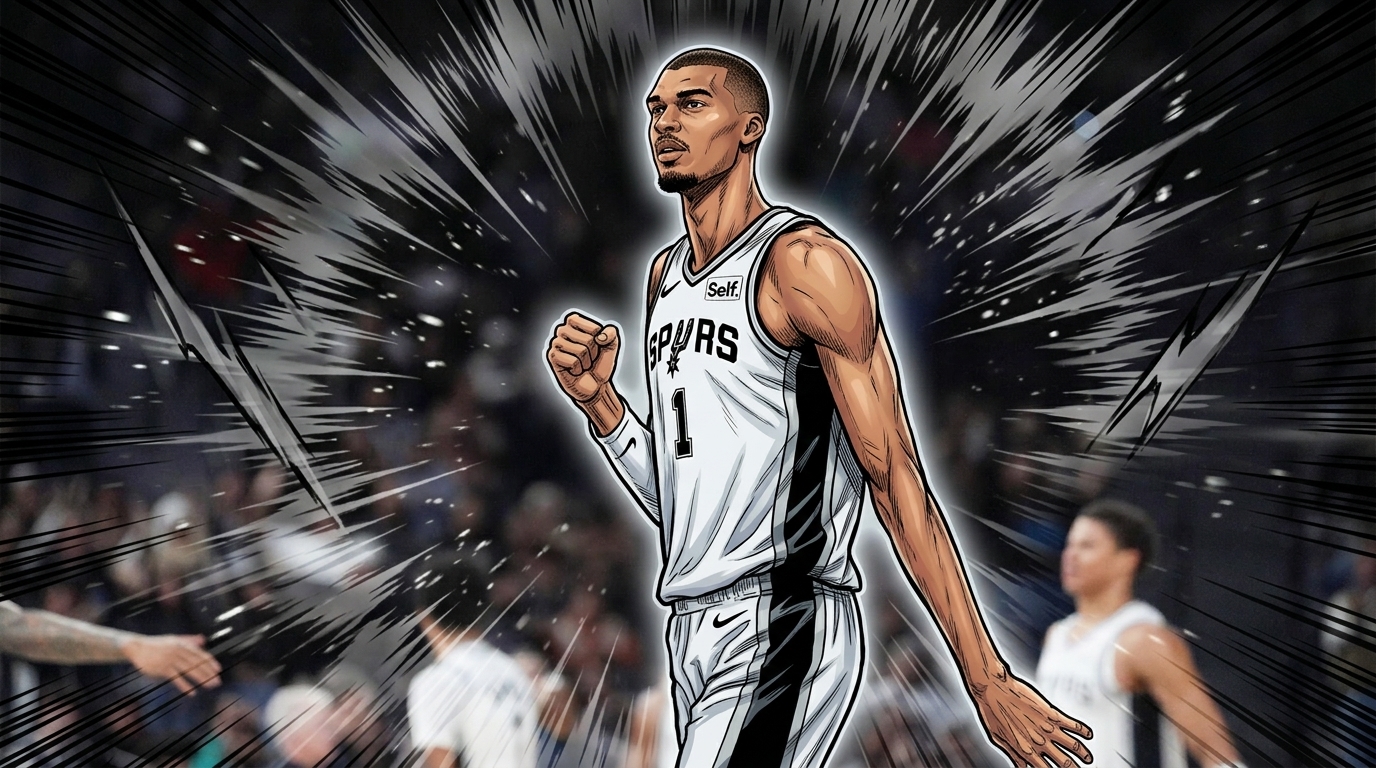
Victor Wembanyama went 6-for-21 and looked visibly gassed in the fourth quarter of NBA Finals Game 1, and Mitch Johnson played him thirty-eight minutes against the best defensive team in the league.
Not 30. Not 32. Thirty-eight.
Brian Windhorst said he felt Wemby was low on energy from the first quarter — observed him bending over grabbing his shorts before the Knicks had even started their second-quarter run. Nick Wright’s read was starker: “Victor Wembanyama has been running on a quarter tank since the double overtime game. And that was seven games ago.” The double-OT game was in the WCF. Wemby averaged 37.7 minutes across that entire seven-game series against Oklahoma City. He came into the Finals already running on vapors, and Johnson handed him 38 more minutes in Game 1.
Bill Simmons put it plainly: “Wemby looked tired.” Doc Rivers, watching the same game, said Wemby looked “sped up” — that he was “putting the ball on the floor way more than usual.” That’s not a player in rhythm. That’s a player compensating, grinding against his own legs. It ended the way those nights end: Wembanyama dribbled the ball off his own foot with sixty seconds left, Jalen Brunson hit the corner three on the other end, and the Knicks closed on an 11-0 run to win 105-95.
Mitch Johnson, December 2025, on his load management philosophy:
https://twitter.com/UnderdogNBA/status/2004259179037622451
Johnson said no triple-overtime minutes. Then played him 38 in a Finals collapse. The quote aged about as well as De’Aaron Fox’s shot selection (3-for-13, 0-for-4 from three, 38 minutes of crunch-time deployment while Dylan Harper — 6-for-10, 16 points, the best Spur on the court — sat on the bench in the closing two minutes). Critics called the Harper-for-Fox decision coaching malpractice, and they weren’t wrong. It’s the same problem wearing a different jersey.
Johnson may not have had a choice. The Spurs’ net rating with Wembanyama on the court is plus-16.7 per 100 possessions. When he sits, they’re essentially break-even. There is no backup who can hold the line. No second unit capable of surviving five minutes against New York’s defense without the series turning into a blowout. So when Johnson faces the emotional labor being asked of him on top of the physical toll — the impossible ask of a 22-year-old to carry this team across a seven-game playoff gauntlet into a Finals — the coaching critique and the front office critique collapse into the same critique. Johnson didn’t build this roster. But he’s the one making the decision to burn its only engine.
Here’s the Game 2 trap. If Johnson pulls Wemby back to 32-34 minutes and he shoots 50%, the narrative becomes “coach made the adjustment.” If he plays him 38 again and Wemby shoots 35%, the narrative becomes “coach buried his franchise player.” Wemby said he just needs to play normal, which is either confidence or cope, and the answer to that question lives entirely in how Johnson manages Game 2. The Spurs are down 1-0 with a visibly fatigued star and a rotation that already exposed itself.
Brunson is scoring 13 points in the fourth quarter. The margin for error is zero. Thirty-eight minutes won’t fix that, and Johnson knows it.
He just has to decide whether knowing it is enough to do something about it.