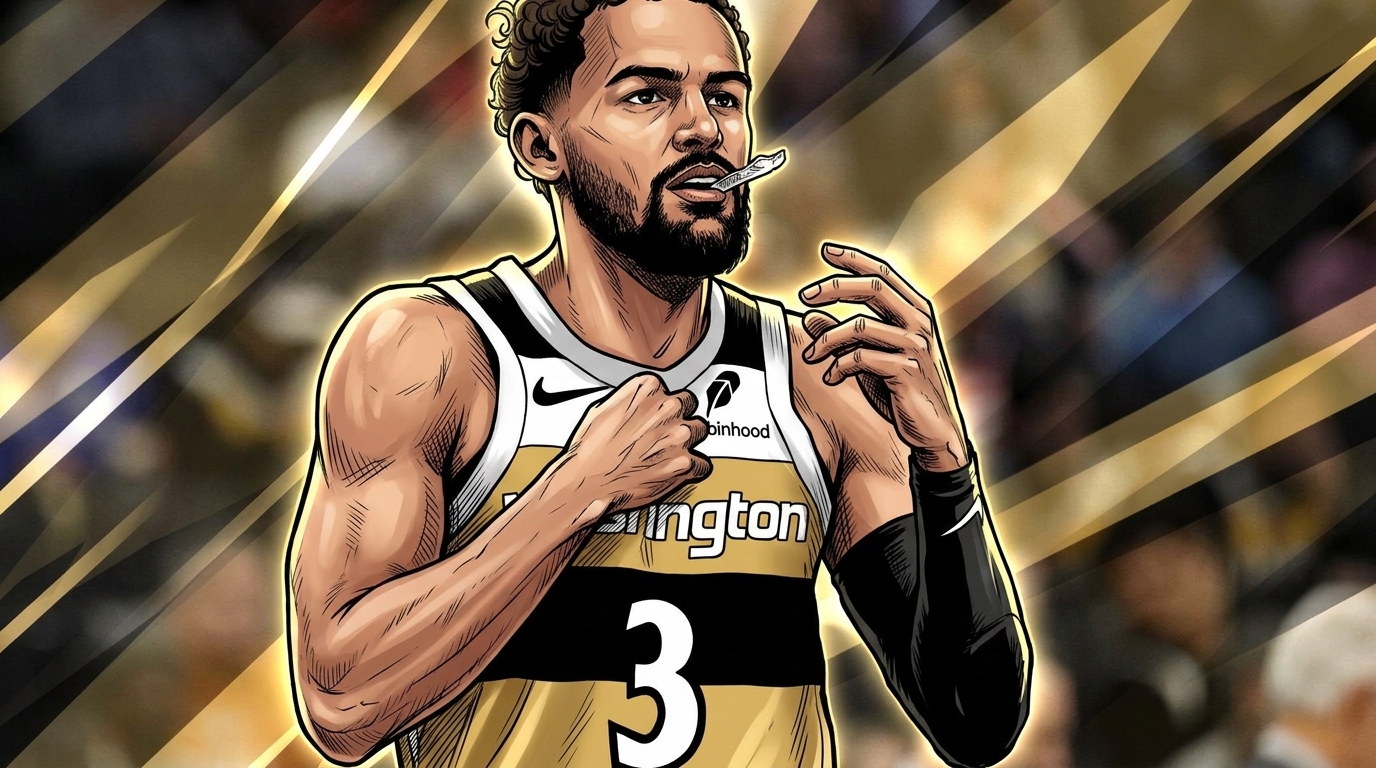

I want to talk about the Wizards fan who renewed their season tickets last fall thinking that seven years of losing was finally structural, finally intentional, finally pointed somewhere. The one who told themselves that AJ Dybantsa at No. 1 was the anchor, that the organization had a direction, that this time the suffering was part of something. That person just watched Washington commit $212 million to Trae Young, and I need them to know: I see you, and I’m furious on your behalf.
Four years, $212 million. Roughly $53 million per season for a player who appeared in 15 combined games last year after spraining his MCL. A four-time All-Star with 9.8 career assists per game and a floater so good it should be in a museum — and a defensive profile so catastrophically bad it should be in a dumpster. The Washington Wizards ranked 29th in defensive rating in 2025-26, allowing 121.2 points per 100 possessions. Twenty-ninth. Out of thirty. And the solution the front office landed on was signing one of the worst perimeter defenders at his position to a max contract.
Here is Will Dawkins, the Wizards GM, explaining his thinking: “The few games that Trae was able to play, you just saw the gravity that he has and how he’ll be able to free up our guys.”
Gravity. He used the word gravity. Offensive gravity — the way defenses have to collapse toward Trae Young, opening lanes and corners for everyone else. That part is real. Trae Young absolutely has gravity. What Dawkins left out is what happens on the other end of the floor, where Young’s own gravity works differently: it attracts mismatches, drags rotations out of position, and pulls opponents toward the basket for uncontested layups. The word he was looking for was liability, but that one doesn’t play well at a press conference.
Meanwhile, Anthony Davis is locked in at $58.5 million for 2026-27, his one remaining guaranteed year before his deal expires. Add Young’s $53 million. That is $111 million committed to two stars on a roster still waiting for its No. 1 pick to develop into whatever he’s going to be. The financial math here isn’t bold. It’s a franchise trying to look decisive while avoiding every hard question about why it has lost seven consecutive seasons.
Trae Young himself is not the villain. You can understand why he wanted out of Atlanta — that situation was corrosive — and you can understand why he’d sign a max deal in a market where someone was willing to pay it. His tweet says everything about where he’s at mentally:
https://twitter.com/TheTraeYoung/status/2074988662400635103
“D.C. is my New Home! Let’s do it, Ready to go!” Great. He’s motivated. The problem isn’t Trae Young’s desire. The problem is that Washington just committed $212 million to a player who declined his player option to chase this payday — and the Wizards handed it over without solving a single thing that has made them irrelevant for most of a decade.
This is how organizational dysfunction reproduces itself. Not through malice — through press release logic. You sign a name, you generate coverage, you give season-ticket holders something to point at when their friends ask why they keep going. The accountability gap is baked in: by the time it becomes undeniable that this roster doesn’t work, the people who built it will have reframed the narrative, moved to different jobs, or simply waited long enough for the discourse to move on. They’ll say they couldn’t have predicted the injuries. They’ll say the pieces needed more time. They’ll say something.
Brian Keefe enters year three as head coach of a team that was 29th in defense last season and is now adding a guard who will make that number worse. Seven losing seasons. Three head coaches in five years. One max contract that addresses none of it.
But hey — gravity.