
Every consequential draft decision can be collapsed into two tests. The Floor Test: what is this player’s realistic median outcome? The Ceiling Argument: what happens if every variable goes right? Most No. 1 picks are settled before the tests even run — the prospect is so clearly superior that both tests point at the same name. The Washington Wizards, holding the top pick in the 2026 NBA Draft two days from now, do not have that luxury. For a deeper look at where this class stands, see our earlier breakdown of this draft class.
AJ Dybantsa and Darryn Peterson pass their respective tests in different directions. Dybantsa aces the Floor Test. Peterson wins the Ceiling Argument. How a franchise handles this kind of split, when the data genuinely refuses to converge, is one of the most definitional choices an organization makes. The Wizards tanked deliberately, finished 17-65, secured a 14% lottery shot, and hit it. That work has led them here. The next decade of Washington basketball flows from what they decide on June 23rd.
The Floor Test: What Dybantsa’s Numbers Actually Say
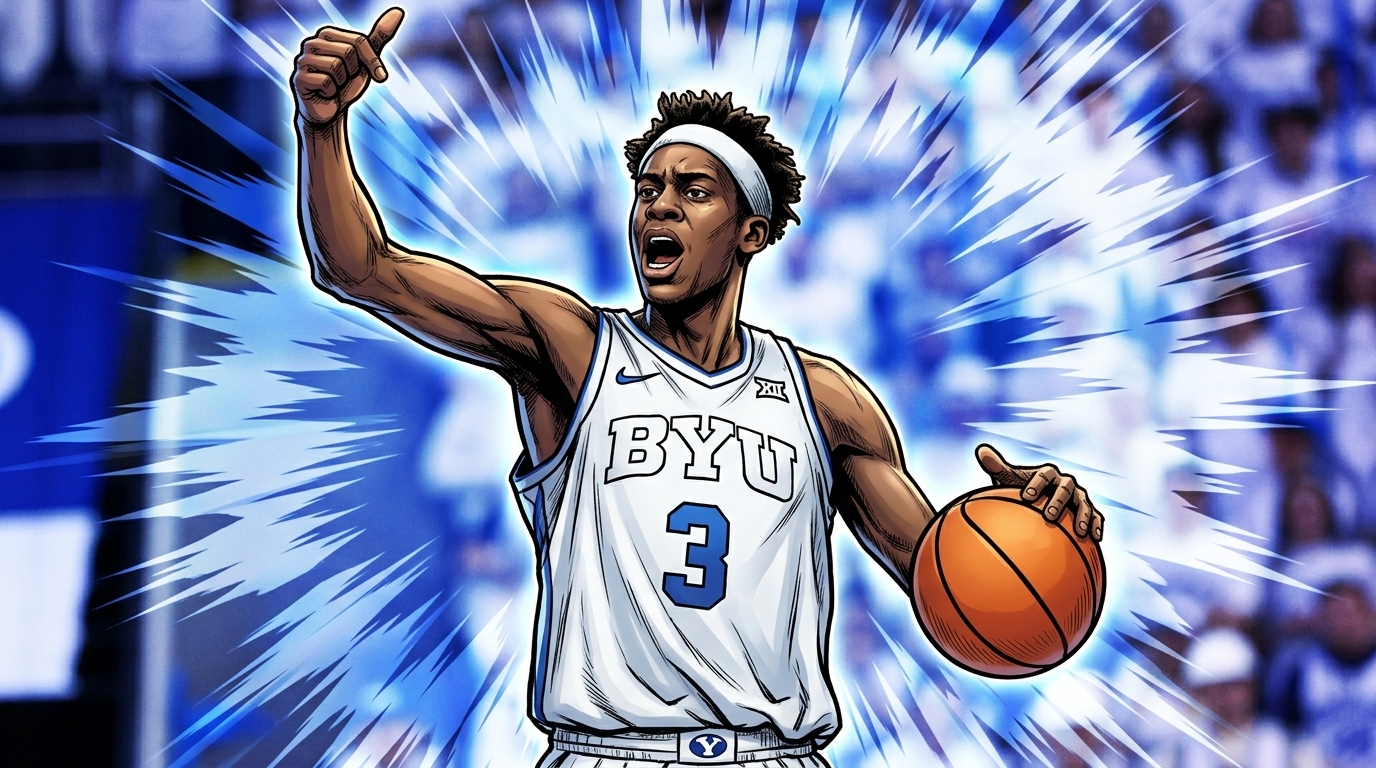
AJ Dybantsa’s 2025-26 season at BYU was, statistically, one of the most complete freshman campaigns in college basketball history. He led the nation with 25.5 points per game across 35 games, added 6.8 rebounds and 3.7 assists, and did it on 51.0% field goal shooting and 55% effective field goal percentage. When CBS Sports assembled a roundtable to contextualize this, they landed on Bird, Erving, Maravich, Oscar Robertson, and Jerry West as the only players in the historical record who averaged 25/6/3 as freshmen in major-conference ball. That is either one of the most remarkable comp lists ever assembled or the most alarming, depending on your priors about historical comparisons.
The physical profile makes the numbers feel sustainable rather than a product of college-level mismatch. Dybantsa is 6’8.5” with a 7’0.5” wingspan and a 42-inch max vertical. He is a prototypical modern wing: switchable defensively (in theory), playmaking at volume, scoring in every zone on the floor. An anonymous Eastern Conference executive told Bleacher Report, “He’s special. There’s just so much for him to still grow into.” That last sentence, easy to gloss over, is actually the Floor Test’s most important input: the upside is not fully priced in yet.
Two weaknesses are real and worth naming precisely. Dybantsa’s catch-and-shoot three-point percentage was 30.1% on 83 attempts — not disqualifying for a 19-year-old but a live concern if the Wizards want spacing around Alex Sarr. More structurally, his off-ball defense was, per scouting consensus, almost a complete non-factor. Dybantsa tracks the ball, not his man. Against NBA athletes, that gap will be visible immediately.
Still, the floor here is a reliable 20-plus point wing who stretches defenses vertically and makes plays off the bounce. That player has never failed to be useful. The Wizards’ young core (Sarr, Bilal Coulibaly, Kyshawn George, Bub Carrington, Tre Johnson) can absorb a player with Dybantsa’s specific redundancies. Sarr’s recovery from foot surgery (expected ready for training camp) only matters more if the player beside him can carry offensive load independently. Dybantsa can.
The Ceiling Argument: Why Peterson Has Believers
Darryn Peterson played 24 games at Kansas in 2025-26. Hamstring, ankle, cramping. The film catalogue is thin. By any conventional evaluation standard, that volume of injury-related absence at the most important audition of a prospect’s career should drag a player’s stock toward the middle of the lottery, not the top of it.
Woof.
Peterson still averaged 20.2 points per game (the highest scoring average ever recorded by a Kansas freshman, per Yardbarker) on 44% field goals and 38.2% from three on 6.9 attempts per game. The three-point efficiency number matters more than it looks. The volume is NBA starter territory. The accuracy is All-Star territory. Bill Self called Peterson “the best player I have ever recruited.” Kendrick Perkins went further on ESPN First Take, arguing Peterson has “zero flaws offensively” and projecting a ceiling of Kobe Bryant with a floor of Bradley Beal producing 20-plus immediately. Floor and Ceiling Substack framed him as a “genuine offensive superstar” at his ceiling, a “gravitational off-ball shot-maker” at his realistic worst case.
The most telling signal came from Peterson himself. He declined pre-draft visits with every team except Washington. He visited only the Wizards, a deliberate signal that he expects to go first. Players with genuine concerns about their draft position spread their visits to stay optioned. Peterson did not.
https://twitter.com/ShamsCharania/status/2066502245894475809
ESPN’s Jeremy Woo, who covers this draft as closely as anyone working, moved Peterson to No. 1 on his final big board after the combine medical clearance came through clean, citing Peterson’s “shot-making ability and long-term upside as a lead guard.” Marc Stein reported the Wizards were “still undecided” entering the final week with “increased consideration” for Peterson, unusual language for a team that typically telegraphs consensus early.
The ceiling case is simple and slightly unnerving: if Peterson is healthy and the shooting holds, you may be passing on the best player in this draft. The NBA’s premium remains on shot-makers who can operate as primary playmakers. Peterson’s pull-quote skill, that 38.2% from deep on near-seven attempts per game, maps directly onto what organizations covet above any other trait in 2026.
Should the Wizards Take AJ Dybantsa or Darryn Peterson No. 1 Overall?
The Wizards should take AJ Dybantsa at No. 1 overall. He offers a safer, statistically grounded floor as a 25-point wing with elite athleticism and size, and his complementary fit with Alex Sarr is manageable. Peterson’s ceiling is real, but 24 games of injury-riddled film combined with a limited passing profile makes him the higher-variance choice for a franchise still in construction.
That said, the case for Peterson is not speculative. It is data-driven and has legitimate insider weight behind it. If Washington believes in Peterson’s medical clearance and trusts the shooting efficiency over the small sample concern, taking him first is defensible. This draft decision is genuinely bilateral in a way that the No. 1 pick almost never is.
The Variable That Decides Everything
The final analytical frame I’d offer is what I’ll call The Construction Variable — which pick fits the specific roster being assembled, not the abstract best-player board.
Washington already has Alex Sarr: a 7-footer averaging 17.7 points, 7.5 rebounds, and 2.2 blocks on 49.8% from the field and 34.3% from three as a sophomore. Sarr is a ball-handler, a shot-creator, and a rim protector. He is, in other words, a self-sufficient offensive hub who does not need another self-sufficient offensive hub beside him. I spent a chunk of my PhD work building lineup efficiency models, and the question of whether two high-usage primary creators can coexist in the same half-court system is not abstract to me. Ball doesn’t grow on trees, and both Dybantsa and Sarr want it in their hands.
Darryn Peterson is listed as a SG/PG at 6’5”. Beside Sarr, he slides into a role where he catches, attacks off movement, and operates within defined spacing: a configuration that plays to his shooting and cuts without creating the usage conflict. Dybantsa at 6’8.5” is also a wing, also a primary ball-handler by instinct, and his heliocentrism tendencies were flagged by scouts as a real concern precisely because of that overlap with Sarr’s game.
Peterson, architecturally, fits better. The just-concluded NBA Finals settled around the question of whether you can build a contender without a true lead-guard spine. Washington’s young core is already forward-heavy. They could genuinely use what Peterson offers in terms of positional distinction.
And then there is the 2003 reference point, the one everyone keeps reaching for. LeBron James versus Carmelo Anthony. Cleveland versus Denver. The debate was real. Anthony’s national championship with Syracuse freshman year made it credible, and Carmelo actually outperformed LeBron in Year 1 (21.0 points, 6.1 win shares, made the playoffs). Cleveland’s 5.1 win shares and a missed playoffs. What the 2003 comparison should teach us is not which prospect was right, but that the debate being real does not mean the choices are equivalent. LeBron was the correct pick. The heat of the deliberation didn’t change that in retrospect.
The 2026 version, Stein reported, is more genuinely contested at the organizational level than Cleveland’s ever was. Whether that means the Wizards are doing their jobs thoroughly or losing the thread is the only remaining question.
My read: Washington takes Dybantsa. Not because Peterson is a wrong answer, but because the Floor Test is what you optimize for when you have spent three years deliberately losing to earn one swing. Dybantsa’s floor is defined and high. Peterson’s ceiling may be higher (the shooting numbers demand that concession), but the ceiling only matters if the floor holds. After 24 games and three separate injury interruptions, the Wizards cannot be certain it does. They pick Dybantsa on Thursday, Sarr-Dybantsa becomes the backbone of a legitimately interesting rebuild, and the Peterson debate fades into the category of choices that had no wrong answer, only different risks with different timelines.