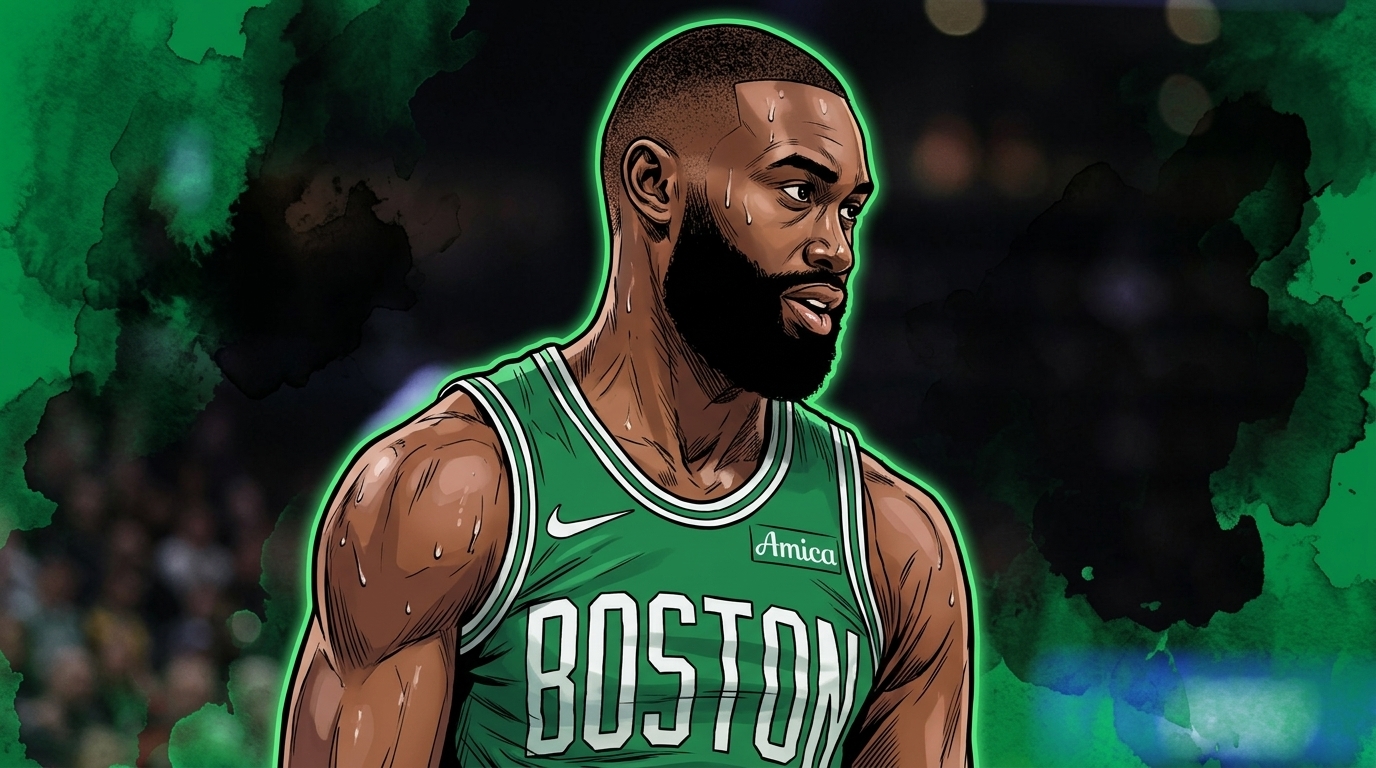

When the Philadelphia 76ers landed Jaylen Brown last week, sportsbooks moved like someone had flipped a breaker. DraftKings went from 66-1 to 22-1 overnight. ESPN Bet dropped from 60-1 to 20-1. The implied championship probability jumped from roughly 1.5% to 4.5% in the span of a news cycle. That is a significant market correction, and the market is not wrong about what it is pricing. Brown at 28.7 points, 6.9 rebounds, and 5.1 assists per game — all career bests — is a genuine superstar. Pair him with Joel Embiid and Tyrese Maxey and you have a three-star alignment that would make any front office feel dangerous.
Tyrese Maxey said it plainly:
https://x.com/TyreseMaxey/status/2072455538638520513
The NBA is doing that thing again. It does this. A big trade drops, the market reacts, the discourse runs hot for two weeks. Everyone is pricing the ceiling. Almost no one is pricing the floor.
I want to price the floor.
What the Market Priced
The 22-1 number captures the genuine upside of this roster. Brown just led Boston to 56 wins while Jayson Tatum was recovering from a torn Achilles. He finished fourth in scoring, sixth in MVP voting, and Second Team All-NBA. He is not a supporting character — he is a co-star. The Celtics’ asking price started at Brown plus Edgecombe plus five first-round picks. Philadelphia negotiated it down to Paul George plus two firsts and two seconds, which is remarkable leverage for a player of Brown’s caliber. George averaged 17.3 points across 37 games in 2025-26 and hasn’t made an All-Star team since 2023-24. That is not an equal exchange — that is a franchise inflection point.
The market saw all of this and moved accordingly. The ceiling of Brown plus Embiid plus Maxey is genuinely terrifying. When Embiid is at full health, he is a 26.9/7.7/3.9 big man who can anchor a championship defense and create mismatches that the league has no clean answer for. When that center is flanked by a 28-point wing and an All-NBA point guard, you have a lineup that could beat any team in the East on any given night.
The market priced that lineup. Here is what it may not have fully priced.
The Number the Sportsbooks Didn’t Model
Joel Embiid has played 38, 19, and 39 games in the last three seasons.
Those are not “injury-shortened” seasons in the euphemistic sense — they are representative of who Embiid is at this stage of his career. In 2023-24, a torn meniscus cost him 43 games. In 2024-25, lingering left knee issues ended his season at 19. This past year, he played 38 regular season games and then had an appendectomy just before the playoffs. He played through Games 5 through 7 against Boston with post-surgical complications affecting his hip and adductor. The man competed through that. The Sixers won that series. And that fact tells you something important about both his toughness and the fragility of a roster built around him.
Embiid has never played 82 games in a season. His healthiest recent stretch was 2021-22, when he played 68. His three-year average is now 32 games.
Here is the expected value problem: a 22-1 line implies roughly a 4.5% title probability. That probability is calculated, however implicitly, against a team that exists as constructed. But the Sixers’ starting lineup is fully assembled for only a fraction of their games. If Embiid plays 40 games in 2026-27 — consistent with recent history — the team that actually takes the floor most nights looks materially different from the one the market priced.
I am not in the business of predicting injury. Nobody is. But patterns matter when they span three consecutive seasons, and the pattern here is not ambiguous.
Are the 76ers Real 2027 Title Contenders?
Yes — conditionally. That conditional is doing a lot of work.
The Eastern Conference picture heading into next season has Philadelphia third at +750, behind the Knicks at +325 and Boston at +450. The Knicks remain the Eastern Conference’s current favorites, which means any Philadelphia path runs through New York. That is a real gauntlet. It is also a gauntlet that requires Embiid to be healthy for a full playoff run, which is a separate and more demanding ask than simply getting through a regular season.
The counterargument is real and I want to give it fair weight: a team with Brown and Maxey as co-stars doesn’t fall off a cliff when Embiid misses time. They won a playoff series without him at full capacity. That roster has genuine depth of star power, and the Brown acquisition was arguably the right bet to make given the alternative — a post-Embiid rebuild that would set the franchise back five years.
But the expected value of a 22-1 line is different from the ceiling of a healthy lineup. Expected value accounts for probability-weighted outcomes across all scenarios, including the ones where Embiid plays 35 games and the Sixers finish as a six-seed.
What the Sixers Are Actually Worth
The data here is unambiguous: Brown is a real acquisition, the ceiling is legitimate, and Philadelphia is a genuine contender when their roster is healthy. None of that is in dispute.
What is in dispute is whether 22-1 appropriately accounts for three consecutive sub-40-game seasons from the player the entire system is built around. My model says no. The market prices hope efficiently. It prices injury history less so.
If Embiid gives them 55 games with his usual production, the Sixers might be underpriced at 22-1. If he gives them 38, which is what he gave them last year, Philadelphia is probably closer to a second-round team than a Finals team. The truth will land somewhere between those poles.
The market bet on the dream. The dream is real. The math on the nightmare, though, hasn’t been shown its work.
For more on the NBA landscape heading into the offseason, visit our NBA hub.