
There is a specific type of post-retirement athlete content that sports fans have learned to decode instantly — the charity cameo, the broadcast booth appearance, the Instagram where they’re watching from the owners’ box and looking conspicuously fit. We’ve gotten very good at reading these signals. We’re also good at understanding what they actually mean, which is almost nothing. Just proximity to the thing they used to do.
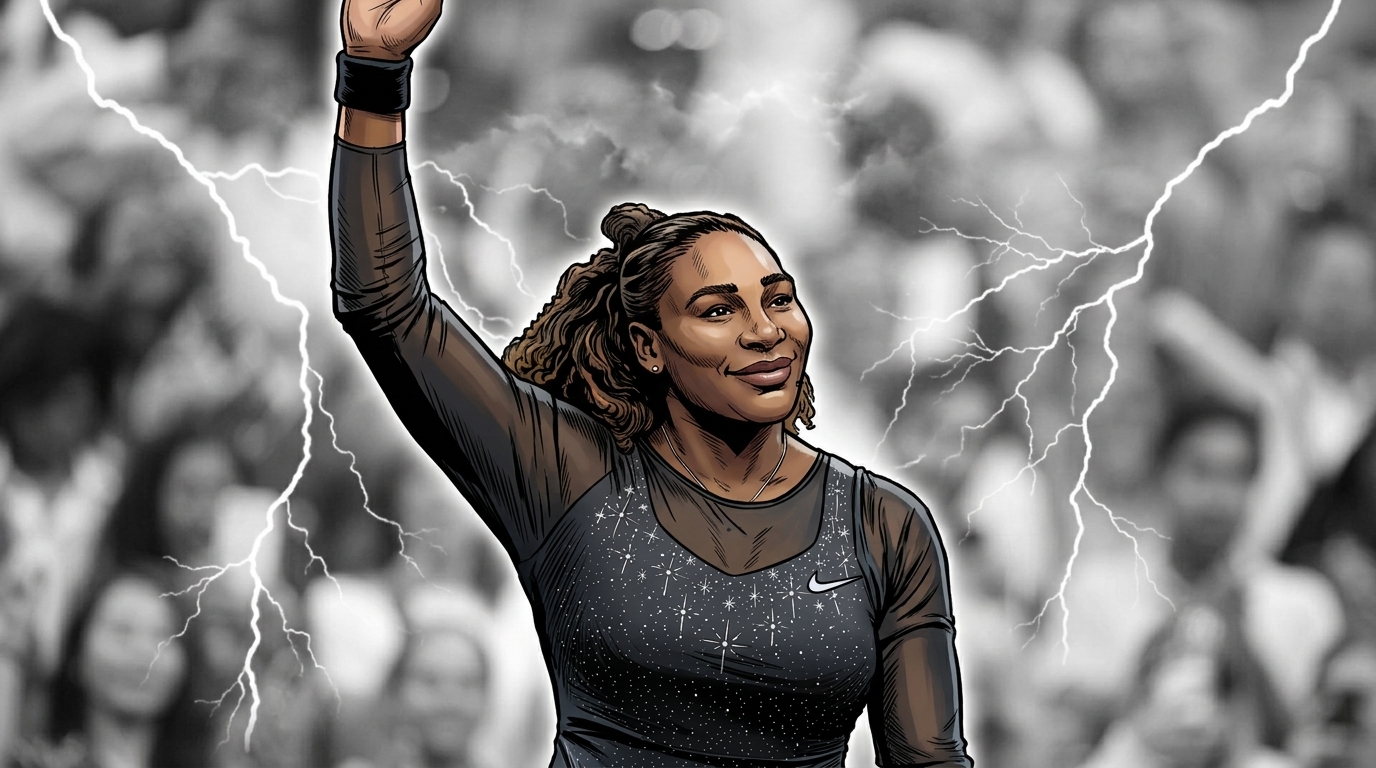
Serena Williams’ June 1st announcement was not that. A Nike video, no words, just Serena walking off a court while her phone floods with notifications. Caption: “Good news travels fast.” I watched it three times. I’m not sure I’ve ever seen a comeback announcement that looked less like a comeback announcement. It was power dressed as understatement, and it worked on me completely.
https://twitter.com/serenawilliams/status/2061447936563638388
The Serena Williams comeback 2026 is real, and here is what we know: she is 44 years old, she has not played a competitive match since the 2022 US Open, and she is entering the HSBC Championships at Queen’s Club in London (a WTA 500 event on grass, running June 8-14, 2026) for women’s doubles only, alongside Victoria Mboko, age 19, world No. 9. She is not testing the waters. She cleared the ITIA anti-doping testing requirements on February 22, 2026 before returning to competition. That is not the behavior of someone planning a photo opportunity. That is paperwork.
https://www.instagram.com/p/DZDPeiXke4o/
Her partner in this is worth understanding correctly, because the discourse around Mboko has ranged from “young phenom gets a moment” to the actual reality, which is that she is per ESPN one of the fastest-rising players in WTA history: the fastest to break into the top 10 since Jennifer Capriati in 1990, a process that took her 203 days. She won the 2025 Canadian Open, defeating Naomi Osaka in the final. She is, in short, not a symbolic selection. When Serena said she was “looking for someone that wants to win,” the name she landed on was a 19-year-old Canadian who already has a WTA title on her home soil. The 25-year age gap is the part that stops people; the part that matters is that they chose each other. Mboko, speaking to Al Jazeera, did not even try to be casual about it: “I’m very happy. Me and Serena have stayed in touch, which is really, really nice because I really look up to her. I mean, the fact that she even knows me is very exciting.” She is 19. She is world No. 9. And she said “the fact that she even knows me.” That is what Serena Williams does to the game, even now, even four years gone. The gravity does not expire.
What I keep coming back to is not the comeback itself but the speed of the reaction. Within hours of the Nike video, the entire sports internet had opinions: John McEnroe told TNT/Sky Sports that “she wants to win another major, that’s the only reason…she could do that anytime.” Martina Navratilova said she “brought the game to another level and it is incredible for the sport that she’s pushing the boundaries and coming back.” Coco Gauff said one of her biggest regrets was never getting to play her. Naomi Osaka said it would bring people to tennis. Hot takes, tributes, analysis threads, retrospectives, all of it before she had hit a single ball in competition. This is what happens when a figure of her size moves. The discourse doesn’t wait.
But the speed of that response is its own kind of data. I want to sit with it for a second, because I think it says something about how we talk about legacies in sports right now. When Serena said she was “evolving away from tennis” in 2022 (not retiring, a distinction she insisted on), a lot of people didn’t know what to do with that framing. Evolution implies something still ahead of you. Four years later, the framing turns out to have been literal. And now the entire sports world is asking, sometimes without realizing it, whether they are allowed to believe this is real. Whether they are allowed to want it.
https://www.instagram.com/p/DY45X2gSL2s/
The Venus question lives at the center of all of this, and I want to be precise about what it is and is not. Venus has publicly said she is “not worried about how she’s going to play,” that “the quality of her stroke is obviously there,” and that Serena is “very tenacious.” That sounds less like a sister offering neutral commentary and more like someone warming up a crowd. But no doubles reunion has been announced. Neither of them has confirmed it. The story everyone wants may not be the story that happens. What the wanting itself tells you, though, is something about what we need from Serena Williams at this point — not just wins, but the possibility of wins, the suggestion that the complete version of the thing could still happen. That is a different kind of pressure to carry, and she seems to have decided to carry it anyway.
She told Vogue in 2022 that she “should have had 30-plus Grand Slams.” I have thought about that quote a lot over the past few years. It is not bitterness, exactly. It is accounting: the tallying of what injuries and circumstances and a tennis body subjected to more scrutiny than almost any athlete’s in the modern era did not allow. Twenty-three Grand Slam singles titles (Open Era record at the time of her evolution). Fourteen doubles titles with Venus. Three hundred and nineteen weeks as world No. 1. A career Golden Slam in both singles and doubles. She carried her own math around with her and decided, at 44, to come back to the ledger. Not on a ceremonial stage. On Queen’s Club grass, where women’s tennis returned after a 52-year absence only last year, with a wild-card invitation and a 19-year-old who told the world it was an honor to share a court with her. At 44, coming back like this is a specific kind of math about what you still believe is possible.
There is something going on culturally with how we respond to athletes who make us feel the passage of time. I grew up watching Serena during the Duncan era, in a sports household where greatness had a fixed look — durable, unquestioned, something you could build a worldview around. Part of what makes the Serena Williams comeback 2026 feel different from other unretirements is that she was never really gone in the way other athletes go. She appeared on magazine covers. She built a fashion line. She gave a talk about venture capital. She was visible everywhere except on a tennis court, and the absence from that specific space became its own presence. Coming back is answering a question she decided she was not done with.
Queen’s Club starts June 8th. She has been photographed on the practice courts already, returning to competitive tennis for the first time in nearly four years. No match has been played, no result entered. I am not writing about outcomes. I am writing about what accountability and redemption look like in 2026, and what defiance looks like at 44, and the specific cultural weight of a figure who walked off a court in 2022 having staved off five match points in a third-round loss that lasted three hours, and who showed up four years later like none of that was ever meant to be final.
I’m not sure what it means that I want this to work as badly as I do. That might be the most honest thing I can say.