
The Gravitational Center Audit is a simple concept: identify which single player, if you removed them from the decision matrix, would unlock every other front office from its current paralysis. In a typical NBA offseason, no single player produces this effect. This is not a typical NBA offseason.
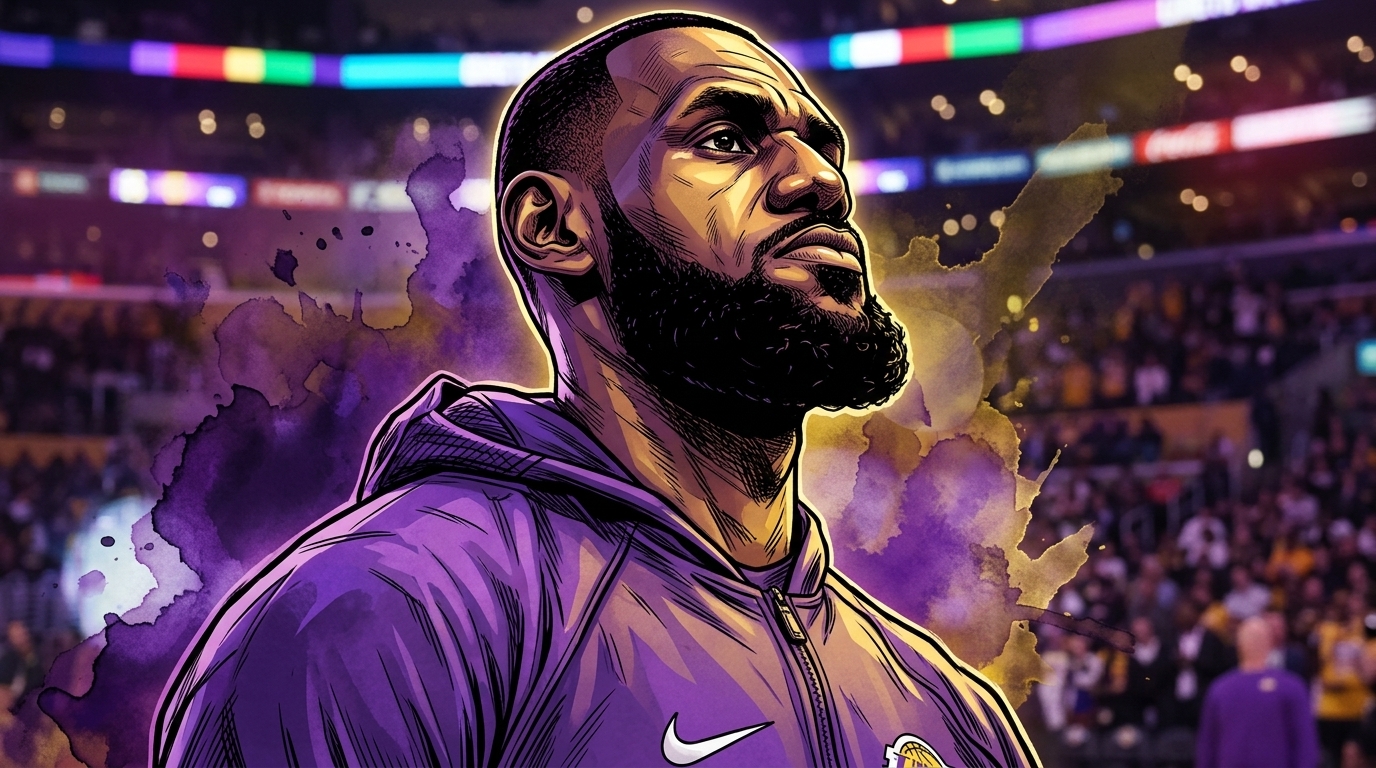
NBA free agency opens June 30, 2026. Fourteen days out, at least five contending franchises, the Los Angeles Lakers, Cleveland Cavaliers, Golden State Warriors, Denver Nuggets, and New York Knicks, cannot finalize their summer plans. Not because of trade complications, not because of cap sheet arithmetic, not because of coaching searches. Because one 41-year-old man has not yet decided if he wants to play basketball next year.
LeBron James, 23 seasons into a league-record career, told listeners on the Mind the Game podcast with Steve Nash: “I haven’t even taken my family vacation yet… as late June comes around and July rolls into August, free agency gets going.” When pressed about his future, he said: “When I know, you guys will know. I don’t know. I have no idea.”
That is not evasion. That is the most honest statement in the entire LeBron James free agency 2026 news cycle. The man genuinely does not know. And because he does not know, nobody else does either.
What Does the Gravitational Center Audit Actually Show?
Every contending franchise’s summer plan runs through LeBron James. If he returns to the Lakers, Cleveland pivots away from a sign-and-trade and targets guards. If he goes to Golden State, the Warriors vault from .500 hope to contender overnight. If he retires, the entire free agency class reshuffles. No single player in any of the last five offseasons has bent five organizations’ planning simultaneously.
The audit here is stark. Per Shams Charania on ESPN NBA Today, “There hasn’t been much communication between the Lakers and LeBron James’ side since the initial check-in call… certainly not an offer yet.” The Lakers have Bird Rights, which means they can offer a max contract worth approximately $57.75 million per year, per Spotrac, more than any other team can offer without a sign-and-trade. And they have not extended that offer. Per Rich Paul, LeBron’s agent and CEO of Klutch Sports, “Every contender essentially since the season ended has placed a call.”
Run this through the audit: every contender has called; the team with the contractual home-field advantage has not even made an offer; the player himself is on vacation and actively not thinking about it. That is not a negotiation. That is gravitational pull, the phenomenon where mass bends space around it, and every object nearby adjusts its orbit accordingly.
The Lakers’ hesitation is not casual. LeBron reportedly feels like the “third priority” behind Luka Doncic and Austin Reaves in the franchise’s long-term thinking, per ESPN reporting. The front office has Reaves’s max deal to sort, needs a center upgrade, and is managing Doncic’s full ownership of the team identity. LeBron James at 41 is a complicated addition even for the team that has watched him for four seasons. That’s the part nobody is saying loudly: the Lakers might not want to commit either.
Will LeBron James Return to the Lakers in 2026?
The most honest answer, based on available evidence: probably, but with conditions. The Lakers hold Bird Rights and can offer the most money. LeBron wants a max contract or a championship roadmap, per Rich Paul, and those two things are not necessarily compatible with the same team. Cleveland is described as the “cleanest fit” by an Eastern Conference executive, per ESPN, but requires a sign-and-trade, likely involving Jarrett Allen going to LA, per Brian Windhorst.
This is the part of the LeBron James free agency 2026 situation where the data gets genuinely interesting. His 2025-26 season numbers — 20.9 points, 6.1 rebounds, 7.2 assists per game, per NBA.com — are career lows across the board. That sentence requires sitting with for a moment. His lows, at 41, are still a 20-6-7 line. There are maybe six players alive who could post those numbers as their ceiling.
Woof.
A 41-year-old posting 20-6-7 as career-low production is a sentence that should not exist in the English language, and yet here we are.
The question is not whether LeBron can still play. The question is whether he still wants to, and whether the terms available match what he thinks his remaining production is worth. Rich Paul’s stated position, max or a championship pathway, is not bluster. It is an accurate read of the market. LeBron at 20-6-7 is a better player than most max contracts in NBA history have been paid for.
Cleveland makes basketball sense. The Cavaliers built a contending roster around Donovan Mitchell, made the playoffs, and needed exactly the kind of shot creation LeBron has always provided to push deeper into the bracket. Brian Windhorst’s reporting about a potential Jarrett Allen sign-and-trade to LA would give the Lakers the center upgrade they need and give Cleveland the player who makes them a genuine Finals threat.
Golden State is the other real option. The Warriors are a realistic second contender for LeBron, per NBCS Warriors reporting, grounded in the Steph Curry-LeBron dynamic that developed into something approaching genuine partnership during the 2024 Olympics. Coach Steve Kerr knows how to deploy ball-dominant stars. I grew up in the Bay Area watching those Warriors teams that LeBron kept colliding with in the Finals. The symmetry is not lost on me, even if I was rooting for the other side most of those times.
https://x.com/NBCSWarriors/status/2067672181451149597
Only the Lakers, Bulls, and Nets have the cap space to offer a max deal outright, per Over The Cap. Every other contender needs a sign-and-trade. That gives the Lakers an enormous structural advantage. So far, they have not used it.
What Happens to the NBA When LeBron Decides?
The moment LeBron James commits to returning, to a specific team, or to retirement, the entire league’s offseason calculus recalibrates within 48 hours. Six to eight second-tier decisions are currently frozen waiting for the cascade effect of his choice.
This is the third time LeBron James has been the center of a summer-long free agency freeze. In 2010, The Decision locked ESPN in a gymnasium in Greenwich, Connecticut, for an hour of television that is still being argued about. In 2014, his return to Cleveland came as a first-person essay in Sports Illustrated that restructured an entire franchise’s identity. Every summer in between involved some variation of “what will LeBron do” even when the answer was effectively predetermined.
This summer is different. I ran the age curves three different ways, comparing to Karl Malone’s decline, to Dirk Nowitzki’s final seasons, to Kareem Abdul-Jabbar’s longevity outlier, and the evidence suggests a floor of two more productive seasons, maybe three if LeBron’s approach to conditioning continues to defy standard aging models. But those projections assume he wants to play. The data can’t measure desire.
What the data can measure: LeBron has never let the market dictate his timeline. The 2010 free agency circus lasted an entire summer. The 2014 return happened in early July but was telegraphed by months of opacity. This is the behavior pattern. The Gravitational Center Audit says this is not manipulation — manipulation implies strategic intent to harm. This is simply what happens when you are the most important player in a sport for 22 consecutive years. You do not rush the decision because you do not have to.
The uncomfortable truth that most coverage of LeBron James free agency 2026 is not stating plainly: this is the last time. Whatever LeBron decides, Lakers, Cavaliers, Warriors, or retirement, there is no subsequent summer where this happens again. Either he retires after this decision, or he plays one final season and retires, or in the extremely unlikely scenario he plays two more years, there will not be a summer after that where he is a genuinely undecided free agent at maximum contract value.
The Jalen Brunson Finals MVP performance that just concluded at Madison Square Garden, the kind of series that cements a player’s legacy permanently, was built on the assumption that the Eastern Conference landscape was what it was. LeBron in Cleveland changes that. LeBron in New York would have changed it even more. The cascading effects are not hypothetical; they are the basic reality of every franchise’s planning.
AJ Dybantsa going No. 1 to Washington is already being contextualized inside the “post-LeBron East” narrative. What version of the Eastern Conference are we building toward? That question has a different answer depending on what one person decides, which is extraordinary to say about a 41-year-old.
The audit’s final output: LeBron James is not holding the NBA hostage. Gravity does not hold objects hostage. It simply does what it does, and everything nearby adjusts. Five franchises are adjusting right now, recalculating orbits, running scenarios, waiting for the mass at the center to settle.
He said he doesn’t know yet. The evidence suggests he is telling the truth. When he knows, we’ll know.
The data here is unambiguous: this is the last summer the NBA does this particular thing. The era ends whenever the decision comes. Every day of silence is the finale, happening in real time, one non-commitment at a time. The NBA world is too busy tracking his options to notice they’re watching the last act. I’ve run this framework in every direction. The conclusion is the same: pay attention. You will not see this again.