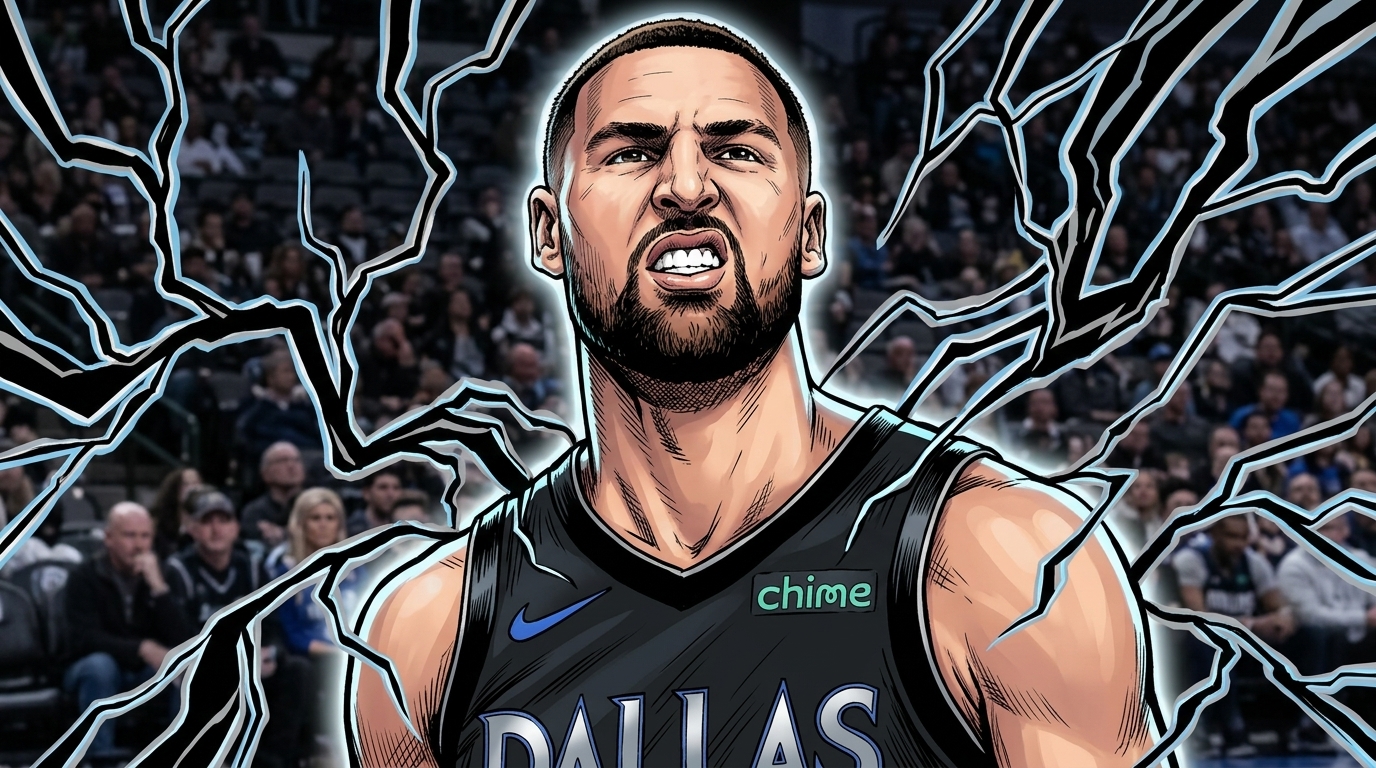

Klay Thompson makes $17.5 million this season. The rule blocking his path back to Golden State caps out at $15 million. That $2.5 million gap is the entire Warriors reunion story right now, and it has nothing to do with sentiment.
This isn’t a story about whether Klay Thompson wants to come home. It’s a story about the Warriors triggering a trap of their own making: Draymond Green re-signed this week for $27.7 million, pushing the roster over the NBA’s first apron, and the league’s rule on signing bought-out players caps out below Thompson’s actual number. Golden State built the cap sheet that’s now boxing him out.
How Draymond’s Deal Pushed Golden State Over the Apron
Green declined his $27.7 million player option earlier this summer, freeing up cap room for a run at LeBron James and Anthony Davis — the front office’s shot at assembling a “Big 4” around Stephen Curry. That was the LeBron chase that fell apart in two weeks; LeBron ended up signing with the Philadelphia 76ers instead. With the superteam swing dead, Green and the Warriors landed back on the same number by Tuesday: one year, $27.7 million.
That’s the same $27.7 million cap hit that put Golden State over the league’s $209 million first apron. Draymond’s return already had Golden State fans nervous about the timeline for a title push around an aging core, and now it’s carrying a consequence nobody was discussing in June: it closed the door on Klay Thompson before a single buyout conversation happened.
Shams Charania broke the signing Tuesday afternoon:
https://twitter.com/ShamsCharania/status/2082171223409393746
Same number, different context. In June, it was ammunition for a superstar chase. By late July, it was the exact figure keeping Thompson in Dallas.
Why Can’t the Warriors Just Sign Klay Thompson?
Golden State sits above the NBA’s $209 million first apron after re-signing Draymond Green for $27.7 million. Teams over the first apron cannot sign a player who was bought out of a contract paying more than the $15 million non-taxpayer mid-level exception. Thompson makes $17.5 million, so a buyout signing is off the table.
It’s a blunt rule, and it doesn’t distinguish between a team mid-rebuild and a franchise trying to squeeze one more contending window out of Stephen Curry’s prime. Only a trade works now, and that opens a different set of problems entirely.
Timing is what makes this sting. Golden State didn’t cross the first apron by piling up salary through trades or extensions signed months ago. It crossed by re-signing one player this week, in the same news cycle Thompson was fielding reunion questions in public. A roster decision that looked manageable in June became, by Tuesday, the exact reason a buyout signing turned illegal.
The $14 Million Number That Would Have Changed Everything
Run the counterfactual and the whole situation reframes. Had Green signed for something closer to $14 million instead of $27.7 million, Golden State stays under the first apron entirely. Under that math, a Thompson buyout signing is legal the moment Dallas moves on from him — no trade package, no third team involved, just a number on a check.
I’ve spent enough hours as a Bay Area kid staring at Warriors cap sheets that the size of this gap stopped me for a second when I first laid the numbers side by side. Golden State didn’t lose Klay Thompson to Dallas’s leverage or to Thompson’s loyalty to his current team. It lost him to arithmetic it created by paying its own starting power forward nearly twice the number that would have preserved flexibility.
What a Trade Route Back Would Actually Cost
A trade route back to Golden State remains technically possible this season. Nothing in the apron rules forbids it outright; trades run on a different set of matching rules than buyout signings, which is the caveat “dead” needs here. Both outlets tracking the situation independently call it impractical anyway, and the reasons stack up fast: Thompson’s $17.5 million salary requires outgoing money to match it, Dallas has no obvious motivation to give up a proven shooter at a discount, and Golden State’s tradable pieces get thinner every summer.
That impracticality matters more once the competition shows up. The Miami Heat and Los Angeles Lakers are both reportedly positioned to chase Thompson if Dallas ever does buy him out, and the Heat are already running Miami’s own version of a Klay Thompson pursuit. Both teams sit under the threshold that’s currently locking the Warriors out, so the buyout route closed to Golden State is wide open to its rivals.
Thompson isn’t shutting the door publicly, either. Asked about a Warriors return at Fanatics Fest on July 19, he told a fan who said they missed him: “Never say never.”
Where This Actually Leaves Golden State
The realistic reunion window isn’t this season. It’s 2027-28, when Thompson would be 37 and Curry, Green, and Jimmy Butler are all free agents again at the same time. That’s the scenario where the front office could build around an actual homecoming instead of squeezing one through a buyout loophole.
This lesson outlasts one contract. Golden State now has to weigh every future move against a hard line that a single misjudged re-signing can trip overnight, from extensions to trade kickers to the minimum-salary fillers rosters need in March. The margin for error shrinks fast once a front office starts operating in apron territory, and this summer showed exactly how little room there actually was.
Until then, the trade market stays technically open and practically closed, and every version of the reunion conversation runs through the same $2.5 million gap the Warriors created for themselves in late July. Golden State spent its flexibility chasing a superteam that lasted about two weeks, and the bill came due in the form of the one player half the fan base actually wanted back.
By 2027, that math resets. This one doesn’t.