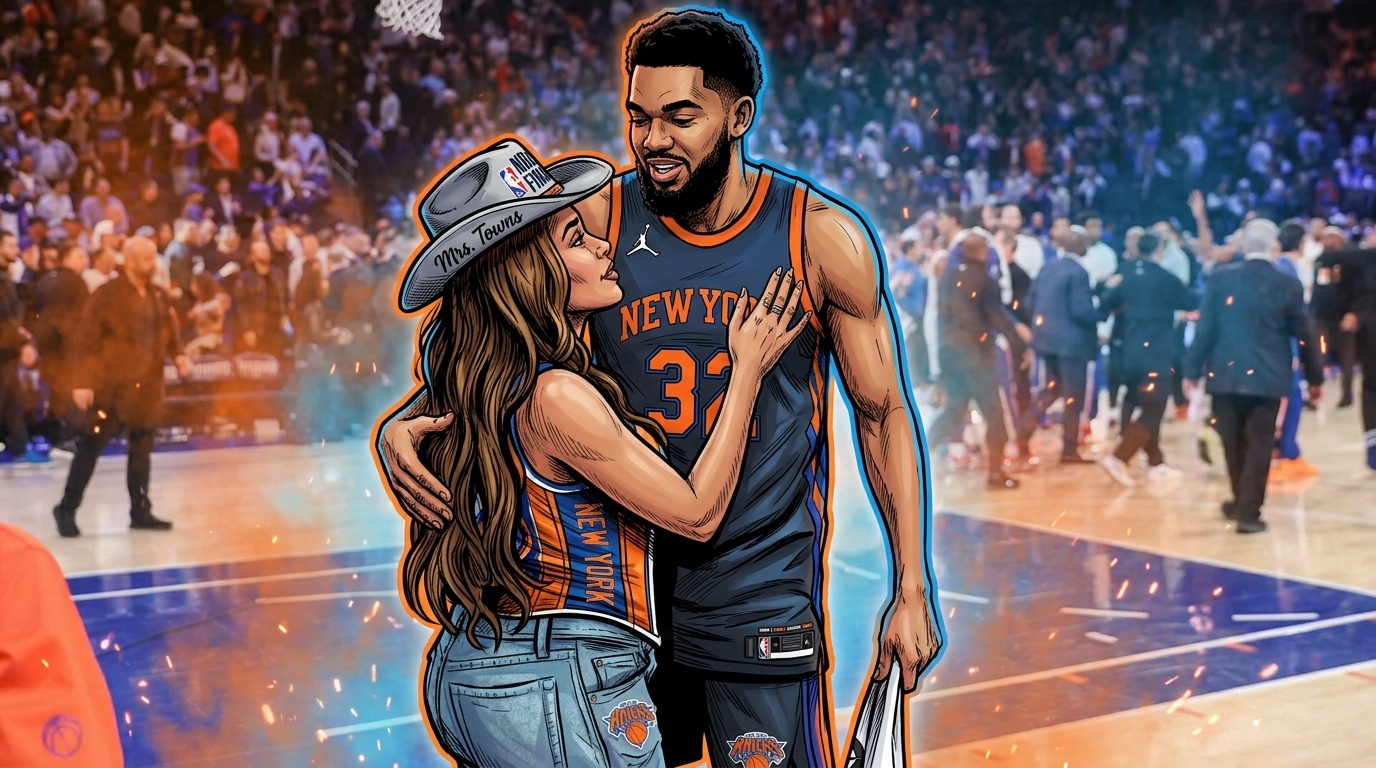

The thing about the bag-turned-shoe story is that it wasn’t really about the bag. I say this as someone who spent a non-trivial portion of Sunday night reading about the bag. The story travelled because people wanted it to travel — because the narrative ecosystem of a major sports event now depends on celebrity adjacency the way a vine depends on a fence, and when Jordyn Woods posted an Instagram Story explaining that she’d repurposed her lucky orange ostrich clutch into footwear to get past MSG’s no-bag policy, the internet recognized its cue and performed accordingly.
What I keep returning to is not the ingenuity of the workaround, but the word “lucky.” She has carried that bag to every Knicks win this postseason. Thirteen games. The streak ended Sunday night in the Game 3 recap when Victor Wembanyama put up 32 points, 8 rebounds, 6 assists, and enough defensive plays to make Madison Square Garden feel like a different building than it had been for the first two games of the series. The Spurs won 115-111 and Jordyn was courtside for all of it: custom corseted orange-and-blue-and-white “NEW YORK” tank, wide-leg denim with the Knicks logo patch, custom grey cowboy hat reading “NBA Finals” on one side and “Mrs. Towns” on the other. Thirteen games. Thirteen wins. Lucky shoes, no lucky bag.
https://www.instagram.com/reel/DZWXUxIJ8SB/
KAT took ten shots.
There’s a version of this story that’s just fashion coverage: the outfit, the hat, the engagement ring (Christmas Day 2025, balcony overlooking the Brooklyn Bridge), the brand account for Woods by Jordyn calling the repurposed bag her man’s lucky shoes. Complex ran it. Yahoo ran it. SI ran it. The Big Lead ran it. Hello Beautiful ran it. ESPNW ran it. The story has genuine cultural texture — a woman building a public persona around devotion to a team, manufacturing her own iconography at the exact moment the team needs all the iconography it can get. That’s worth covering. I’ve been writing about the WAG economy this Finals and this is the fullest expression of it so far.
But the volume of coverage relative to the actual basketball happening at MSG tells you something about what the audience is actually hungry for, and it’s not always what the audience says it’s hungry for. Everyone claims they want basketball. The discourse suggests they want something else.
https://x.com/SportsCenter/status/2064149927043711244
What the audience actually wants, I think, is a love story that follows the sports calendar. This is not a cynical observation. The appetite for Jordyn Woods at NBA Finals Game 3 is real and it’s not stupid. It’s a genuine human response to the fact that sports, at their highest stakes, produce an intimacy between the public and the people involved that almost nothing else in civilian life replicates. The Finals are watched by millions. Karl-Anthony Towns is one of the best players alive. He proposed to Jordyn on Christmas Day. She has been at every game since. She dressed herself like a devotional object and turned a Secret Service bag check into a fashion moment. If you can’t feel the poetry in that, you’re reading sports wrong.
What I’m more interested in is the specific texture of who is doing the watching. The coverage of Jordyn’s courtside presence (her Instagram account, @jordynwoods, has been cataloging this run with the care of someone who understands she is a character in a larger story) travels in a very specific direction. It doesn’t travel on NBA Twitter, primarily. It travels in the spaces where women talk about sports, or where sports intersect with fashion and celebrity and engagement rings. It travels in the places that sports media has historically treated as secondary, or soft, or not really about the game.
https://www.instagram.com/p/DZWALSYjOko/
The Defector model of sports writing has a ready answer here: institutional skepticism, follow the money, ask who benefits. The celebrity-courtside economy is manufactured content, a mutually beneficial arrangement between leagues desperate for mainstream cultural relevance and celebrities who need new contexts for their personal brands. The NBA gets Vogue. Jordyn gets the NBA. The audience gets a parasocial love story with high production values. Everyone wins.
I find this framing correct and also insufficient. The fact that something is instrumentalized doesn’t make it inauthentic. Jordyn Woods has attended every single Knicks playoff game this postseason. She has been visibly, physically present for a 13-game winning streak that ended on Sunday. She did not attend these games for the content. She attended them because her fiancé plays for the team, and this is what love looks like when your fiancé plays in the NBA Finals. The outfit was an expression of that. The bag was an expression of that. The shoe workaround was an expression of that. The fact that it also produces content is a downstream effect of living a visually interesting life in public, not evidence that the life itself is a performance.
What the volume of coverage does reveal, though, is an anxiety the sports media ecosystem hasn’t fully worked through. KAT took ten shots. He scored eleven points. In a Finals game. For a team that needs him to be a co-star to Brunson’s lead. The quietest game of his postseason, by any measure, in the biggest game the Knicks have played in a generation. Wembanyama is 22 years old and he is operating at a level that makes everything around him look slightly unreal. The Spurs lead in the series now sits at 2-1 Knicks, which is still fine, but the series is no longer comfortable in the way it felt comfortable after two games.
The bag story was easier. I understand the bag story. It had a clean arc: woman carries lucky bag, faces obstacle, solves obstacle with ingenuity and style, posts about it. The basketball story is messier: a 22-year-old potentially dismantling a beloved city’s championship hopes game by game, while the local star produces a quiet line in a historic venue in front of a sellout crowd that waited a decade for this moment. That’s not a fashion moment. That’s genuinely hard to watch.
Jordyn Woods won Game 3. In the sense that matters to the internet, she absolutely did. She got more coverage than KAT, more coverage than Brunson’s 32 points, possibly more coverage than the final score. The custom hat, the lucky shoes, the Instagram Story that became a national conversation — this is what the 2026 Finals will be remembered for in Vogue, and Vogue is not nothing.
I’m not sure what to do with the fact that I read all of this coverage and found myself genuinely moved by it, and also genuinely unsettled by the gap between what happened on the court and what dominated the discourse. Both things are true. The WAG economy is real and the basketball is also happening. The question of which one the audience actually comes for is one I don’t think the audience itself could answer cleanly if you asked. Maybe that ambiguity is the story.