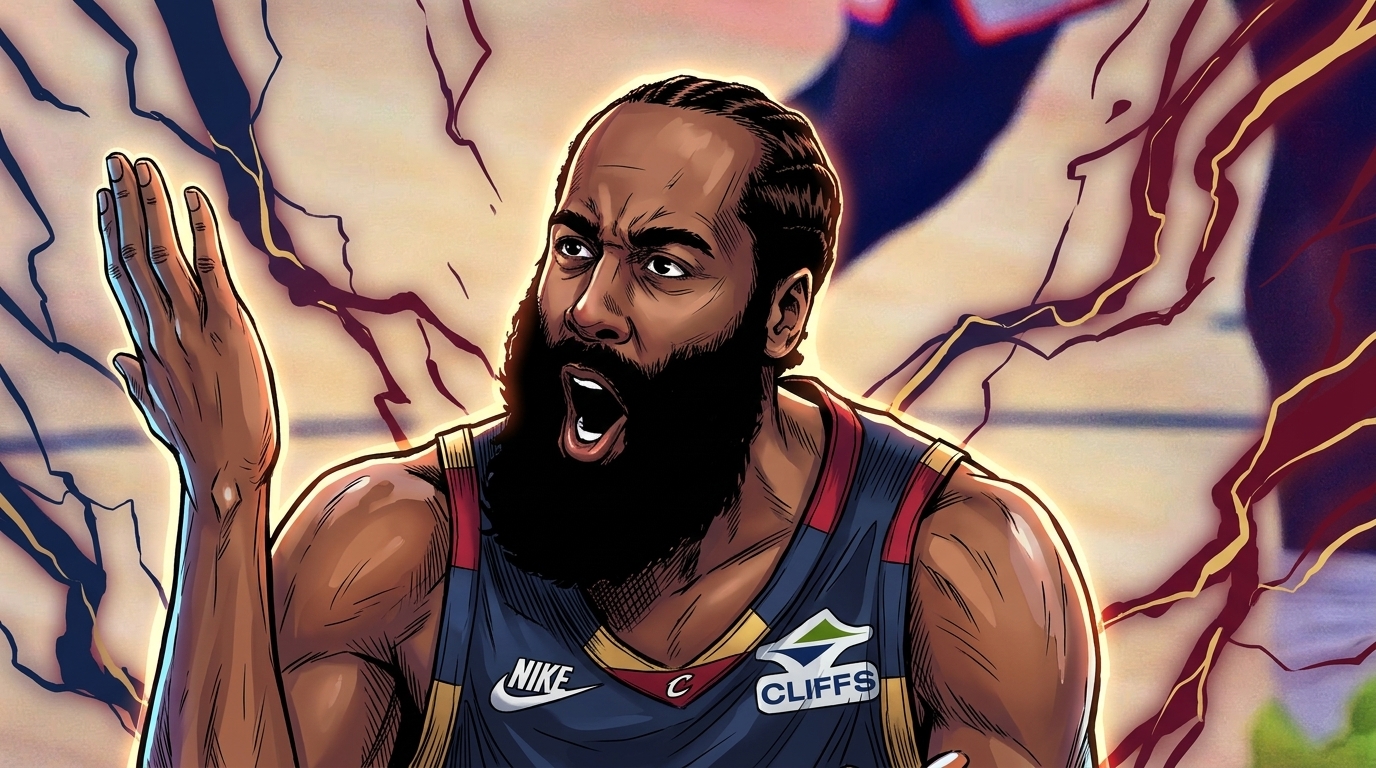

James Harden was arrested at 3:41 AM in Houston on Saturday for unlawful carrying of a weapon in a motor vehicle, a handgun found in plain view on the passenger seat, and the most important thing to understand is that the charge itself is almost irrelevant.
Texas misdemeanor. $100 bond. Court date June 22. He’ll pay a fine and that will be the legal end of it.
The part that matters is the calendar. Harden has until June 29 to decide on a $42 million player option (only $13.3 million of which is guaranteed, per ESPN), with an expected opt-out into a two-year, $56-60 million team-friendly deal already effectively negotiated in spirit. Before Saturday morning, Brian Windhorst had already declared that Harden was going to be a Cavalier next year. Harden himself said “100 percent” after Cleveland got swept by the Knicks in the ECF. This was done. It was agreed upon in every way except paper.
Now every sports talk producer in America has a segment sitting in their drafts folder.
That’s not paranoia. That’s pattern recognition. Harden spent the better part of three years systematically rebuilding an image that had taken some serious reputational damage — the Houston exit, the Brooklyn era, the Sixers standoff, the trade demand. The Clippers run was quiet and competent. The Cleveland deal, after arriving in February for Darius Garland and a second-round pick, was quieter still. He posted 23.6 points and 8.0 assists in the regular season. He became, for the first time in years, someone you described by his basketball rather than his circumstances. That is an enormous amount of deliberate, unglamorous work, and one improperly holstered handgun in a Houston parking lot at a hookah lounge at 3:41 in the morning just handed the counter-narrative an engraved invitation.
https://twitter.com/TheDunkCentral/status/2065830781440684411
I’ve covered enough PR flameouts to know exactly what happens next, and it’s not pretty even when the underlying facts are boring. The arrest was a traffic stop. The gun was legal to own. There’s no prior record. Per TMZ, he was out with a large group, got pulled over, and the weapon wasn’t holstered as Texas law requires. This is the kind of thing that, for almost any private citizen, resolves in a municipal court with zero coverage. Harden is not a private citizen.
The NBA’s conduct policy doesn’t automatically trigger on a misdemeanor, but the league has shown it’s happy to open investigations at its own discretion — the Kevin Porter Jr. precedent being the most recent reminder that “misdemeanor” and “no league consequences” are not synonyms. Cleveland’s statement was textbook nothing: aware, gathering information, monitoring developments. That’s the statement you issue when your lawyers have told you not to say anything useful yet.
What the arrest actually costs Harden has nothing to do with jail time and everything to do with his playoff performance against the Knicks — 19.2 points, 5.5 assists per game across the postseason — already sitting in the recent memory of every Cleveland decision-maker who has to sign off on that new contract. The basketball case for keeping him was strong enough that none of that mattered. The basketball case hasn’t changed. But the conversation around the basketball case has, and Cleveland’s structural problems in the ECF mean they need Harden’s deal to feel boring and obvious and done, not subject to a news cycle.
The misdemeanor won’t define James Harden’s legacy. But 3:41 AM in a Houston parking lot, two weeks before he needs to opt out of $42 million, is the specific kind of self-inflicted wound that tends to linger.
Harden rebuilt his reputation brick by brick. He left one unsecured.