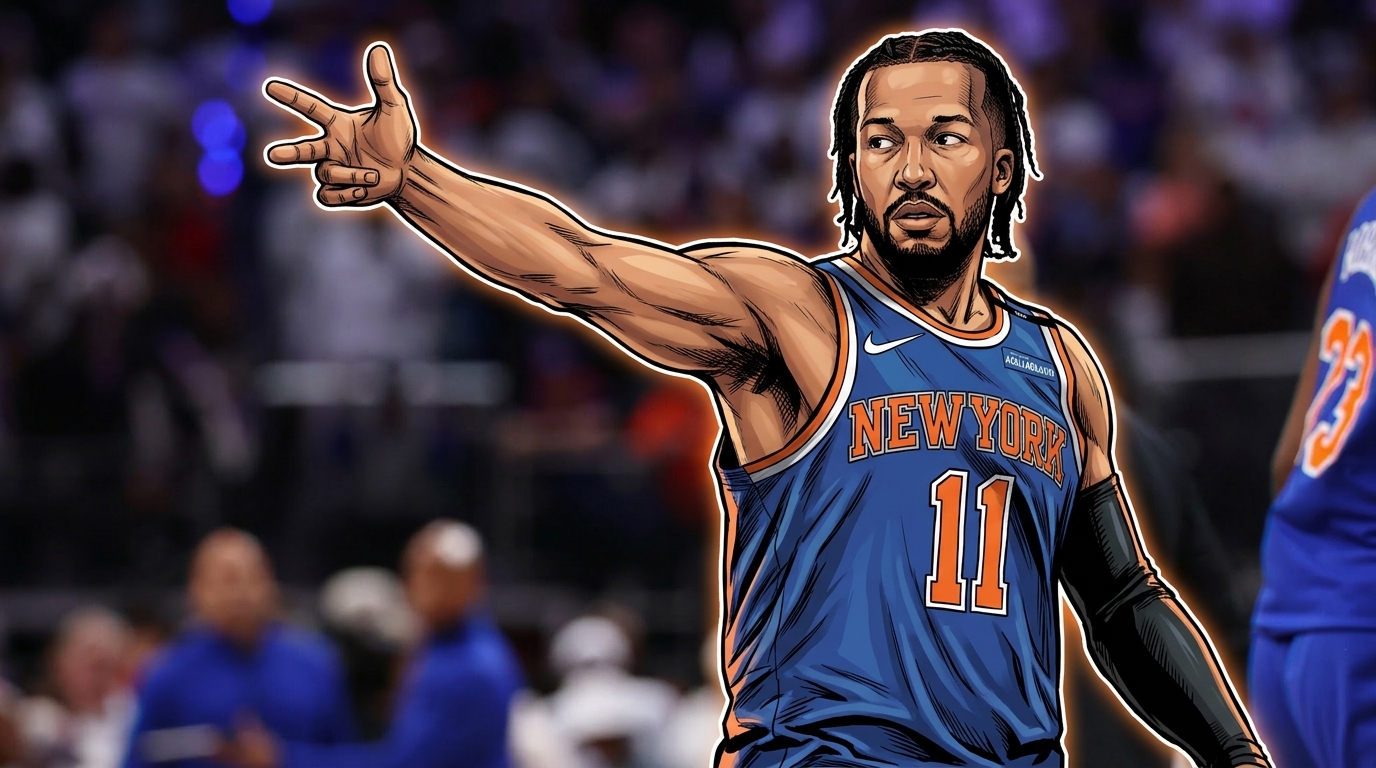

The Jalen Brunson NBA Finals MVP 2026 story is, at its core, a story about institutional malpractice. One franchise’s failure to recognize what it had is now someone else’s championship banner.
Dallas found Brunson at pick 33. Third pick of the second round, a slot most front offices use to stash a name for two-way roster paperwork. Donnie Nelson, the ex-Mavs GM, later said he was “in disbelief” Brunson lasted that long. That sentence deserves to sit there for a moment: the man who drafted him at 33 was in disbelief that anyone let him fall to 33. The organization nonetheless treated him accordingly. When Brunson’s camp came looking for an extension after the 2022 Western Conference Finals run, Dallas countered with four years and $55 million, a number his representatives reportedly laughed at in real time, out loud, without embarrassment. Dallas then went silent. “Crickets,” per Brunson’s own account. No follow-up. No recalibration. No acknowledgment that they were watching a player outgrow their assessment of him in real time. They had the information and chose not to update it.
The New York Knicks signed him for $104 million that summer, fair market for a good second option, which is what Dallas had convinced everyone he was. The Knicks were buying the misclassified asset; they just didn’t know yet exactly how misclassified. Two years later, Brunson signed a four-year, $156.5 million extension at roughly $113 million below his actual market value, enabling New York to build an actual roster around him. Yahoo Sports called it “the greatest paycut in sports history.” It was less a paycut than a correction, voluntary and deliberate, from a player who understood the arithmetic of winning better than the franchise that drafted him ever understood him.
He averaged 32.6 points, 4.6 assists, and 4.2 rebounds in the 2026 Finals. Game 5 in San Antonio: 45 points, a Knicks Finals record, in a 94-90 win that closed it out. Game 4: 36 points and a 29-point deficit erased in a 107-106 comeback that no one who was watching will ever fully account for. He was the unanimous Finals MVP — all 11 voters, the same number of people who once would have watched him at Villanova and filed him under “good-but-not-elite” before moving on to the next thing. His 22 clutch points in the series were the most by any player in the Finals in 15 years. He also became the first player in NBA history to win the NBA Cup MVP, the ECF MVP, and the Finals MVP in the same season; the trifecta exists as a category now only because someone needed to describe what he did.
People will reach for Derek Jeter here, the obvious analog: the transcendent New York athlete who defines an era, whose name becomes inseparable from the city. The comparison is available. It also obscures more than it illuminates. Jeter was a product: cultivated in the Bronx, drafted first, made into a symbol before he had earned one. The machinery of the Yankees organization was designed to produce exactly Derek Jeter. Brunson is something more unsettling, a player the machinery failed to produce anywhere, who arrived in New York as surplus inventory and became the most important athlete the city has had since the last time the Knicks won in 1973. He is not a product of New York; he is from Abington, New Jersey. He went to Villanova. The city did not grow him. It simply recognized, eventually, what Dallas couldn’t.
There is also a detail that operates on a frequency beyond ordinary sports narrative. Rick Brunson — Jalen’s father, now a Knicks assistant coach — played for New York in the 1999 NBA Finals against the San Antonio Spurs. Lost 4-1. Twenty-seven years later, his son played for the same franchise in the Finals against the same franchise and won 4-1. The same opponent, the same series shape, reversed. You can read that as poetry or you can read it as arithmetic; either way it happened, and the Spurs were there for both. For the full weight of his father’s 1999 Finals loss to the same San Antonio Spurs, the thread runs straight through the same franchise and a 27-year gap that just closed.
https://twitter.com/jalenbrunson1/status/2066553177806102856
The first thing Brunson posted in three months, after winning the championship: “Somebody take Mikal’s phone.” That tells you exactly what kind of person he is. Not the one making noise. The one watching everyone else make noise and finding it amusing. For a fuller look at how the championship actually unfolded, Josh Hart quietly carrying Game 1 explains why this team was never just one man, even when one man was doing everything. And the rest of our NBA championship coverage is right there if you want more.
The 33rd pick ended 53 years. He is from New Jersey. Dallas had him and let him walk for a $55M offer his camp laughed at. The city of New York is now celebrating an athlete it did not produce, drafted by a franchise that underestimated him, signed for money that turned out to be a bargain, and extended for less than he was worth because he understood something about building a winner that most organizations never figure out. The most New York thing that has ever happened is that none of that matters now.
Dallas is still figuring out what happened.