
Before the critics weighed in, the comments section had already decided. “Greatest World Cup squad photo ever.” I want to stay with that reaction for a moment, because what the audience chose to say — not about Norway’s chances but about the image’s mythology — tells you something about what we actually want from international football. We want myth, not just matches. We want to believe the team with the best visual story is the team with destiny on its side. The fan who wrote “Take this Viking energy to the field” and the one who typed “Jævlig insane!!!!!” in Norwegian on English-language social media are both telling you the same thing: the photo landed as a feeling, not a fact.
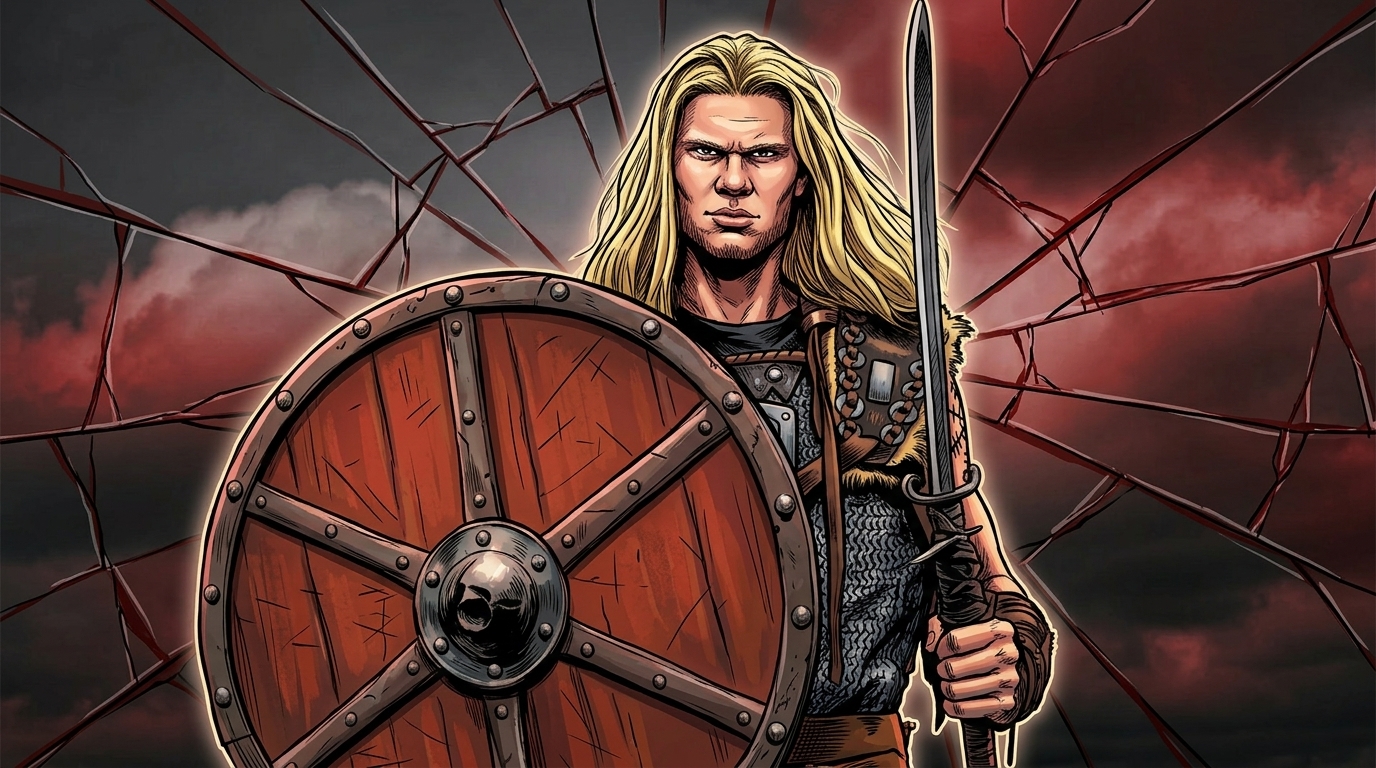
On June 4th, the Norwegian Football Federation released their Norway World Cup Viking photo 2026 and it moved through the internet the way only a few sports images do: not as news, but as mythology. Twenty-six players in chainmail and leather armour at an Oslo fjord beach. Erling Haaland at the center, sword in hand, shield gleaming, long blond hair unbound, looking assembled from central casting’s idea of Norse destiny. The NFF’s caption was three words: “Norway is coming 🇳🇴.” Haaland’s own caption, posted to his personal account, was two: “Viking blood 🇳🇴.”
https://twitter.com/ErlingHaaland/status/2061777103519891610
The campaign traces back to 2023, when British photographer David Yarrow shot Haaland solo, waist-deep in an Oslo fjord, for a piece titled “The Vikings are coming.” The squad shoot built deliberately on that foundation. Yarrow’s framing instinct was precise: “If you had to choose one sportsperson in the world that doesn’t need much hair and make up to look like a Viking, it’s Erling Haaland.” He also noted, with the dry satisfaction of someone who has thought about visual equality at length, that his composition flattens football’s financial hierarchy entirely: “If you’ve got someone that’s worth £200m and then you’ve got Watford’s goalkeeper that’s worth £250,000 — they both occupy the same amount of the frame.”
That democratizing gesture sits in productive tension with what the image does at the macro level. Norway, a nation of 5.5 million turning their World Cup presence into a cinematic moment, returns to the tournament for the first time since 1998. They arrive with Haaland, who scored 16 goals in 8 European qualifying matches, the most of any player in the region. They arrive in Group I against France, Senegal, and Iraq as 35-to-1 championship underdogs. What they don’t arrive with is the institutional weight of a footballing superpower. So they built a different kind of weight. They built a visual mythology.
This is the part that interests me as a sociologist more than as a football observer: Norway’s World Cup Viking photo is a masterclass in national branding precisely because it refuses to operate on the terms available to nations that already have institutional weight. It’s not a team photo; it’s a brand document. A deliberate bet that the most valuable commodity in modern international football is not your FIFA ranking but your cinematic ambition. They presented their World Cup presence not as a sporting aspiration but as a cultural inheritance, one that predates football by about a thousand years.
Haaland as cultural artifact: in this framing, the sword and shield are not metaphors for his playing style. They’re a claim. We have always been this. The World Cup is just the newest arena. Martin Ødegaard missed the shoot because he was playing in the Champions League final; the team digitally composited him in afterward, carefully matched to the cloudy fjord conditions. That detail matters. Even a logistical compromise became an act of precision. Everything in this image is deliberate, and none of it is less effective for being so. The photo will fundraise for Norwegian charities and be displayed at Norway’s Greensboro, NC base during the tournament, a cultural object with a second life beyond the feed.
Norway’s domestic critics noticed the weight of that claim immediately, and their discomfort is the most intellectually useful part of this story. Coverage in The Local Norway captured the debate in full: Janne Stigen Drangsholt, writing in Aftenposten, said the image gave off “a kind of masculinity aesthetic and a slightly toxic boyish vibe.” Hans Petter Sjøli in VG found it “a little too loud and Disney-like for us Norwegians.” More pointed still, researcher Jane Haug Skjoldli warned in Klassekampen that pairing Norse imagery with hyper-masculine idealization mirrors symbolic language used by neo-Nazi and far-right movements. Markus Slettholm in Morgenbladet called it “chauvinistic and exclusionary.”
The counterargument arrived from an unexpected direction. Mímir Kristjánsson, a Red Party MP whose Facebook post went viral inside Norway, offered the clearest rebuttal: “The Nazis don’t own Thor, Odin, runic writing, or Valhalla. We have to take that back from them.” NFF president Lise Klaveness emphasized that the photo reflects values of “courage, and the ability to stand together” — not a glorification of historical violence. These are not PR talking points. They’re genuine ideological positions about who gets to hold a cultural inheritance, and who decides what it means.
This is a real fight. It maps onto something larger than a sports photograph, and it’s playing out in ways that show how viral World Cup moments can fracture along cultural lines we don’t always anticipate from the outside. The Norway World Cup Viking photo 2026 arrived globally as a universal good-vibes moment and domestically as a contested identity text. Both readings are accurate. Neither cancels the other. The international press ran the image and the fan reactions and moved on, which is its own kind of data point about whose interpretive frame sets the terms. There’s more World Cup coverage engaging seriously with this layer, but you have to look for it.
What I can’t settle, watching all of this, is whether the image’s power derives from its authenticity or from its precision as a manufactured thing. Yarrow built this concept in 2023 and spent three years developing it. The NFF approved every element. Haaland, who captioned his post “Viking blood,” is fully in on it. The fjord, the overcast light, the composited Ødegaard: all deliberate, all controlled. The fans who called it the greatest squad photo ever weren’t wrong. They were responding to craft as though it were nature. Maybe that’s what nation-branding at its most effective looks like: the seam invisible, the myth fully load-bearing, the audience’s emotion genuine even when the product is not. Whether a seam that invisible is a sign of excellence or a warning about something harder to name, I genuinely don’t know yet. Norway opens against Iraq on June 16, and I’ll be watching the stands as much as the pitch.