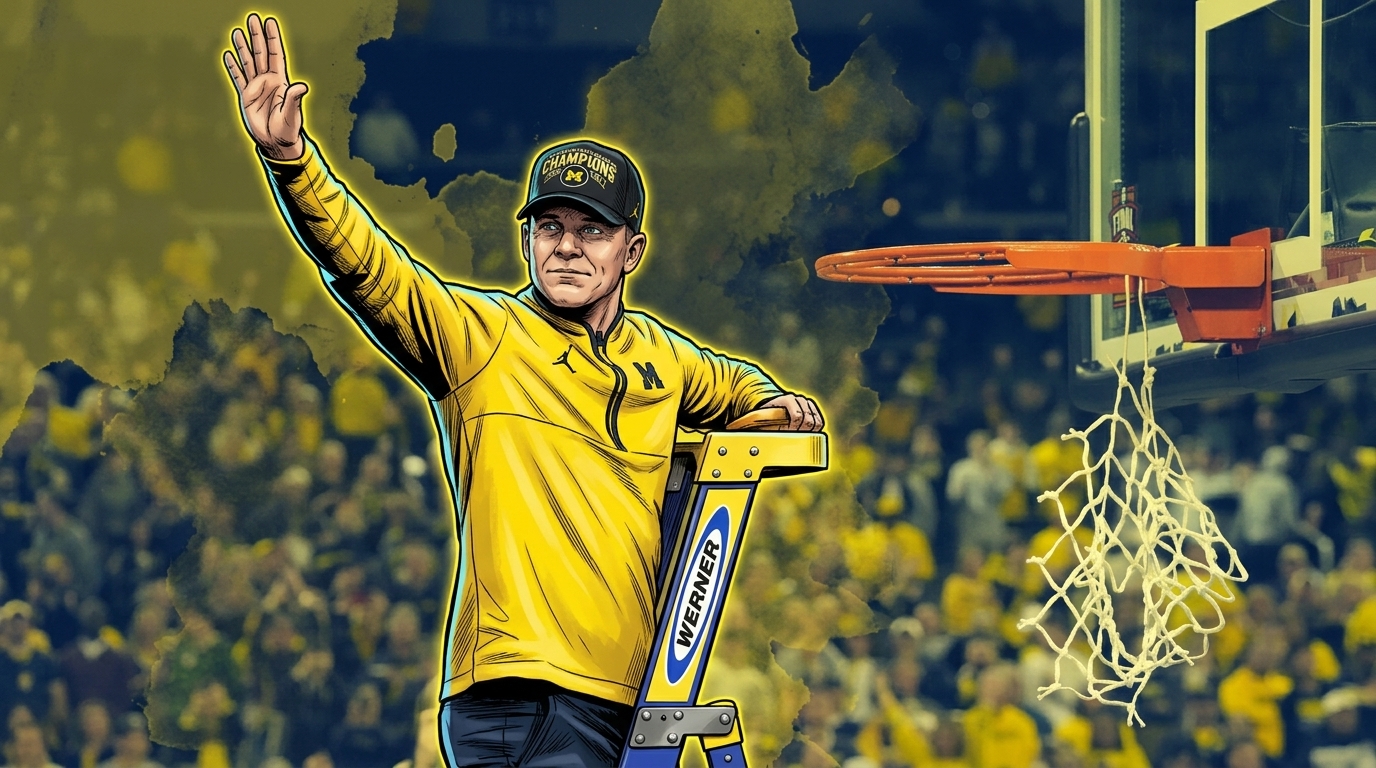

Dusty May won a national championship at Michigan in April 2026. Thirty-seven wins, three losses. A 69-63 win over UConn, the program’s first title in 37 years. By June, he was gone. Not fired. Not recruited away by a richer program. Gone to the Dallas Mavericks, to a league where the job he was hired to do is still, recognizably, the job.
His explanation is worth sitting with, because it’s rarer than the departure itself. Coaches don’t usually say the quiet part at their introductory press conferences. May said it.
“I didn’t enjoy the day to day. The coaching became much less a part of what we were doing.”
That sentence is the most honest public diagnosis of what college basketball has become in the NIL era. And the data on coaching turnover since 2021 suggests May isn’t an outlier. He’s a data point in a pattern that the sport hasn’t figured out how to acknowledge.
What Did Dusty May Actually Say?
The public version of May’s departure, the one he offered while still being diplomatic, was careful. “I wouldn’t say [NIL is] a big reason,” he told reporters at his Mavericks introduction, per On3. Reasonable hedge. You don’t burn bridges with a program that just handed you a championship.
But the fuller picture, drawn from multiple exit interviews, tells a different story. “It’s almost impossible to even enjoy it,” he said in April, weeks after cutting the net, describing the immediate return to portal and NIL demands, per 247Sports. At the Mavericks presser he added, per On3: “It’s much more complicated than it used to be… In college basketball you don’t get to do near as much of [coaching and teaching] as you used to.”
The most revealing line was one he framed as a positive: “The last five years of the NIL era is a segue into the NBA,” per On3. Translation: the skills that the modern college job now requires, negotiating financial packages, managing relationships with collective donors, navigating agent dynamics for players who aren’t yet professionals, map surprisingly well onto the NBA front-office and player-relations work a head coach does. He wasn’t describing a betrayal of college basketball. He was describing how much it had already become something else.
Michigan President Domenico Grasso confirmed the diagnosis in his own statement, per 247Sports, citing “uncertainties and pressures involving the Transfer Portal and NIL support for student athletes” as factors in May’s departure. That’s a university president saying, without ambiguity, that the job description had changed on the person holding the job.
https://x.com/ShamsCharania/status/2069061865527767340
The Numbers Behind the Burnout
Before May won the title, Michigan’s athletic department was managing NIL costs that, per reporting, were increasing by 300 percent annually. That’s not a budget line. That’s a perpetual crisis negotiation.
Per HoopDirt, 2024-25 saw 28 high-major coaching changes, a reported record. Eighteen percent of power conference jobs flipped in 2025 alone. Average tenure before a coaching change across Division I currently sits somewhere between 4.6 and 5.8 years, per HoopDirt’s 2026 tracking data.
The NIL era formally began in 2021. The tenure compression and the era’s start date are not a coincidence.
What’s harder to capture in a single number is what changed underneath the turnover. Pre-2021, a head coach negotiated with their athletic department, their staff, and their recruits. Post-2021, that tripartite now has a fourth vertex: NIL collectives, which operate as a parallel financial power center with their own donors, their own staff, their own asks, and zero formal accountability to the coaching staff. A coach at a program like Michigan isn’t just building a team. They’re simultaneously managing relationships with agents, collective stakeholders, and compliance offices, often on overlapping timelines for different players.
And when you win, the collective budget grows, the donor expectations grow, and the agent conversations multiply. The championship amplifies the pressure rather than resolving it.
Why Winning Made It Worse
This is the part of the story that the “man quits job” framing misses entirely.
May is the first national championship-winning college basketball coach to immediately leave for another job since Larry Brown left Kansas for the NBA in 1988. That’s not a trivia footnote. It’s a diagnostic signal. The title used to be the resolution of the pressure cycle. Win, recruit from the pedestal, enjoy the loyalty. May described a world where the title simply raised the stakes on everything he didn’t enjoy.
He’s not alone in the pattern. Tony Bennett, the 2019 Virginia national champion, abruptly retired in October 2024 and said the game was “not in a healthy spot,” explicitly citing NIL and the transfer portal. Dan Hurley, two-time UConn champion, reportedly considered walking away after 2024-25. The coaches who won it all are the ones most willing to say, publicly, that it stopped feeling sustainable.
The Wolverines’ own athletic director publicly declared in March 2026 that he wanted May in Ann Arbor for years to come. Three months later, May was in Dallas.
https://x.com/JonRothstein/status/2036912439787151461
The counterargument is real: coaches have always complained about their jobs, the money has never been better, and plenty of elite coaches are staying. John Calipari’s career arc is a different kind of data point. But the specific cohort that’s leaving, recent champions with leverage and options, tells a more targeted story than general coaching dissatisfaction.
What This Means for the Next Generation of Coaches
The NIL/portal pipeline creates a perverse incentive structure at the top of the profession. The coaches who are most successful at winning are now demonstrating, with their career choices, that winning doesn’t make the job more sustainable. It makes it more demanding, in ways that have less and less to do with basketball.
If the NBA increasingly looks like a refuge (no portal, no collectives, no 300-percent annual budget increases, just coaching), the pipeline of elite college-to-NBA exits is not going to stop with May. The skills transfer, as May himself noted. The burnout doesn’t.
The transfer portal has been debated as an athlete empowerment tool, a roster management challenge, a recruiting disruption. What May’s departure adds to that conversation is a labor-management argument from the coaching side. The job description changed without formal negotiation. The people holding the job are now voting with their feet.
College basketball’s NIL landscape has produced genuine benefits for athletes. That’s not the argument here. The argument is that the changes created winners and losers on both sides of the employer-employee line, and the coaches at the very top of the profession are now telling us, through their choices, which side they landed on.
May didn’t leave Michigan because Dallas was a better challenge. He left because Michigan had stopped being the challenge he signed up for. The data on coaching turnover says that calculation is becoming more common, not less. And championships, it turns out, don’t change the math.