
There’s a corner of YouTube where retired wrestlers talk about the exact night they stopped being able to sell it, the night a real injury broke through decades of performing invincibility for a paying crowd. I’ve watched more of these than I’d like to admit, mostly because the gap between the persona and the person underneath it says more about the people watching than it does about the performer. Deion Sanders has been running his own version of that performance since he played cornerback in gold chains and made a Falcons uniform look like a costume he’d chosen himself. His bit was never a work, though. The bravado was real, which is exactly what makes this year different.
Sanders said this summer that he considers himself cancer-free, following a bladder cancer diagnosis and surgery ESPN detailed after a routine CT scan caught a malignant tumor doctors gave roughly even odds of coming back. The response wasn’t just relief. It was closer to catharsis: Magic Johnson, Michael Strahan, Randy Moss, RG3, a wide swath of the sports establishment reacting in public to a guy most of them have needled or been needled by for two decades. That reaction was never really about Colorado’s win total. It’s about what a certain kind of fan needs from someone who’s spent thirty years refusing to look rattled, and it isn’t proof he never bleeds. It’s proof that he can, and that bleeding didn’t end him.
Doctors removed his bladder entirely in a robotic surgery and rebuilt him a new one out of his own intestinal tissue, a procedure performed by Dr. Janet Kukreja at UC Anschutz. “I consider myself cancer-free,” Sanders said, and by the time he sat down for a health update ahead of the season, the framing had shifted from survival to something closer to a victory lap. “I’m healthy. I got my health back. I got my swagger back,” he told the room, and then, quieter: “last year at this time, I’m fighting cancer. I didn’t know which way it was going to go.”
Here’s what got lost in the swagger talk. This was the fourteenth surgery of his life, not the first real scare. The prior thirteen trace mostly to blood clot complications that cost him two toes and part of his left calf back in 2021, a stretch he mostly powered through in public without letting anyone clock how close it got. The bladder cancer wasn’t an aberration in an otherwise indestructible run. It was the loudest chapter in one that had been quietly precarious for years, which reframes the whole invincibility bit as something closer to a bluff he’d been running the entire time. And the comeback hasn’t even been clean. Sanders has needed two more blood clot procedures since the cancer surgery, one roughly three months later and another in March, which means the guy currently doing interviews about getting his swagger back has spent the better part of a year in and out of operating rooms.
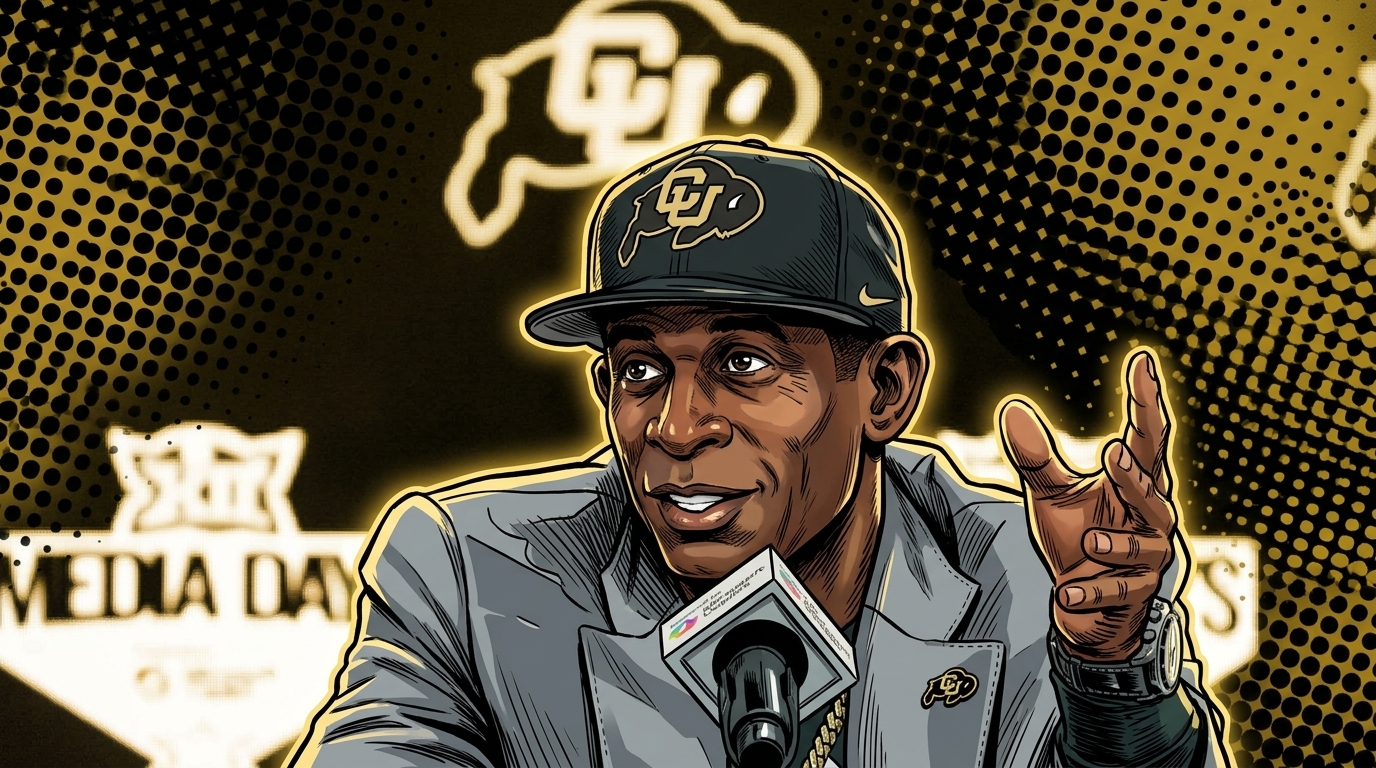
By the time he got to Big 12 Media Days in July, the health questions were as central to the coverage as anything about the roster:
https://x.com/D210S/status/2075319891540783422
Cured, according to his medical team, is a real word with a real chart behind it — that’s the language ESPN used when the news first broke. It’s also doing a lot of narrative work for a fan base and a media apparatus that badly wanted a clean resolution to a scary story, and got one, mostly.
I keep coming back to how deliberately Sanders built the version of himself that made this reaction possible. The visor flip. The jewelry. The refusal to ever look surprised, whether the topic was a blowout loss or a reporter’s dumb question. It’s the same instinct that made him bring Travis Hunter, who he coached at both Jackson State and Colorado, into his orbit as a kind of extension of the brand, and it’s the same instinct running through how carefully his son Shedeur, quietly outplaying his draft slot in Cleveland, has learned to talk. Confidence as inheritance. The family doesn’t do rattled.
Except this year the father did, on camera, in front of everyone, and the outpouring afterward tells you something about what fans actually wanted from that persona the entire time. Not that he was untouchable. That he could be touched and come back anyway, still pointing at the camera, still doing the bit. Colorado opens its fourth season under Sanders on September 3 against Georgia Tech, coming off a 3-9 finish and a 16-21 record in three years that hasn’t come close to matching the hype of his arrival. None of that will matter much in the coverage of that opener. What will matter is whether the guy walking out in the visor still looks like the guy who was fighting for his life fourteen months earlier, and whether anyone in that stadium can tell the difference between the armor and the person wearing it anymore. I’m not sure Sanders can either, and for the first time in his career, I don’t think that’s spin.