
There’s a genre of fandom warfare where two sides watch the identical fifteen-second video and each walks away convinced the footage proves they were wronged. I’ve spent enough time inside K-pop stan wars over cropped fancams to recognize the shape of it: everyone insists they’re looking at raw evidence, and everyone somehow ends up more certain of what they already believed going in.
That’s the frame I keep reaching for whenever the Clark-Reese rivalry produces a new piece of contested footage, and Friday night in Atlanta handed us two in a single overtime game. Early in the first quarter, Angel Reese’s forearm caught Caitlin Clark somewhere between the collarbone and the throat while both of them fought for a rebound. No whistle. In overtime, officials called a shooting foul on Clark that nearly cost Indiana the win, reviewed it, and upheld it. Two clips, same officiating crew, opposite verdicts. Somehow both produced identical complaints from opposite fanbases. This isn’t actually a debate about officiating consistency anymore. Clark-Reese discourse has become a closed loop where any single frame of video can be read as proof of exactly the bias you already believed in. Nobody’s watching the same tape. That’s what this discourse reveals about the audience, not about the refs.
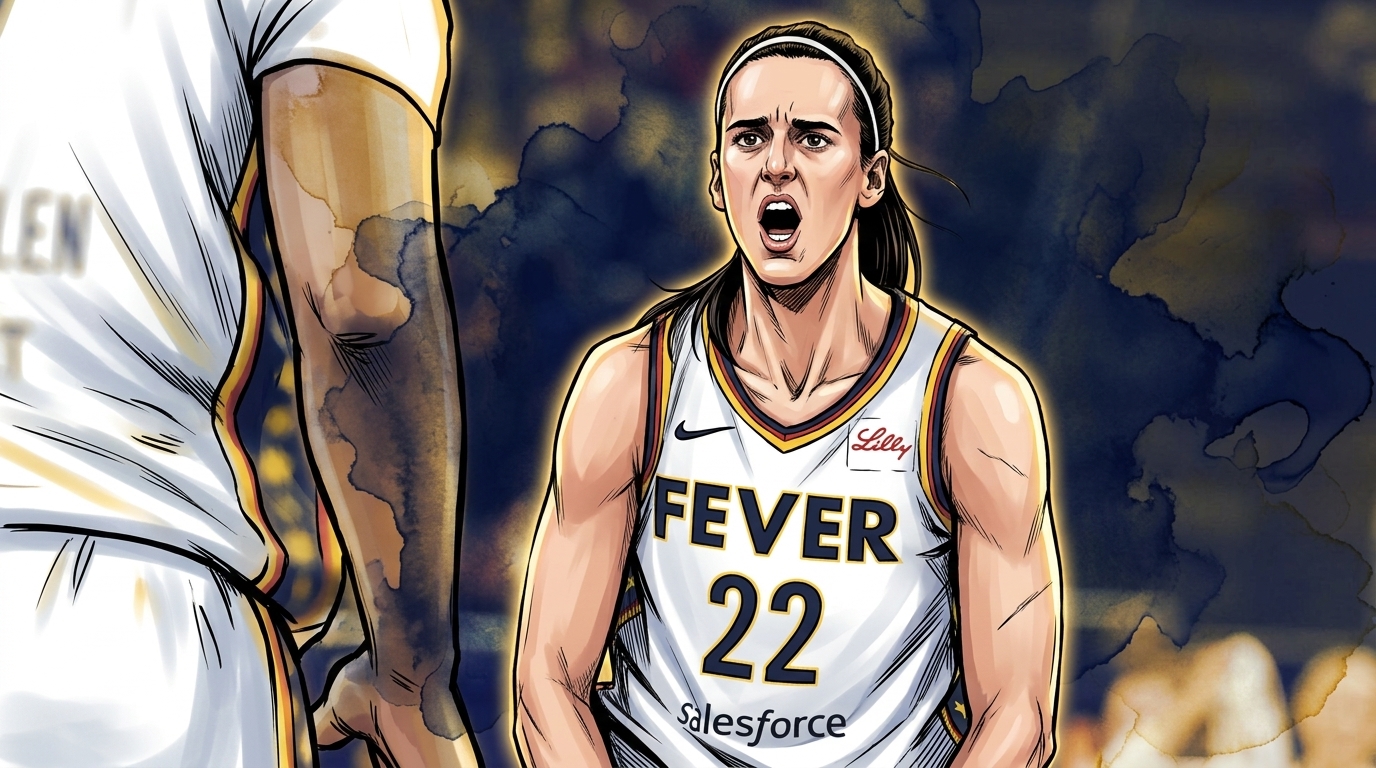
The play everyone’s still replaying happened with about four minutes left in the first quarter. Clark and Reese both went up for a rebound off a missed shot, and Reese shoved off toward the baseline with a forearm that landed on Clark’s neck and upper chest. Clark turned to the nearest official immediately, arguing for a foul that never came. Indiana called a timeout. Clark then walked over to a second official and gestured at her own neck, pushing for a review nobody granted. The whistle stayed in the official’s pocket both times.
By the fourth quarter, the clip had done what these clips do: it stopped being about the play and became a referendum on the league’s disciplinary posture toward Reese specifically. “It’s every game she’s smacking someone,” read one of the more measured reactions. Others were less measured: “Angel playing dirty already under the basket.” A podcaster named Orlando Alzugaray Jr. called the WNBA “the worst run league in all of American sports,” adding, “pure incompetence from top to bottom,” which says more about institutional trust than it does about one missed call. Someone else wrote that the no-call was “more maddening than the foul itself,” and honestly, that one’s hard to argue with even from a remove: contact to the neck probably deserves a whistle regardless of who’s throwing it.
Then overtime happened, and the tape flipped sides. With ten seconds left, officials whistled Clark for a shooting foul that sent Rhyne Howard to the line for three free throws. Indiana challenged. ESPN’s broadcast crew said on air they expected the call to get overturned. It didn’t — the review upheld the foul, Howard made all three to cut the lead to 93-91, and Clark answered with two free throws of her own to close it out at 95-91. If the first clip made Reese’s defenders furious about selective enforcement, the second made Clark’s defenders furious about the exact same thing, aimed the other direction. Nobody switched sides. Nobody even seemed to notice the symmetry.
This is where “the refs are against my side” stops functioning as an argument and starts functioning as a load-bearing belief, something fans arrive with rather than something the tape actually produces. Two clips, same officiating crew, opposite verdicts, and both fanbases treated their own clip as the smoking gun and the other one as noise. It’s not even the first time officiating in a Fever game has gone viral this season; there’s an earlier version of this discourse built around naming a referee by name in a postgame scrum, and it followed the identical pattern — outrage first, video second, consensus never.
None of this happened in a vacuum. Indiana Fever improved to 23-12 and climbed into fourth place, a game and a half ahead of an Atlanta Dream team now 21-13, with the season series tied at two apiece. Clark finished with 26 points and 9 assists. Reese put up 15 points, 14 rebounds, and 6 assists on a rough 5-of-16 shooting night, and missed a potential game-winning putback at the end of regulation that would have made all of this moot. Makayla Timpson had a career-high 20 for Atlanta, Allisha Gray matched her own career high with 32, and Kelsey Mitchell quietly extended her streak of 20-point games to 19 straight, the kind of stat line that would be the headline in a rivalry that wasn’t so allergic to letting anything just be a good basketball game.
The clip that started it:
https://twitter.com/HouseLowlights/status/2089108345005502488
And the angle that racked up 344,000 views on its own:
https://twitter.com/BrickCenter_/status/2089133469234565372
I’ve watched both of those more times than I’d care to admit, and I still can’t tell you with total confidence whether Reese’s forearm was a deliberate shove or two players tangling mid-box-out, the kind of contact that happens forty times a game and gets called maybe twice. What I can tell you is that everyone else watching those same nine seconds landed somewhere between “obviously” and “obviously not” within about four seconds of pressing play, and the speed of that certainty is the actual data point here. The refs missed a call, maybe. The rest of us apparently don’t need to see the same tape to know exactly what we saw.