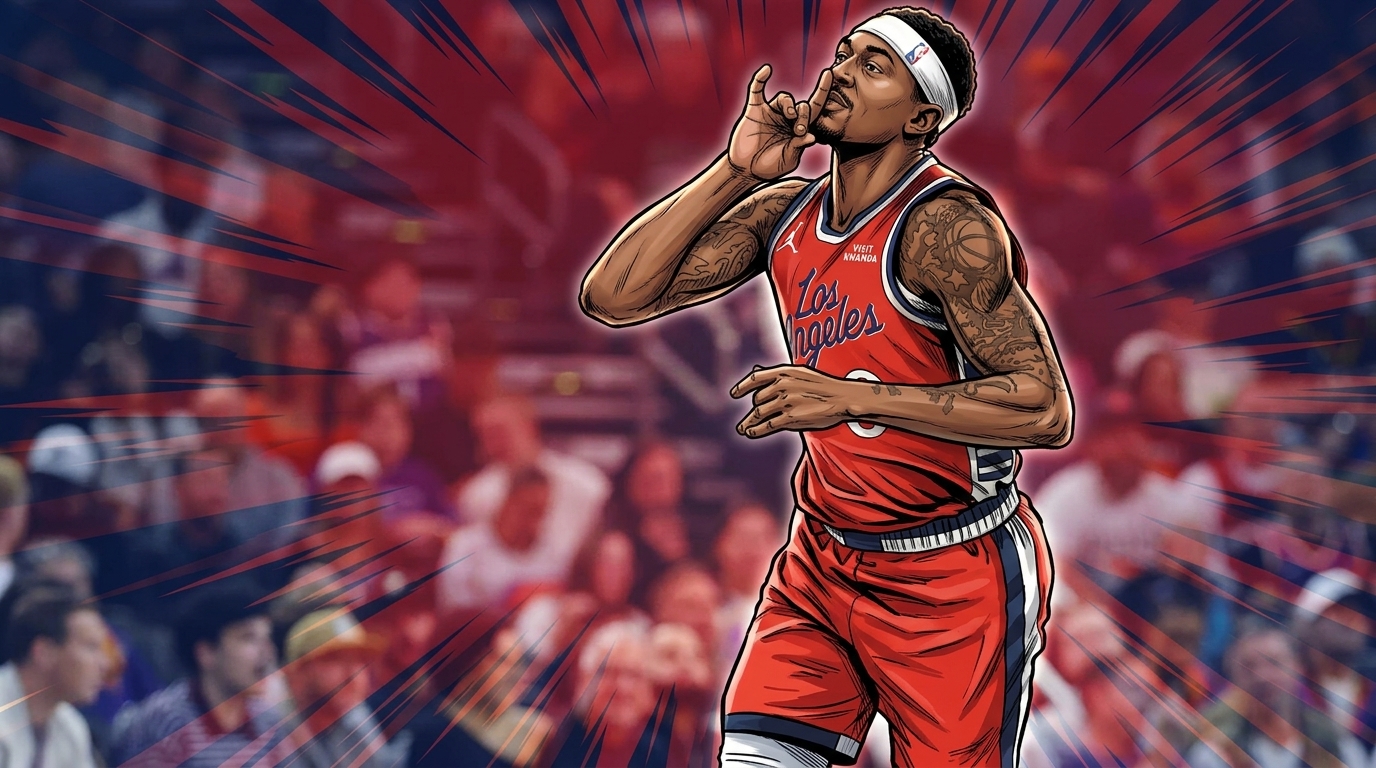

Two numbers, seven weeks apart, explain most of what people find strange about Bradley Beal’s return to the Los Angeles Clippers: $5.6 million and $13.2 million. The first is the player option he declined on June 29. The second is the total value of the two-year deal he signed in mid-August, which averages out to $6.6 million a season, roughly a $1 million annual bump over the money he walked away from. A lot of fans read that gap as proof the front office had lost its mind. It reads differently once you account for what happened to Beal’s body in the four months between those two numbers: a six-game season, a fractured left hip, and season-ending surgery that priced him almost exactly where he started.
That’s the sequence in full. What follows is where each number came from, and why the market barely moved between June and August despite genuine outside interest.
What Beal Actually Turned Down in June
Chris Haynes reported the decision as part of the broader wave of June opt-outs: Beal walked away from a $5.6 million player option, betting a full free-agency period would land him more money and a bigger role somewhere else. On paper, the bet looked reasonable. Beal was entering his age-33 season carrying a resume that still reads like a foundational NBA guard: three All-Star selections, career averages of 21.4 points, 4.3 assists and 4.0 rebounds, and a 37.6 percent mark from three for his career. His last 20-point-a-game season came with Washington in 2022-23, three years and two franchises removed from this contract, but that scoring history is still enough to get a phone call in July.
Reported interest from the Miami Heat gave the bet real substance. A team with cap room evaluating a veteran scoring guard is exactly the scenario that turns a modest option into something bigger. It’s also the scenario that never fully materialized.
The Games-Played Number That Explains Everything
Beal played six games for the Clippers in 2025-26 before a fracture in his left hip ended the season and required surgery. Across those six appearances he averaged 8.2 points and 20.2 minutes, shooting 37.5 percent from the field and 36.8 percent from three. A six-game sample tells you little about shooting form on its own, but the injury behind it fits a pattern that’s been building for years: Beal has played 202 of a possible 410 games over his last five seasons, a 49.3 percent availability rate, and he hasn’t reached 60 games in a season since 2018-19.
Translate that into contract terms and the relevant figure isn’t 8.2 points a night. It’s 49 percent — roughly the odds, based on recent history, that any team gets a full season out of him at all. Front offices don’t pay premium money for coin-flip availability from a player entering his mid-30s. They discount around it, and a $6.6 million annual salary is what that discount looks like in practice.
Why did Bradley Beal re-sign with the Clippers for so little?
Beal re-signed for close to what he turned down because four months of free agency, including reported interest from Miami, couldn’t outrun a season-ending hip surgery and a five-year durability record that already discounted his June price. The final number reflects the market’s honest read on a 33-year-old carrying that injury history into his 15th NBA season.
What the Clippers Are Actually Betting On
The reunion still makes basketball sense in a way the contract size obscures on its own. Los Angeles has spent years managing the Clippers’ cap situation around a roster built for a closing championship window, and a two-year, $13.2 million commitment to a veteran scorer barely dents that plan. At this price, Beal doesn’t need to replicate his Washington peak. He needs to be a capable second-unit shot creator in the games he’s available for, with a career track record that still gives the Clippers real upside if his body cooperates.
That same logic shows up in the deal’s structure. Beal holds a player option for year two, meaning the Clippers are only guaranteeing one season and letting the second sort itself out based on how his hip responds. That approach has become standard practice around the league lately — player options have become the league’s preferred hedge against exactly this brand of injury uncertainty, giving both sides a way out instead of locking in a bet neither can fully evaluate in August.
News of the agreement came from Shams Charania, who reported the terms through Beal’s representation at Priority Sports.
https://twitter.com/ShamsCharania/status/2088051165858554161
The public reaction to that report skewed skeptical fast. One widely shared response asked how the deal could make sense for either side, and that reaction tracks if you’re reading $13.2 million in isolation, without the six games and the surgery attached to it. Context changes the read considerably: six games, one surgery, and a hip that hasn’t cooperated in half a decade sit behind that number.
Nothing about this deal guarantees a healthy 2026-27. Hip surgeries at 33 don’t carry expiration dates on risk, and the Clippers are still committing real bench minutes to a guard who has appeared in under half his team’s games across the last five seasons. But the price tag stopped being a mystery the moment you line it up against June. It’s the outcome the injury already wrote before August had a chance to argue with it.