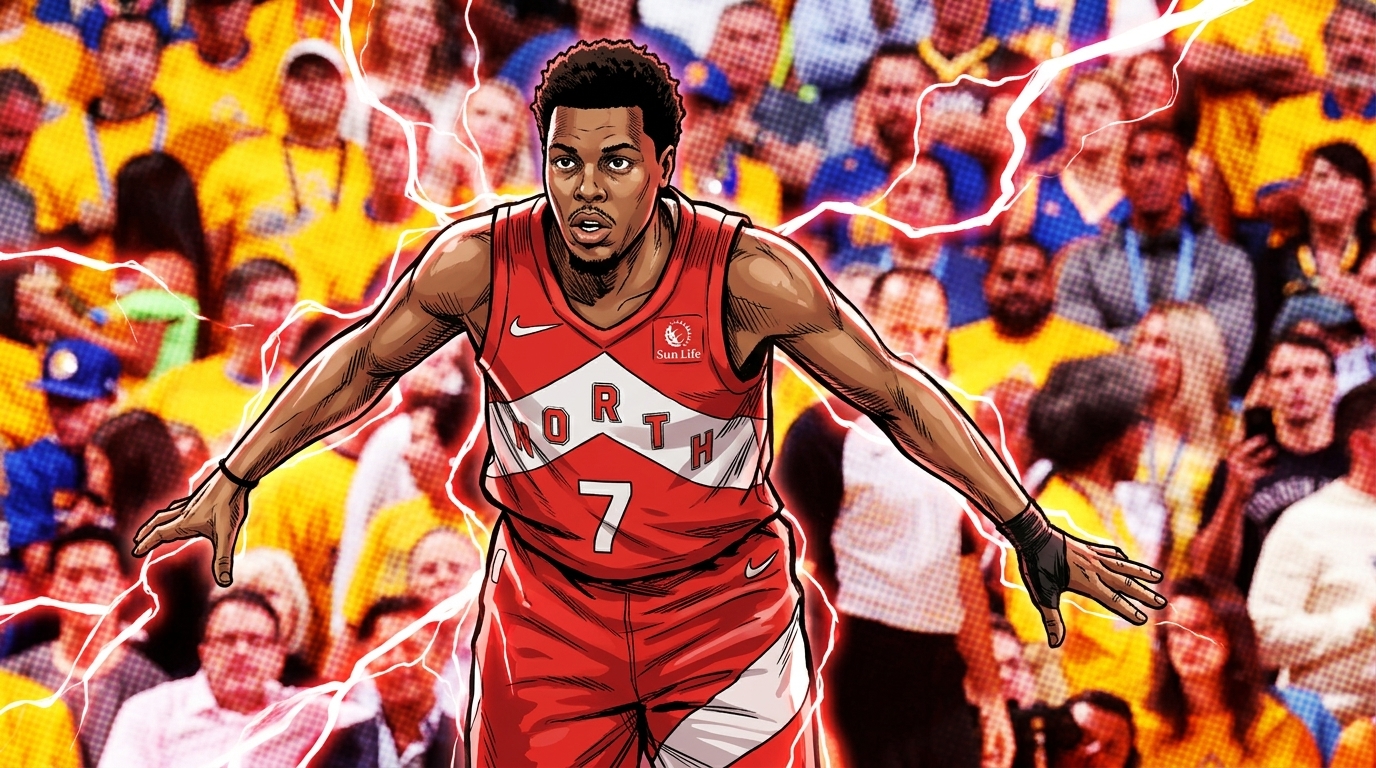

Portland traded away their best shooter to acquire a point guard who would have ranked ninth in three-point percentage on their own roster, and they’re calling it a rebuild.
The Trail Blazers sent Jerami Grant and Kris Murray to Memphis on June 30th for Ja Morant, and the transaction makes a certain kind of sense if you squint hard enough and accept that basketball teams are now run by people who think leverage is a strategy. Grant shot 38.9% from three last season — the best spacer on a team that ranked 28th in the NBA in three-point percentage. Morant, in the healthiest stretch of his recent career, shot 30.9% from three; in 2025-26, before a UCL elbow injury ended his season after 20 games, he was at 23.5%. Portland didn’t just fail to address their spacing problem. They paid to make it worse.
https://x.com/trailblazers/status/2071760708233212327
“Ja dropping. Welcome to Rip City, Ja Morant!” The official Trail Blazers account posted this with the enthusiasm of an organization that has not yet been informed what Rip City currently contains: Ja Morant, Damian Lillard, Scoot Henderson, and Jrue Holiday. Four point guards. Portland now has four point guards. Three of them are in their prime or approaching it; one just missed the entire 2025-26 season recovering from a torn Achilles. None of them are particularly interested in standing in the corner.
Think of Portland’s offense as a highway with four drivers and one car. Morant needs the ball to do what Morant does; so does Lillard, who returned on a 3-year, $42M deal after Milwaukee waived him and who has historically treated ball possession like a mortgage — something you acquire and hold. Henderson, 22 and developing, is now buried at the bottom of a depth chart that reads like a general manager’s dating profile: swipe right on everyone, figure out the logistics later. Holiday is the only functional off-ball player in the group, which is roughly equivalent to discovering a fire extinguisher after the kitchen is already burning. Every dollar Portland is committed to in the backcourt assumes the player in question controls the pace.
That brings us to Morant’s availability, which is the other thing you have to square with the $87M and two years left on his contract. He has played 79 of approximately 246 possible games over the last three seasons — 73 missed in 2023-24, 32 missed in 2024-25, and the UCL cut his 2025-26 short after just 20 games. The highway has four drivers; one of them has a recurring elbow problem, another is rehabbing an Achilles, and the remaining two are being asked to wait in the parking lot indefinitely. Head coach Micah Nori, a first-time head coach on an incentive-based yearly contract, said he was “beyond encouraged” after speaking with Morant. Nori’s employment security is roughly equivalent to a substitute teacher’s, so his enthusiasm is understandable.
The front office’s rebuttal, to the extent one exists, is that this is a set-up trade. Kevin O’Connor laid it out plainly:
https://x.com/KevinOConnor/status/2071694688839479507
This is a coherent theory; it is also the kind of theory that requires everything to go right in an offseason full of chaos where nothing has. You don’t need to trade Grant and Murray for Morant just to manufacture trade chips unless your front office is operating on a level of dimensional chess that the rest of us can’t see, and that nobody asked for. You could have just kept Grant.
BlazersEdge ran the numbers: Morant would have been the ninth-best three-point shooter on Portland’s old roster. The Grizzlies came out ahead; they shed a contract and received two contributors who can actually space the floor. Portland shed its best spacer and got a point guard who has played a third of the games available to him over the last three years. Nori called it encouraging. Someone had to.