
The question that should be bothering you right now is not “how did an undrafted player get $185 million?” The question is “why did we think the draft was measuring the right things in the first place?”
https://twitter.com/ShamsCharania/status/2069805085991801101
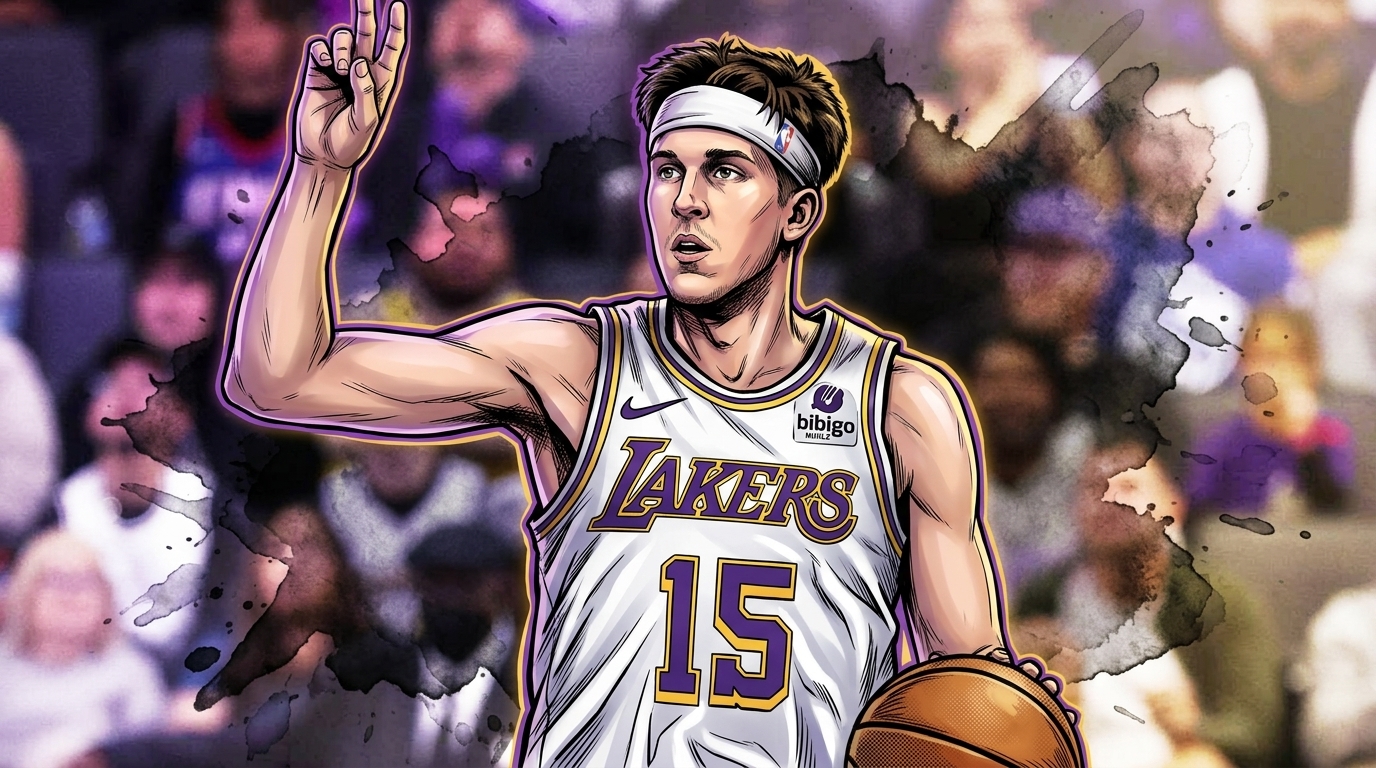
Austin Reaves just signed a four-year, $185 million extension with the Lakers — the largest contract in NBA history for an undrafted player. $41.3 million in year one. A player option in 2029-30. This is not a charity deal for a beloved locker room presence. The market for skill has spoken, and the number it produced is uncomfortable for anyone who spent time defending the 2021 draft board.
I want to build a framework for what this contract actually represents. Call it The Invisible Skill Premium: a method for identifying the skills that pre-draft evaluation systematically undervalues: off-ball movement, shooting under defensive pressure, clutch composure, and the specific defensive versatility that doesn’t require elite athleticism to be effective. These skills share one trait: they only become legible after three to five years of in-game evidence. Workouts don’t measure them. Combine drills don’t capture them. The draft can’t price them. The free-agent market has to do the correcting.
Reaves is the clearest case study this framework has ever produced.
What Does $185 Million Actually Measure?
Start with the number itself. Per Basketball Reference, Reaves posted 23.3 points, 5.5 assists, and 4.7 rebounds per game in 2025-26 on 49% from the field, 36% from three, and 87.1% from the free-throw line across 51 games. True shooting: 64.1%. That’s not a role-player season. That’s a first-option season, by a player nobody thought to select in 2021.
The previous record for an undrafted contract was Fred VanVleet’s three-year, $130 million deal with Houston in 2023, roughly $43.3 million per year. Reaves clears that at $46.25 million annually. The gap isn’t as large as the headlines suggest, but the direction is clear: the market keeps revising upward for this player type, and it keeps being right.
The production alone doesn’t fully explain the price. What the contract is really pricing is replaceability — or, more precisely, the absence of it.
Woof.
When you break down what Reaves actually does for the Lakers, you start to understand why the number feels right even when it looks enormous. In the 2026 playoffs, across six games, he averaged 20.0 points, 5.8 assists, and 4.0 rebounds. He didn’t disappear. He didn’t need extra screens. He just kept doing exactly what he does in October in the highest-leverage moments of the season, and that consistency is worth a lot more than a single spectacular performance.
The Skill Stack the Draft Couldn’t Quantify
This is the core of The Invisible Skill Premium argument, and I want to be precise about it.
The NBA draft evaluates what is observable in pre-professional contexts: raw athleticism, size-speed ratios, shot mechanics in controlled settings, vertical leap. These are real inputs. They predict real outcomes for a specific type of player — the high-ceiling athlete whose upside justifies the risk of underdevelopment. The draft is reasonably good at finding those players.
What it fails at is valuing the complete package of basketball intelligence that doesn’t translate from a workout gym to a 5-on-5 playoff game under a functioning shot clock. Off-ball movement requires reading a defense in real time across multiple possessions. Shooting under pressure requires the same muscle memory to work when a hand is three inches from your face in Game 6. Clutch composure is almost entirely invisible until you have three years of data on how a player’s performance metrics hold up in the fourth quarter of close games. None of this shows up in Reaves’ 2021 draft profile.
What showed up in 2021 was a 6-foot-5 guard out of Oklahoma who could not get a team to guarantee him a roster spot at 42nd overall. The Detroit Pistons offered him that pick. Reaves declined — the Lakers had already called with a two-way deal, which gave him a better path to actual NBA minutes than a guaranteed second-round selection on a rebuilding team.
So the draft didn’t exactly miss him in the traditional sense. No team walked away from a clear signal. The issue is more subtle and more damning: no team looked at what he did in college and said “those skills scale to an NBA role that matters.” They evaluated him as a prospect and found a middling one. He evaluated himself as a player and found something different.
The market corrected over five years. The 2021 draft board has not been amended.
Why Fred VanVleet Wrote the Blueprint Reaves Perfected
VanVleet is the closest comp and the most instructive one. Also undrafted. Also a point-forward type who shot well, played sound defense, and raised his performance in playoff environments. His $130M deal was controversial when Houston signed it — the Raptors had let him walk, and plenty of analysts thought Houston was overpaying for a role player aging out of his prime.
VanVleet’s contract worked as a market signal more than a basketball decision. It told the league that shooting, two-way reliability, and playoff composure were being systematically underpriced, and that teams willing to pay the correction price would get real value.
Reaves took that signal and scaled it. He’s younger than VanVleet was at signing. He’s posted better efficiency numbers at a higher usage rate. And critically, he’s done it in a Lakers system that has leaned on him more heavily with each season — which means his numbers reflect actual offensive burden, not a favorable role on a deep roster.
The Jalen Brunson comparison is worth making here. Brunson’s own 33rd-pick journey to championship contender followed the same general arc: overlooked in the draft, steadily re-priced by the market as evidence accumulated, eventually commanding a max-scale contract that looked aggressive until the playoffs made it look conservative. The draft had Brunson roughly right as a prospect. It had no framework for valuing what he’d become.
Reaves is the undrafted version of that trajectory, which makes the number feel even more like a correction than an overpay.
What This Contract Tells You About NBA Labor Markets
The $185 million figure doesn’t exist in isolation. It’s downstream of a set of structural realities about how NBA teams compete in 2026 — and it connects directly to the economics that make the luxury tax second apron such a meaningful constraint on roster construction.
Championship-caliber rosters are built around one or two franchise cornerstones and then assembled from role players who each do a very specific thing at a very high level. The cornerstones are expensive and visible. The role players are where front offices actually separate themselves. A player like Reaves who can shoot off the catch, create off the dribble at a secondary level, defend multiple positions without needing a schematic bailout, and maintain all of that in playoff intensity is almost impossible to replace through the draft because the draft isn’t structured to find him.
What that means for NBA labor markets is that the players who fill those roles most completely will always get paid more than their individual stats suggest they should. The market isn’t pricing what Reaves did last season. It’s pricing what it would cost to field a comparable skill set from another source — and the answer, increasingly, is that there isn’t one at a reasonable price. You either keep the player you have or you spend three years hoping to find someone similar through a process that has already demonstrated it can’t reliably identify him.
I ran this three different ways, and I keep arriving at the same place: the $185 million isn’t a statement about Austin Reaves being a transcendent talent. It’s a statement about scarcity. The skills that make him irreplaceable to a championship contender are exactly the skills that pre-draft evaluation has the least ability to surface. The Invisible Skill Premium doesn’t disappear when the market catches up to it — it just gets more expensive.
The largest undrafted contract in NBA history is the price of that lesson. Detroit still has pick 42 from 2021 somewhere in a filing cabinet. Los Angeles has a $185 million player who just told the free-agent market what undraftable actually means.
Sign the extension. The data here is unambiguous.